Posts Tagged ‘Virtual Collaboration Projects’

h1

Team Project – Future Direction

February 27, 2020

How much distance do we need to form an objective opinion? Photo by Tyler van der Hoeven on Unsplash.

As you prepare to leave college with your degree the prospect of seeking a fulfilling career will become increasingly important. Much is being written now about the changing nature of work. As long ago as 2012 Forbes suggested that Job Hopping is the New Normal for Millennials. But, the Guardian newspaper reported that the trade unions in Britain are concerned about the abuses of the gig economy suggesting it results in lower wages. TUC wants clampdown on ‘poverty pay’ in gig economy revealed that almost half of adults aged 25 or over were earning less than the minimum wage.

The World Economic Forum report on The Future of Jobs 2018 provides a comprehensive analysis of trends on an industry-specific and country-specific basis. In the section on Strategic Drivers of New Business Models it concludes that the unfolding of the Fourth Industrial Revolution is resulting in a variety of new and emerging jobs while the more traditional job roles are declining. But, there is some good news for you as the Economist reported in 2016 that people working in creative fields are less susceptible to automation in Automation and Anxiety.

Taking a more holistic perspective raises deeper concerns for the future of not just work, but the entire ecosystem of society. French philosopher Bernard Stiegler suggests that the world is heading rapidly towards a dead end thanks to the consumerist model. Speaking in London in 2018 he argued that a radically new approach to shaping our society is required. Rather than allowing capital and technology to dictate we need to bring epistemological, technological, artistic, judicial, social and economic questions together in order to shape the future.

In 1992 the Union of Concerned Scientists issued a Warning to Humanity suggesting that vast human misery would ensue if we did not change how we are impacting the planet. They ‘feared that humanity was pushing Earth’s ecosystems beyond their capacities to support the web of life.’ In 2017 the warning was updated when 15,000 scientists from around the world published World Scientists’ Warning to Humanity: A Second Notice.

This is a real challenge to you, individually and collectively, as you consider your emergence into society from college. For this project you are asked to consider how you might address the problems facing society while earning a living and living your lives. Do you accept the premise of the World Scientists? Can you see ways in which it is possible to work for a more sustainable engagement with our planet?

The Brief

Your team has been commissioned by a global firm in the communications sector to convince senior leaders that the time has come for change. The Board of the organisation has acknowledged the imminent destruction of our planet and decided that the company needs to lead the world to a new way of working. You have been briefed personally by the Chairman and the Chief Executive Officer who have arranged a day-long workshop in mid-May to which all senior executives have been invited. It is intended that the outcome will be a completely new direction for the organisation that is fully sustainable and indeed, will lead the way in rejuvenating the planet and our relationship with our home.

Your task is to kickstart the session with a dynamic, exciting and informative presentation. You must inspire a group of hard-nosed executives who have been ruthlessly successful in exploiting the planet’s resources for the company’s benefit, without any consideration for the consequences, to review their behaviour and plan a new future.

You will work on this project in your groups to make your presentation in an entertaining, informative and lively manner using whatever medium and format you wish as long as it can be stored for later review (e.g. a talk, short film, narration+visuals). Each team will present live in Second Life. The presentation should be no shorter than five minutes and no longer than ten minutes. You are encouraged to use visual, audio or any other aids to support the presentation during which each member of the team must take part.

Each participant must also describe the progress of the project in a weekly blog post with particular emphasis on your own contribution to the project. (What are you bringing to the group and how does it fit into the team’s work?) Discuss the details of the project and also the issues that arise in working collaboratively online. How easy is it meet up virtually and plan the project? What difficulties arise in development? How easy or difficult is communication? What particular problems arise and how do you deal with them? Focus on the experience rather than writing a ‘correct’ post or having an answer for every difficulty.

Important note: If you use images or sound be mindful of copyright, particularly as presentations will be posted to the module blog.

Presentations should be no less than 5 minutes and no more than 10 minutes in duration.

Your presentation can be made in the TU Dublin campus or any appropriate venue in Second Life selected by the group. Presentations will be delivered in the last class at the end of the semester.

For full details on the Team Project specifications and the assessment criteria see the Assessment Unit.

h1

Class 4: Team Project – New Direction

February 27, 2020

Before starting the class John asked if everyone had read the brief and, while some of you had, many had not. So, everyone was asked to read it now. John also asked that you read the requirements of your submission in the Assessment Unit on Brightspace to ensure you are aware of the deadline for completion, assessment criteria, along with the part of the project that will be group-assessed and the parts on which you will be assessed individually.

Once that was completed John asked for some initial reactions. Most of you agreed that while it is a difficult topic is is current and highly relevant. The main problem to contend with in addressing climate change seems to be our reluctance as humans to acknowledge the problem, to consider the changes we need to make in our own lives and to demand that those with greater influence face up to the reality and do something. We acknowledged the iron will of people like Greta Thunberg, who are unafraid of power and willing to name the issues and those responsible. You also indicated that presenting your projects to a room full of senior executives in a global corporation sounds intimidating. However, John reminded you that the two most senior people in the organisation (the chairman and the chief executive) are backing you.

John outlined your assignments for the coming week: to make contact with your group and hold the first meeting. He suggested that it might seem a simple task to complete in a week but in previous semesters many groups failed to achieve it. There was some discussion on how to make contact: do you share email addresses now? try to find each other in social media? hope to bump into teammates in RL? The logistics of arranging meetings online is somewhat different to doing so in RL. You need to ensure a common approach is understood by, and available to, all team members.

What do you do when (if) you manage to meet? John reminded you that the presentation board from Sitearm Madonna’s talk on Teamwork and Collaboration is still available in the class meeting room. Use it when you meet. Remember the stages teams go through when working on a project. Try to be aware of that when you meet so you can get the most out of your time together as a group.

Sunrise at Lauk’s Nest, the oldest complex build in SL, it dates back to 2004.

John proposed a visit to Lauk’s Nest for the final part of class. Notecards with information about the park were circulated along with landmarks and we all teleported there. Before allowing everyone off to explore John reminded you of the forthcoming deadline for submission of the Website Blog, part 1 for assessment. You must make the submission in Brightspace or John will be unable to award a mark and give you feedback.

h1

Class 4: Team Project – Future Work

October 17, 2019

The discussion started with students reporting back on the Team meetings you held during the week. Most teams had been able to make contact and commence communicating using a variety of tools. It soon became clear that the different parts of team work demand the use of different sets of tools.

Brief for Team Project – Future Work

Forming and Storming: Finding your team mates and commencing a dialogue is the first hurdle. Second Life’s use of avatars with different names from your real selves resulted in some confusion as you tried to identify each other! Some of you asked me for email addresses to facilitate the first connection. You searched Facebook and other social media platforms for your classmates and, for the most part, did not resort to real world encounters.

The first meetings were arranged and this presented the next challenge. Some of you met in SL, some chatted on Facebook, Skype was mentioned as a useful platform but I am not sure if any team actually used it. The ‘forming’ stage of team work, developing the team and getting to know each other, is actually a social activity and therefore social media apps can be useful for virtual teams. They allow you to find out something about your colleagues and open conversations. As your teams coalesce and working together becomes normal tools such as SL and Skype will support the interaction needed to brainstorm ideas for your project and make progress.

Performing: Although this aspect of team work did not emerge until later in the discussion John asked you to consider how ensure your presentation will be completed in time for delivery. Managing your individual commitments on the project and the overall team success is a very specific activity. You need to ensure that the work is divided fairly among the team members and then ensure that everyone does what is expected. There are many productivity and management apps available to support this. For example, trello.com provides a simple yet effective platform that everyone can access without cost to monitor your commitment and progress.

Production: When it comes to producing your project you will need to create and/or source images, movies, sound recordings and so on. We will review these in later classes. In addition, creating the script is so much easier with online collaborative tools that work in real time. Google Docs allows many people to write and edit simultaneously.

Presentation: Finally, when it comes to the presentation of your project there is a wide range of tools from which to select. YouTube and SlideShare are just two of the most common and we will also look at them in more detail in a later class.

+ + +

Finally, we spoke about the project. Everyone had read the brief and was aware of the context. John referred specifically to the assessment criteria for the project noting that of the six, two were for the team and the other four were individual. He asked that you also read the assessment rubric very carefully and review it regularly to ensure you keep on the right track and don’t waste time doing unnecessary work.

h1

Class 3: Teamwork and Collaboration

October 10, 2019
Sitearm Madonna talks about teamwork

Sitearm Madonna shares his insights on teamwork with the class.

Sitearm Madonna joined the class this week to talk about teamwork and collaboration, both generally and virtually. His experience in the global oil industry and also in virtual worlds has enabled him to formulate a practical approach to collaboration which he supports with references to the vast amount of academic writing on the topic. As the graduate of the module who received one of the highest marks ever awarded he is well-positioned to understand your particular needs in working on the Team Project that will be introduced next week.

His developing interest in musical composition informed the opening of his presentation and he gave us a link to a YouTube video:

Sitearm went on to discuss the stages of a project and the roles required of the team members as the project work progresses towards completion. He asked for examples of good experiences of team work and poor examples and you had some great examples to share. The most common poor experiences were where one member tried to dominate and control the project, not letting others explore their contributions. Sitearm noted that where the dominator also has power and/or authority there is very little the other team members can do and the results of the project are going to fall very far short of the potential. The positive experiences were mostly concerned with successful brainstorming where the team relished new ideas and develop an approach that truly was better than any of the individual team members might have achieved on their own. You also noted that in a well-balanced team each person is supported in contributing according to their skill, leading to a satisfying experience for the whole team.

Sitearm also referred to the theory of persona. Speaking about the different personalities we might present in different social situations (eg, at home, in college, at work) and relating it to the avatars we use in SL, he suggested that the various roles that need to be filled for a successful team can be inhabited by any individual member – they are interchangeable and may be temporary – even though some people might be particularly suited to some roles. He also referred to the Greek origin of the term persona and how it relates to your purpose, asking you to consider ‘where your purposes come from?’ John reminded everyone that we will be picking up on this idea again in Class 16 when we look at virtual identities.

To conclude Sitearm told us about a recent paper he read suggesting that we all have 150 meaningful relationships in our lives. That breaks down into five people in our inner circle (family); 15 good friends; and 50 friends. It expands into 500 acquaintances and 1,500 people we can recognise. [This post was amended in December 2019 to include links to Dunbar’s Number in Wikipedia, Social Network Size in Humans by Hill and Dunbar 2003, and The Social Brain Hypothesis by Dunbar 1998.]

[Note: Sitearm Madonna has subsequently provided this edited video (47 minutes) of his presentation]

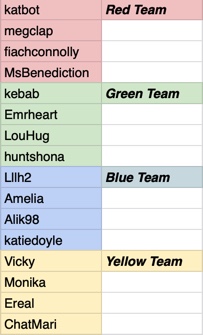
After thanking Sitearm for a most stimulating presentation, John directed you to Brightspace where the Team Project groups are listed. Here they are again.

Project Teams

You will work in these teams for the rest of the semester. John will introduce the Team Project in next week’s class.

h1

Class 8: Presenting your Team Project

April 4, 2019

Again, attendance was disappointing this week. Apart from the first week, which had full attendance, we have had eight attending every week. However, last week only five came to class and this week only six. Both weeks two students gave their apologies. Nevertheless, such poor attendance means that class discussion is not as lively and engaging as it should be and, with only three more classes until the final presentation, it is a cause for concern.

John started by asking the class group if they would mind switching topics between this week and next week. Our guest lecturer is travelling today and therefore unavailable. All agreed so we will postpone the class theme ‘Walking away…?’ until next week. Some of you also admitted to not reading the short story yet so John urged you to ensure you have read it for next week.

We started the class by reviewing the visit to Virtual Ability Island last week. It gave you all a sense of the possibilities that virtual worlds can open up for some people and communities.

John asked for some feedback on the Team Project, in particular, how you were thinking of making the final presentation. Only members of the Blue and Yellow teams were present and most of you seem to be thinking in terms of video. It was not clear if the thinking is to use YouTube or steam directly into SL. John suggested reviewing options such as LinkedIn Slideshare, as was used by Sitearm Madonna in his presentation on teamwork and collaboration in class 3. You can also import images directly into SL and display them much as you would give a PowerPoint presentation IRL. John demonstrated how to make a simple ‘slide viewer’ using the ‘Build’ tool. It costs L$10 to import images to SL so John presented each of you with a budget of L$300 to use if you need to. The exchange rate is approximately L$270 to US$1 so your avatars have not become immediately rich!

Building in SL is normally reserved for premium residents (ie, those who pay a monthly subscription) however, there are lots of public sandboxes where anyone can build. Just remember to save your creation to your Inventory Folder so you can access it at a later time. You can also practice building in the classroom area – just be careful not to delete or change anything there! John reckons he has everything locked but remembers the day he accidentally deleted two of the walls and floor. So, do try out some building – there are links to support information in the reading set for Class 9 Presenting your Team Project.

You should also use some of your Linden dollars to explore the economy in SL. Go and visit some shops and see how the economy works. But, don’t spend everything you have – keep some for your project.

h1

Team Project – Future Work

March 3, 2019

This photograph was taken from lunar orbit by astronaut Bill Anders in 1968, during the Apollo 8 mission. Nature photographer Galen Rowell declared it “the most influential environmental photograph ever taken”.

The World Economic Forum report on The Future of Jobs 2018 provides a comprehensive analysis of trends on an industry-specific and country-specific basis. In the section on Strategic Drivers of New Business Models it concludes that the unfolding of the Fourth Industrial Revolution is resulting in a variety of new and emerging jobs while the more traditional job roles are declining. But, there is some good news for you as the Economist reported in 2016 that people working in creative fields are less susceptible to automation in Automation and Anxiety.

Taking a more holistic perspective raises deeper concerns for the future of not just work, but the entire ecosystem of society. French philosopher Bernard Stiegler suggests that the world is heading rapidly towards a dead end thanks to the consumerist model. Speaking in London in 2018 he argued that a radically new approach to shaping our society is required. Rather than allowing capital and technology to dictate we need to bring epistemological, technological, artistic, judicial, social and economic questions together in order to shape the future.

In 1992 the Union of Concerned Scientists issued a Warning to Humanity suggesting that vast human misery would ensue if we did not change how we are impacting the planet. They ‘feared that humanity was pushing Earth’s ecosystems beyond their capacities to support the web of life.’ Last year the warning was updated when 15,000 scientists from around the world published World Scientists’ Warning to Humanity: A Second Notice.

This is a real challenge to you, individually and collectively, as you consider your emergence into society from college. For this project you are asked to consider how you might address the problems facing society while earning a living and living your lives. Do you accept the premise of the World Scientists? Can you see ways in which it is possible to work for a more sustainable engagement with our planet?

You will work on this project in your groups to present your findings in an entertaining, informative and lively manner using whatever medium and format you wish as long as it can be stored for later review (e.g. a talk, short film, narration+visuals). Each team will also present its project live in Second Life. The presentation should be no shorter than five minutes and no longer than ten minutes. You are encouraged to use visual, audio or any other aids to support the presentation during which each member of the team must take part.

Each participant must also describe the progress of the project in a weekly blog post with particular emphasis on your own contribution to the project. (What are you bringing to the group and how does it fit into the team’s work?) Discuss the details of the project and also the issues that arise in working collaboratively online. How easy is it meet up virtually and plan the project? What difficulties arise in development? How easy or difficult is communication? What particular problems arise and how do you deal with them? Focus on the experience rather than writing a ‘correct’ post or having an answer for every difficulty.

For full details on the Team Project specifications and the assessment criteria see the Assessment Unit in the Brightspace VLE.

Important note: If you use images or sound be mindful of copyright, particularly as presentations will be posted to the module blog.

Presentations should be no less than 5 minutes and no more than 10 minutes in duration.

Your presentation can be made in the TU Dublin campus or any appropriate venue in Second Life selected by the group. Presentations will be delivered in the last class at the end of the semester.

h1

Class 4: Team Project – Future Work

February 28, 2019

John started the class by reminding you all of the deadline for your first assessment item next week. It must be submitted in Brightspace before 5.00 pm next Thursday, 7th March. But, don’t wait until the last moment – get your submission in early. It’s easy: just provide the link to your blog. Full details are given in the ‘Assessment’ section of the module in Brightspace. Remember, you must make the submission in Brightspace so that it is registered and John can provide feedback.

The University is carrying out a survey of staff and students using Brightspace for this pilot phase. Please take this Brightspace Mid-Pilot Review (Students). Your feedback is important so that improvements can be made before the full rollout in September.

It is important that you login to Brightspace regularly during the course of the week. The Essential Reading given for each class is a necessary preparation for our meetings but also provides background material to the subject of your blog posts. You need to be reading and viewing it so that you can cite appropriate examples in your writing. Take the short Quizzes to check if you understand the content. Although they don’t count for assessment purposes they are a useful way of identifying content you might not have fully understood. If you have any suggestions for improving the content please let me know.

Then we turned to the Team Project. In response to John’s query about whether you had arranged team meetings it seems that some have met and some have not yet met. It is important that you start meeting this week. You will remember from Sitearm’s talk last week that teams need time to form. So start working together from now on – visit SL, work on your class assignments, and begin thinking about the project. Give yourselves as much time together as you can to get to know each other.

There is a lot of detail in the brief and plenty of reading to guide your thinking and help develop your approach to the project. Use the time you have without classes next week to get started and become familiar with the material. Another important guide you should review carefully is the assessment rubric for the project. That gives you the criteria on which you will be assessed. There is no point in being busy on work that is not relevant so study the criteria for guidance on how to proceed.

Here is a short (viewing time is less than two minutes) extract from the class discussion:

h1

Class 11: Project presentations

December 13, 2018

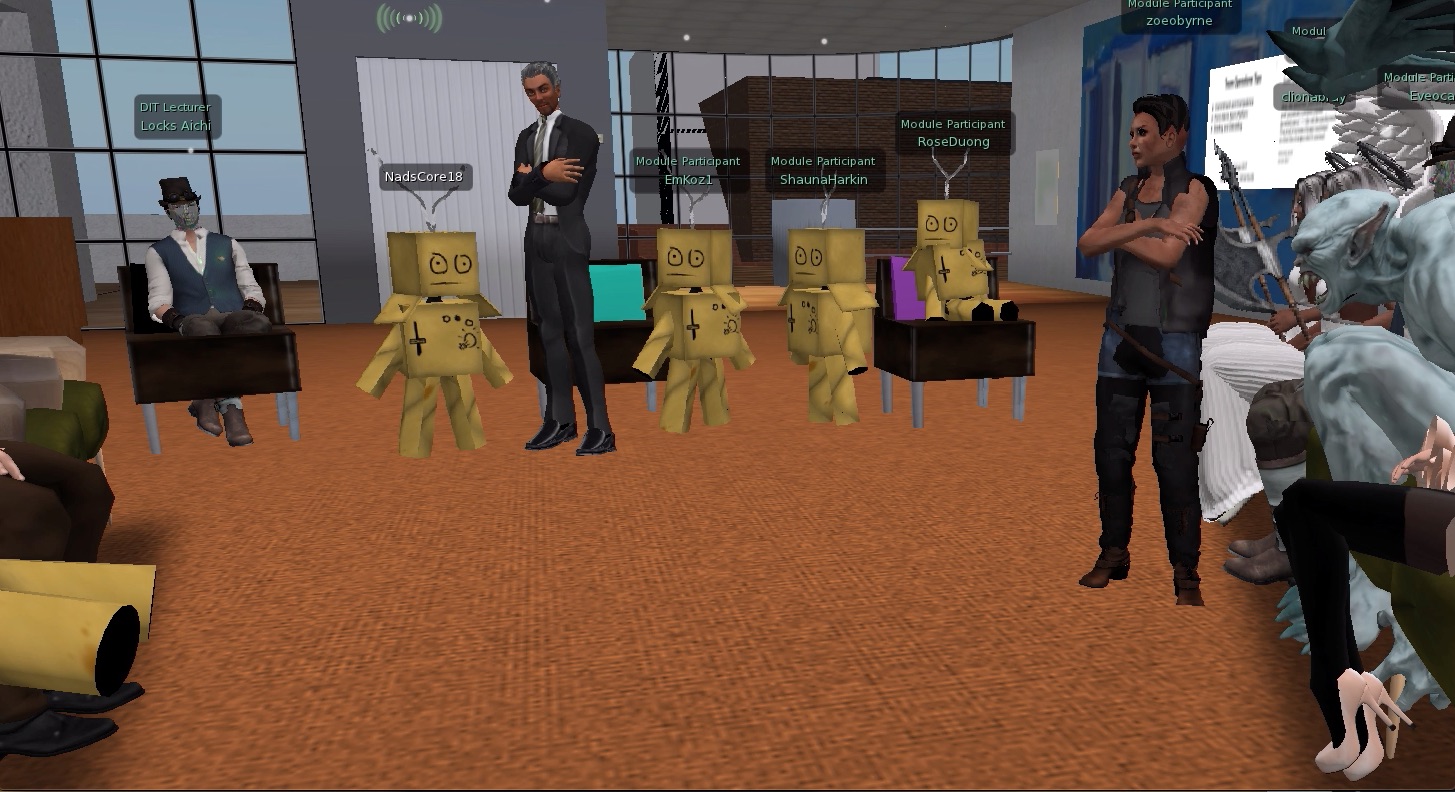
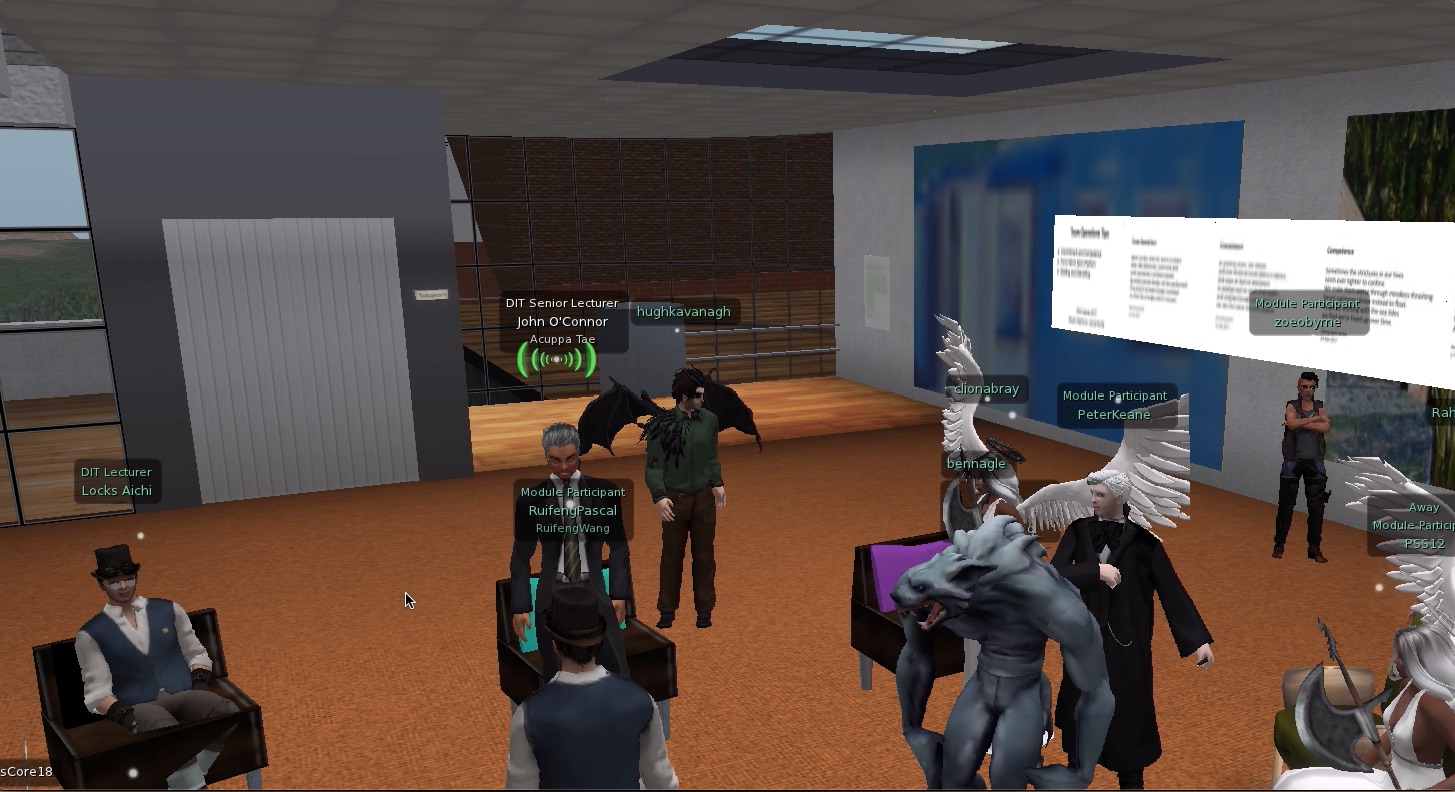
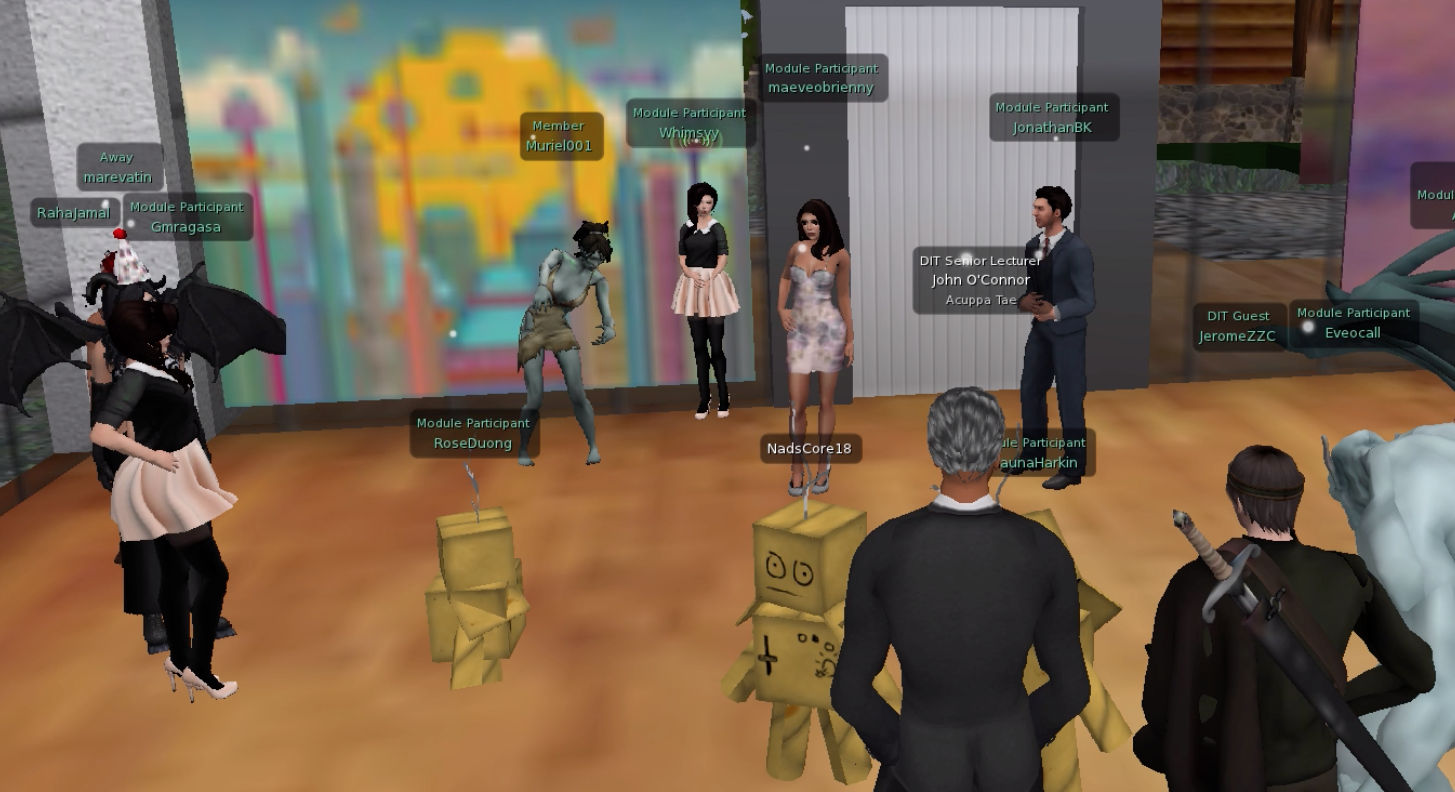
Locks Aichi joined the class for the presentations by each team this week. A variety of approaches was taken including YouTube videos, Google Slide show to illustrate presentations in the classroom and finally, a visit to another location in SL which did not turn out as expected. The group gave us a link to a shopping centre to open their talk with a demonstration. Unfortunately, the owner was online when all thirty of us teleported there simultaneously and she assumed it was a griefing attack! After some serious confusion and much swearing on her part we returned to DIT. An explanation was sent to the shopkeeper by IM and the incident was concluded without any further rancour. It provided an excellent learning opportunity for the final meeting of our group – always ask permission before visiting someone else’s virtual space with a group – much as you would in Real Life. To be fair to the student team it had visited the location during the week and found it deserted and quite reasonably expected the same for our visit.

All teams presented with confidence and obvious preparation. Some presentations seemed more of a team delivery while others came across as a collection of individuals’ ideas but in each case the content was considered, coherent and relevant. Following the presentation each team answered a few questions from John and Locks and explained what tools they used to facilitate their group work.

THINGS TO DO TO COMPLETE YOUR ASSIGNMENT:

  1. Write the tenth post: to your blog reflecting on your team project presentation.

Blue team: PSS12, sarahmurph, RahaJamal, mclmichelle, LukeBob75 and EvoCall.

Green team: LouHug, haithanhnguyen, EmKoz1, NadsCore18, ShaunaHarkin and RoseDuong.

Red team: bennagle, ollyrobyn, Ruifeng Wang, clionabray, PeterKeane and hughkavanagh.

Mauve team: CiaraHoward, OPrincess, zoeobyrne, J98Carey, Assesi and marevatin.

Yellow team: Muriel001, JonathanBK, Whimseyy, maeveobrienny, JeromeZZC and Cmragasa.

h1

Group project: Digital Skies

April 6, 2017

For this project you are required to create a single artwork as a member of a team – a large-scale group canvas. Each individual team member will research and generate their own images which will be combined by the team into a final composite image for exhibition in Cape Able Gallery. The exhibition will open in late May on a date to be announced.

Digital Skies

Digital Skies: Art and Utopian Thought

For the opening of the exhibition each group give a short talk to present their work, and discuss the experience of working in a team, virtually, collaboratively. This will be followed by a crit.

Each participant must also describe the progress of the project in a weekly blog post with particular emphasis on their contribution to the project. (What are you bringing to the group and how does it fit into the team’s work?) Discuss the details of the project and also the issues that arise in working collaboratively online. How easy is it meet up virtually and plan the project? What difficulties arise in development? How easy or difficult is communication? What particular problems arise and how do you deal with them? Focus on the experience rather than writing a ‘correct’ post or having an answer for every difficulty.

See page 6 Module assessment for assessment criteria applying to this project.

h1

Group project: Who’s watching you?

October 6, 2016

742529main_kepler62f_full

For the project you will explore the concept of your digital identity and it’s importance to you and anyone else. In your groups you will research the traces each of you has already left online, your digital footprint: what you are sharing? what can others learn about you? who might be watching you? who owns the information you might have thought was private? And, most importantly, what value might it have to others and what are they doing with it?

The tacit agreement most of us make when we engage online is that our personal details, behaviour, preferences, likes and dislikes and so on will be shared in exchange for the ‘free’ availability of useful or entertaining apps, games, tools, services etc. Most of us share apparently innocuous information online on a daily basis. Taken on their own, these nuggets of personal information seem harmless but, when they are aggregated the result can be a surprisingly comprehensive profile of our behaviour. The corporations engaged in this activity protect themselves by asking us to agree to Terms of Reference when signing up for services but, does anybody read the terms? and if you do read them have you ever decided against proceeding to sign up?

This information is gathered legally and often shared legally. But in addition, there are more sinister operators at work in the so-called ‘dark web’. They will seek to break encrypted information you may reasonably expect to be kept secret: credit card details from legitimate online purchases for example.

In the early incarnation of the world wide web it was often compared with the wild west of the US, a new frontier with little regulation or law enforcement. While that has now changed and much activity is in fact regulated the fact remains that we are in new territory. As major corporations gather information the unexpected consequences of the ‘big data’ phenomenon is only beginning to emerge.

For the project you are to research the digital footprint of your group members. Consider all your online activity, whether through social media, shopping, gaming, correspondence, searching and researching, downloading, communicating and so on. Build a picture of the shadow you are leaving behind, the information that might remain online for others to find. Analyse the impact this may have and envisage a scenario where it might be used by unscrupulous operators to their own benefit.

Present your findings in an entertaining, informative and lively manner using whatever medium and format you wish as long as it can be stored for later review (e.g. a talk, short film, narration+visuals).

Each participant must also describe the progress of the project in a weekly blog post with particular emphasis on their contribution to the project. (What are you bringing to the group and how does it fit into the team’s work?) Discuss the details of the project and also the issues that arise in working collaboratively online. How easy is it meet up virtually and plan the project? What difficulties arise in development? How easy or difficult is communication? What particular problems arise and how do you deal with them? Focus on the experience rather than writing a ‘correct’ post or having an answer for every difficulty.

See page 6 Module assessment for assessment criteria applying to this project.

Important note: If you use images or sound be mindful of copyright, particularly as presentations will be posted to the module blog.

Presentations should be no less than 5 minutes and no more than 10 minutes in duration.

Your presentation can be made in the DIT campus or any appropriate venue selected by the group. Presentation date is normal class time on Thursday 8th December.

Reading and watching list:

Fake It – to control your digital identity In a 2013 TEDx Oxford presentation Danish journalist Pernille Tranberg, who wrote the book Fake It – Your Guide to Digital Self-defense with the German journalist Steffan Heuer, explains what happens with your data, what it can cost you now and in years to come.

The Power of Privacy In this 2016 film by The Guardian, Aleks Krotoski travels the world to undergo challenges that explore our digital life in the 21st century. Watch her be stalked and hacked, fight to get leaked documents back, dive into open data and live in a futuristic home that monitors her every move.

Is someone watching you online? The security risks of the Internet of Things is outlined in this 2016 article from The Conversation by Patryk Szewczyk and Nikolai Hampton.

Who’s watching me on the internet? Technology Correspondent for the BBC, Rory Cellan-Jones writes about our digital footprint and explains data trails in iWonder 2016.

Mockumentary made by Limerick School of Art and Design students in 2014 on how NOT to do a group project. (Only to be used for light relief.)