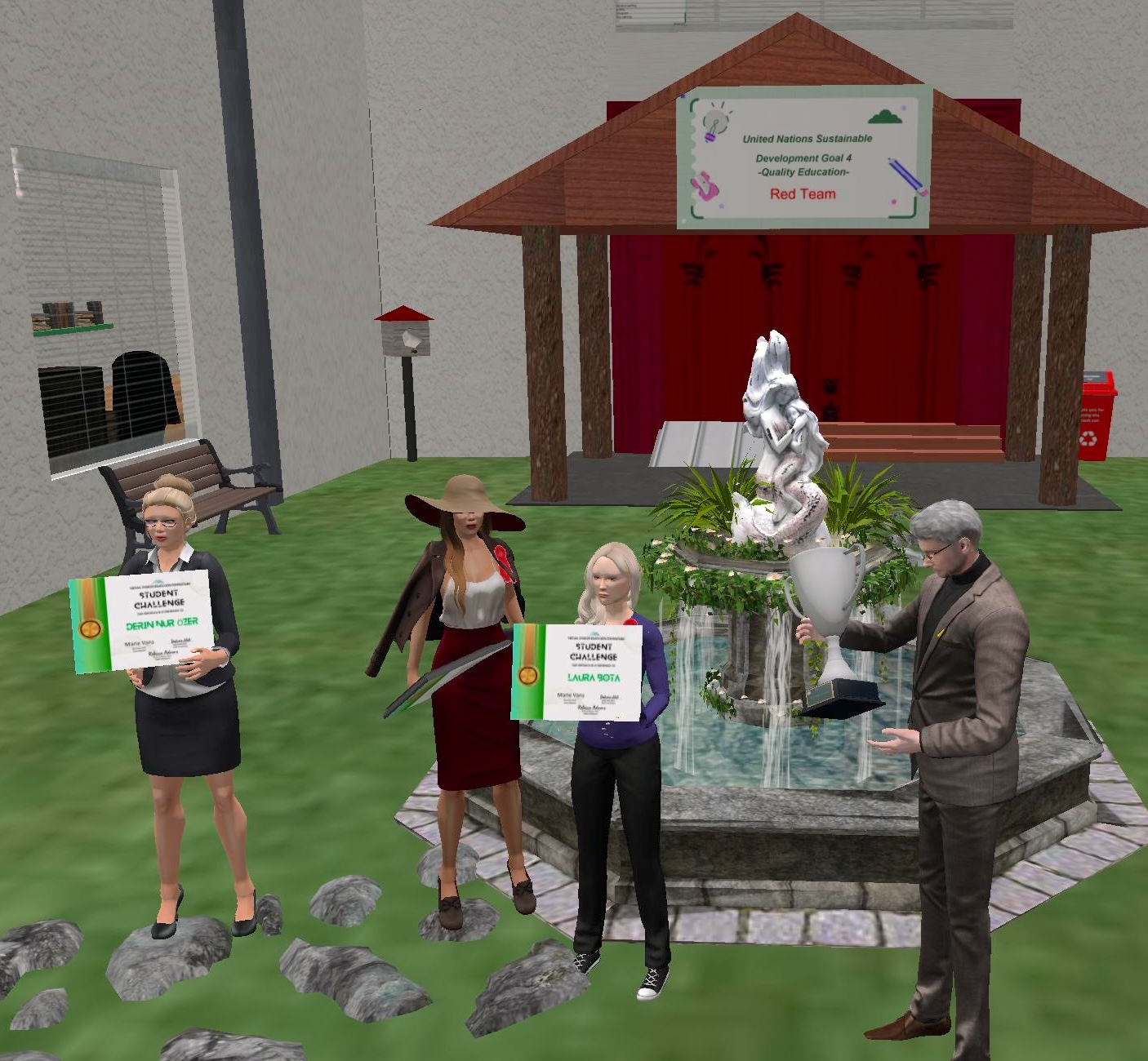
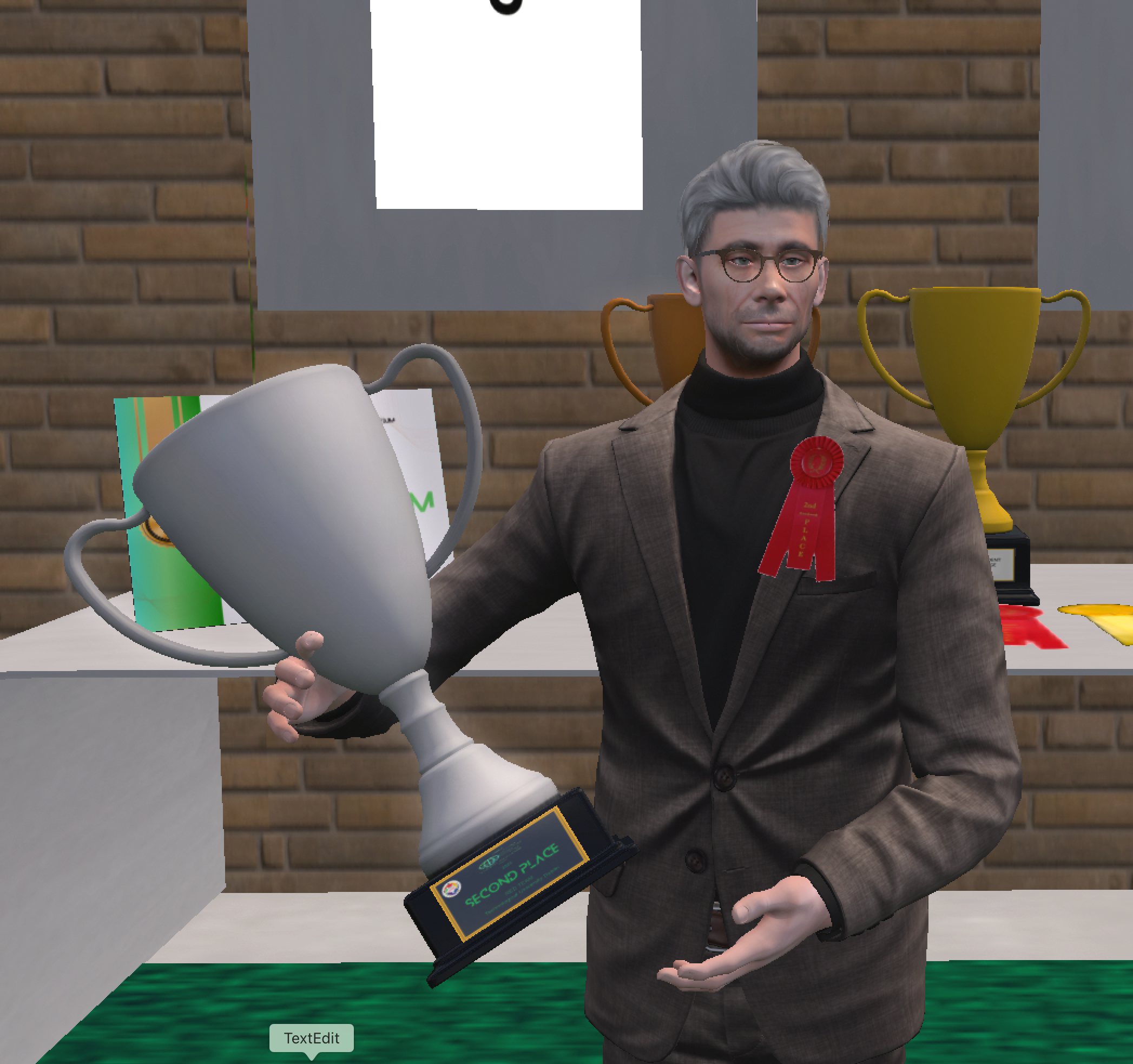
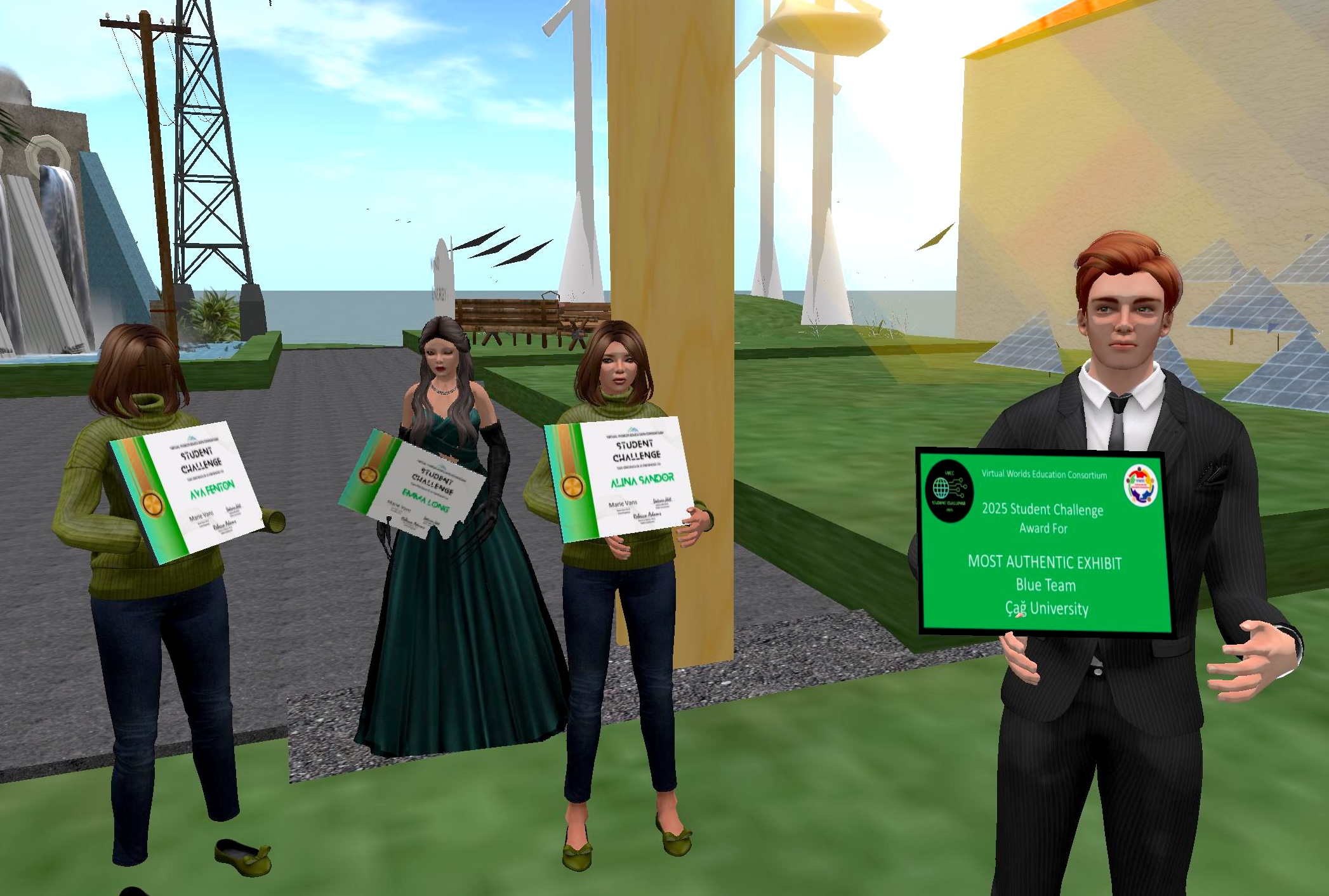
The Awards Ceremony for the VWEC Student Challenge 2025 was well attended by instructors, tutors, lecturers, students, participants, judges and more this year. All the students were presented with the individual certificates marking their completion of the challenge. In addition, The Red Team was presented with the trophy for Second Place overall winner and the Blue Team received the certificate for the Most Authentic Exhibit. Congratulations to all the students who participated in this year’s challenge. Well done! Huge thanks to the instructors who mentored the three teams and to all the guest speakers who shared their knowledge and experience over the semester.
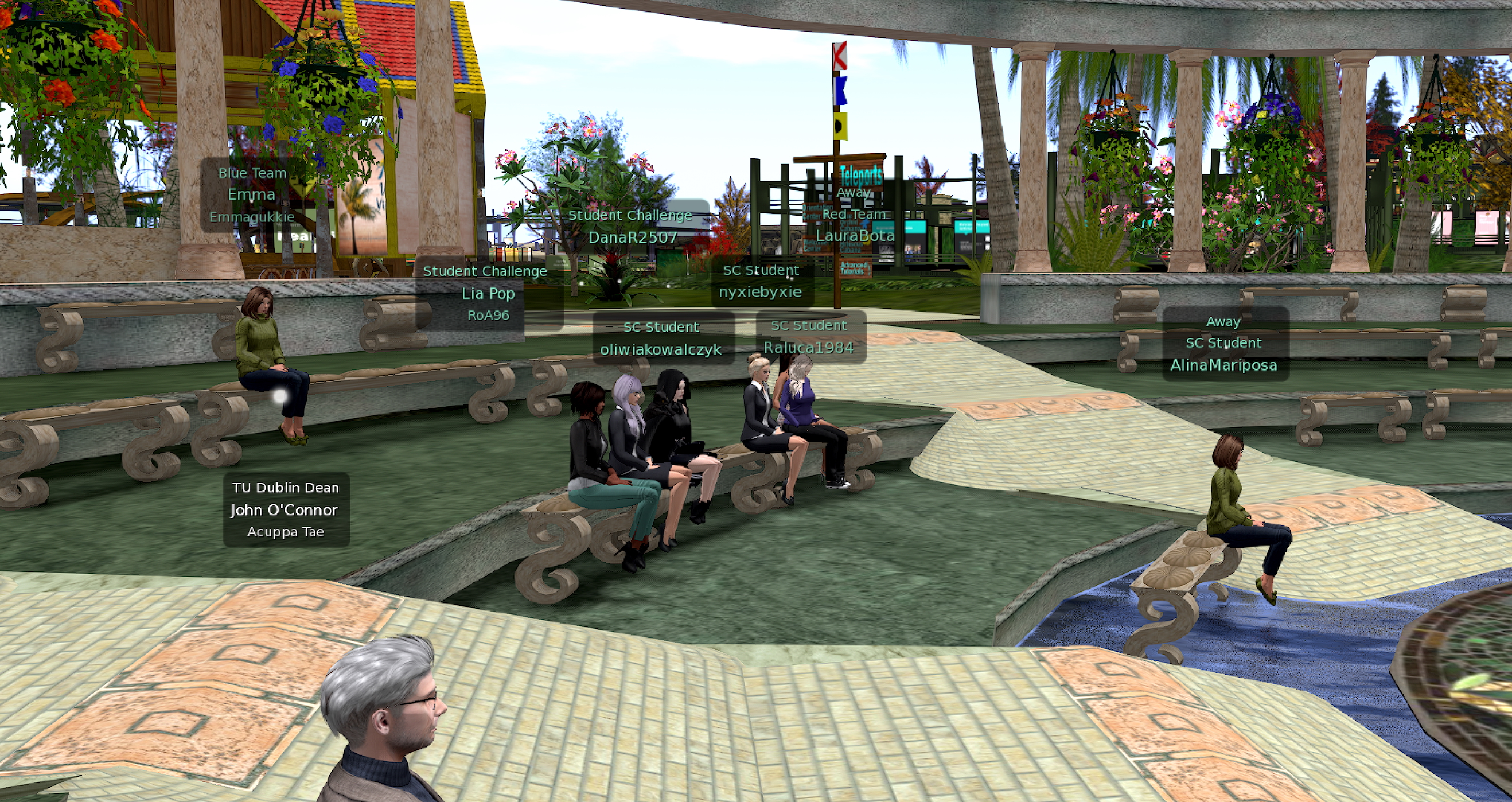
Congratulations to the Red Team who were presented with their certificates. Photo courtesy of Acuppa Tae.John O’Connor (Acuppa Tae) accepted the trophy for Second Place on behalf of the Red Team. Photo courtesy of Acupp Tae.Congratulations to the Blue Team who were presented with their certificates. Ersin Ïnal (Ginger) accepted the certificate for Most Authentic Exhibit on the team’s behalf. Photo courtesy of Acuppa Tae.Congratulations to the Green Team who were presented with their certificates, with Lia Pop.
The student teams have been working hard on their projects for the last two weeks and today we finally saw their completed presentations. Çağla Solak, aka Merino, joined us to record the videos for each team and also made a really nice introduction to the student Team Projects for the VWEC Student Challenge. All the team members were present and took part in the tour of their builds and the presentations. The work was very impressive and the performances were word perfect and delivered with confidence and professionalism. Amber Selenium also joined us to take the team photos.
Here is the introduction to the project from Çağla Solak, aka Merino (video courtesy of Çağla Solak):
.
RED TEAM: Konrad Karolkiewicz (KONRAD1), Laura Bota (LauraBota), Vanesa Hotca Francesca (Vanesa26), and Derin Nur Özer (nyxiebiyxe). Team mentor: John O’Connor (Acuppa Tae). (video courtesy of Çağla Solak):
.
BLUE TEAM: Alina Sandor (AlinaMarsiposa), Ava Fenton (phroggg), Emma Long (Emmagukkie), and Tuğçe Çetinkaya (tugcecetinkaya). Team mentor: Ersin İnal (Ginger). (video courtesy of Çağla Solak):
.
GREEN TEAM: Oliwia Kowalczyk (oliwiakowalczyk), Dana Rusu (DanaR2507), Andreea Pasca (Pasca Andreea), and Raluca Pascaniuc (Raluca1984). Team mentor: Lia Pop. (video courtesy of Çağla Solak):
.
Amber Selenium took the team photos starting with the Red Team: from left, nyxiebiyxie, Vanesa26, LauraBota, KONRAD1. (Photo courtesy Amber Selenium.)
.
Blue Team: Ava, tugcecetinkaya, Emma, AlinaMariposa. (Photo courtesy Amber Selenium.)
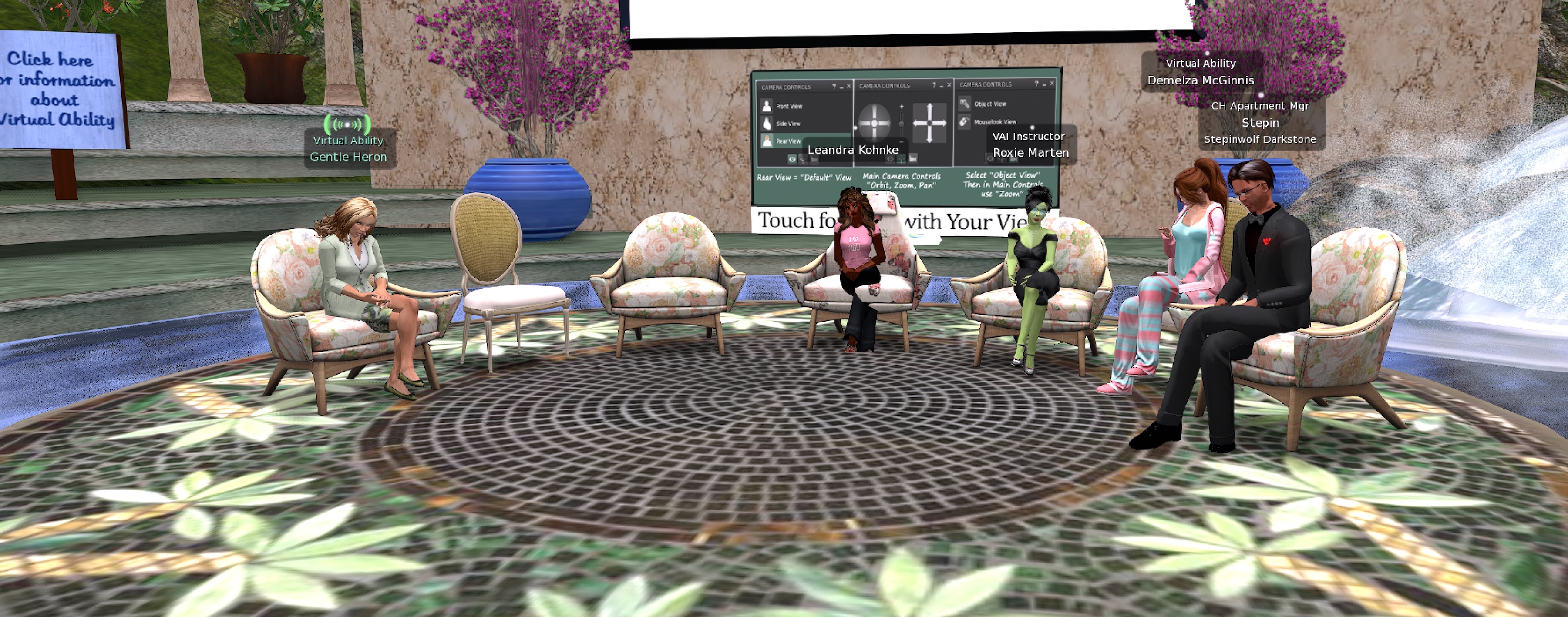
We visited Virtual Ability Island where we were welcomed by Gentle Heron, the founder of this remarkable community in Second Life. Gentle welcomed the class and told us a little about the community and how it came about. Here is the text of her presentation.
Gentle Heron, left, founder of Virtual Ability, with some member of the community. Photo Acuppa Tae
(1) Who is the Virtual Ability community?
Virtual Ability (VAI) is an international cross-disability peer support community of over 1,300 members. We’re international because the people in the community come from 6 continents. “Cross-disability” means our members who have disabilities may have a physical disability, a mental or emotional or developmental disability, or a sensory disability (deafness or blindness). Many of us have multiple disabilities. We offer peer support as well as education, acceptance and understanding. Our community assists people with all kinds of disabilities to enter and thrive in virtual worlds like Second Life and other virtual worlds.
Although Virtual Ability offers various educational and entertainment activities daily, we strongly encourage members to explore throughout Second Life. You only find our members on our islands for our events. Most of the time they are elsewhere in SL. Many of us act as peer mentors or role models. We are NOT acting as professionals, even those of us who are professionals in RL. Sometimes it’s important to communicate with people who are most like yourself, who will “get” your concerns, your language, your point of view. That’s why most people with disabilities seek to relate at times with others like ourselves. But we don’t want to live in isolation from others who do not share our disabilities. We are not a virtual “leper colony.”
About ¼ of our members do not (yet!) have disabilities. We call them TABs, temporarily able bodied. They may be a parent, spouse, child, or friend of a person with a disability; a professional or non-professional caregiver; an academic researcher; medical professional; or an educator. Our community has been in Second Life for almost 18 years, so we have a good record of continuity. We are widely recognized for the quality of our service to our community. We won the first Linden Prize back in 2009 for a project that has “a tangible impact on the real world.” We are supported in virtual worlds by a US nonprofit corporation, Virtual Ability, Inc. We are probably the first SL entity to be given legal RL nonprofit status.
(2) What is the relationship between physical and virtual (online) communities?
I reject the term RL for “real life” when it is used to distinguish the physical world from the virtual world. Some avatars may not be realistic if by realistic you mean a replica of the individual sitting at the computer operating it. But they are realistic in terms of the person who created them. Our avatars express our personal sense of self. Virtual communities are real! I have found that communities are quite similar in both venues.
(3) Why do I consider Virtual Ability to be a community?
Some definitions of ‘community’ are based on geographic proximity. That’s not us. Nor are we culturally similar. In fact, we embrace diversity! The population of persons with disabilities is the largest minority group in the world, and is the most varied. In our VAI group chats, we often hear “Oh, I didn’t know [people with that disability] had that [symptom] too, like I do [with this different disability].” or “Wow, we have the same diagnosis, but your life is really different from mine.” Our diversity is a constant for all our interactions, requiring a group value of respect and accommodation. Both respect and accommodation are necessary for effective collaboration. So we aren’t “together” physically, and we aren’t really very similar.
However, we definitely exhibit other aspects of community:
Our members form both close and informal relationships.
We promote mutual support among members.
We ask potential new members what the community can do for them, and what they can do for the community.
We share common values and beliefs. One important community value is our emphasis on Ability, not DISability.
We offer organized interactions and activities.
Some of the most popular are campfire chats and dances.
Most members exhibit a strong sense of belonging to the community.
(4) How are virtual communities developed and maintained?
I believe community development is by organic, biological-like processes of accretion and evolution. We have a niche within the larger Second Life ecosystem, and we specialize to fill that niche. We are maintained through the continued interest and volunteer time of so many wonderful community members. You will get a chance to meet a few of them during the Q&A session. As a community, we interact with other communities and individuals as well. On our public Healthinfo Island directly to our west, we focus not on disabilities and impairments, but rather on health and wellness. You will find educational exhibits and displays, a pavilion listing research opportunities you might participate in, and the Path of Support. The Path of Support lists information about the more than 120 disability peer support communities we have identified so far in SL. There is a list of the current month’s exhibits and displays on Healthinfo Island on a notecard in the blue poster to the left of the stage. I’ll point at it so you can see where it is. Just click on the poster to get a folder with some notecards in it,
Another notecard in the poster tells more about the SL islands our community maintains. Our community has 3 residential islands, with private properties around the edges and public land in the central area. On Cape Able, there is an art gallery on the public land showing art created by persons with disabilities. Cape Serenity hosts a library with books, articles, stories and poetry by VAI authors and others much more famous whom you may not know have or had a disability. Offering only works created by persons with disabilities goes along with our emphasis on the abilities of people with disabilities. You are welcome to visit our public areas any time. You can learn more about the VAI community at our website: https://www.virtualability.org
Gentle then introduced her friends, members of the community who shared their stories and explained why they joined Virtaul Ability. This was followed by an opportunity for the students to ask questions and engage in a discussion with presenters.
John concluded by thanking Gentle and the members of VAI for their generosity in sharing their experiences and emotions.
Tilly, from Builder’s Brewery leading the class. Photo Acuppa Tae
Excellent attendance again today for the intermediate building class, led by Tilly from Builders Brewery. The folder of items used in the class is still available at the at the Student Training area for anyone who would like to revisit the training. Here is the recording of the class:
If you missed this class visit the Student Training area at VWEC Student Challenge to pick up information: just click on this box below the stage.Photo Acuppa Tae
Gentle Heron from Virtual Ability gave a talk on the importance of accessibility in Second Life. Many of the residents and visitors have one form of disability or another. In fact, all of us are merely Temporarily Able Bodied (TABs) as we are likely to develop disabilities as we grow older: sometime a short-term disability, perhaps a broken leg, and sometimes longer-term disabilities such as loss of vision or hear impairment. Therefore, universal design principles are important to bear in mind when building in Second Life. For example, always give names and desicriptions to objects. This means that visually impaired people, who rely on these descriptions being spoken by the special software they use to navigate the virtual world, will know what you have created.
Recording of Gentle’s presentation courtesy of Valibrarian
Gentle left a box of information at the Student Training area with plenty of useful references and links so if you missed the class you can go back and click the box anytime this week.
We will have another chance to hear from Gentle when we visit Virtual Ability Island next Monday so if you have any questions they can be addressed at that class.
Sitearm Madonna talks about how to forge identity through intent. Photo Acuppa Tae
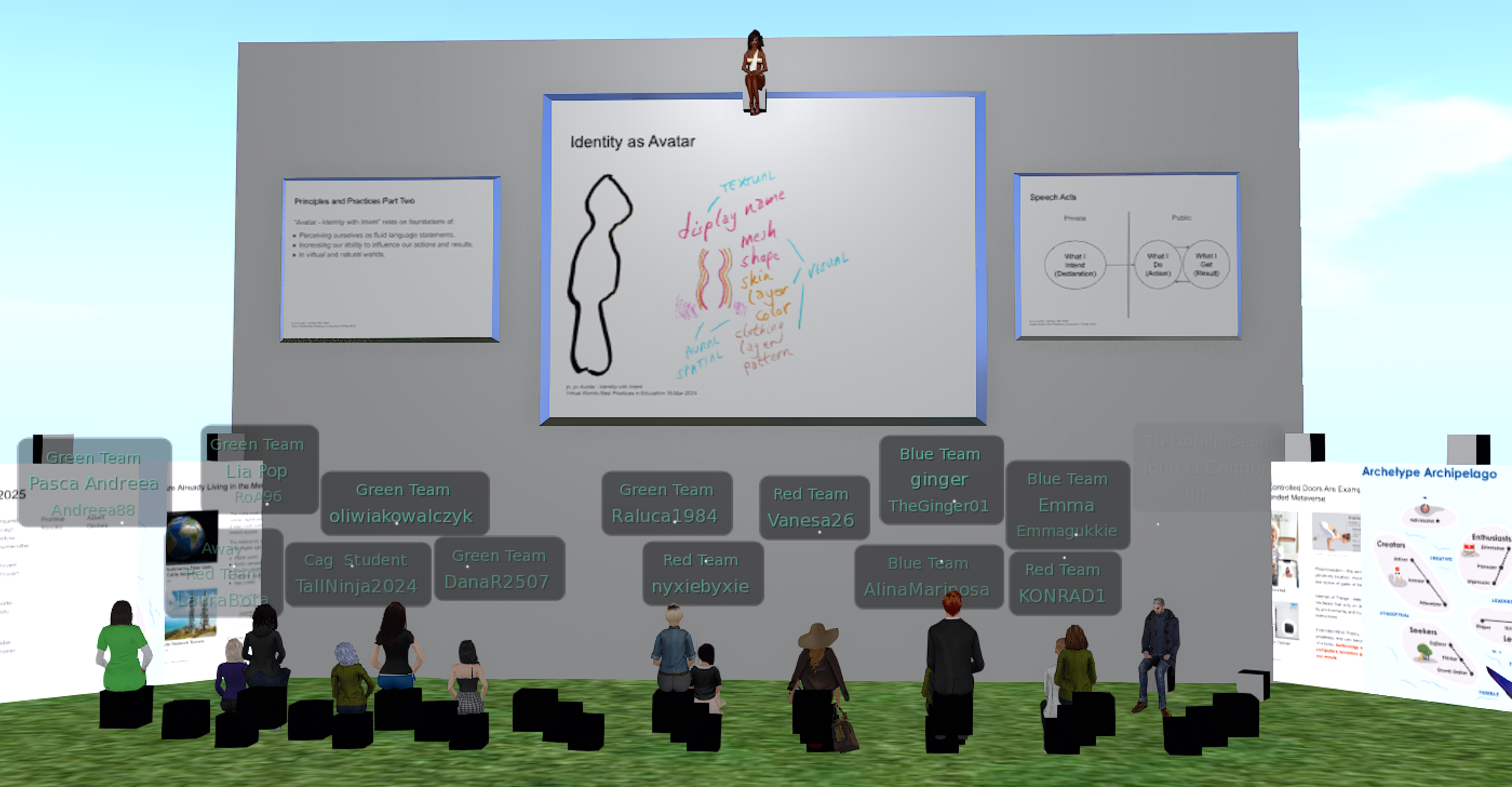
Sitearm and Tae spoke about taking control of our identities in today’s class. Tae gave the background to some of the current thinking around what the ‘self’ might be and how it is formed. This led on to the concept of our ‘personas’ and how this forms our identity. This subject is a little easier to consider in the context of our use of avatars in Second Life.
John / Tae talks about the importance of avatar formation and how it affects our view of ourselves. Photo Acuppa Tae
Sitearm porposed that ‘Avatar –Identity with Intent’ rests on a foundation of self-perception as conversations in physical, emotional, and congnitive realms. We can increase our ability to influence our actions and the results; both in virtual and natural worlds.
Sitearm explains ‘self-editing’. Photo Acuppa Tae
Following the talk Site and Tae demonstrated how to save your current avatar as an ‘outfit’ so that we could all experiment with different avatars. There was an interesting discussion on the experience of coming to class as an avatar instead of attending class in the natural world. Students suggested they feel more able to speak up in SL. There is a sense of freedom using an avatar to voice opinions and ask questions in a more equal environment where the differences between teachers and studetns are less obvious.
Sitearm introduced the Principles You personality archetypes assessment which is similar to the well-known Myers-Briggs Type Indicator and the Belbin Team Indicator. These are all systems for helping us identify our personality types so that teams know what role each member is best suited for. These systems are useful but not absolutely accuate so need to be taken with caution. However, they can be helpful for seeing what skills might be missing in a team. Tae asked you to take the free test (it takes about ten minutes or so) and share the results with your team. Use this to try and allocate team roles and identify any areas you might need support.
The class this week commenced with a look at the impact of technology on our environment and on society. John / Tae explored the development and use of tools using the writing of mid-twentieth century media theorist Marshall McLuhan. If you missed the discussion or would like to review the content here is a recording from a previous semester.
After the break we visited the VWEC Student Challenge building space and set up SL groups for each team. This means that only Team members have permission to build on the site, protecting it from interference from anyone else.
John / Tae asked the Teams to meet before class next Monday and have decided on the SDG they will present and made decisions about dividing the research areas. He also asked each team to build something on their site just to get started.
The introductory class to building in Second Life had almost full attendance, an excellent outcome considering it took place late on Saturday evening for the European students. Builders Brewery has been offering classes for beginners, intermediate and advanced builders for many years and we are fortunate to have their support for the VWEC Student Challenge. For those who could not attend, or if you would like to review the class, here is a recording made by Valibrarian.
Video courtesy of Valibrarian Gregg
There will be an intermediate building class by Builders Brewery on Saturday 22 March at 9:00 am SL Time.
Everybody arrived at Çağ campus in good time for this week’s class but just as we were about to begin we all lost voice. This seemed to be a problem across Second Life because even though we moved to the VWEC Student Challenge area in the Eduverse the issue persisted. Despite logging out and back in again, turning off the voice preference and turning it on again nobody could get voice working. Eventually we decided to proceed with subtitles. Fortunately, Valibrarian is always well prepared and she had the entire text loaded into SpeakEasy to facilitate this. About twenty minutes later voice suddenly became available again and remained stable for the remaining duration of the class.
Following the class Val invited us to the Community Virtual Library for a visit and some closing discussion about the how literate or meatliterate we think we are and what it might mean to call ourselves digital citizens. Val spoke of the importance of teaching these concepts to children from an early age to ensure they will be able to navigate this complex space with confidence and in safety. She also referred to AI and mentioned an experiment where she tested the ability of AI to be creative with poetry – Will AI Slaughter the Muse?
Finally, we visited the VWEC Student Challenge building area where the three Teams were shown their building spaces and recommended to take landmarks. Each space is currently surrounded by a translucent cube which delineates the available space for building. It is recommended that these cubes are left in place until the end of project – they can be removed before the final submission. We also noted that once inside your team space your voice cannot be heard outside the boudary. This is useful so that teams of students building together do not disturb each other, but remember if you want to talk to another avatar they will not hear you outside.
A quick check-in with the three teams revealed that all had selected the UN SDG they will work on. The next task is to start researching the detail of the SDG and begin to identify an appropriate narrative for the preenetation. The first building class will be held next Saturday by Builder’s Brewery so it is importatnt to attend that. Here is the link to the Landmark in SL.
Finally, we visited the Student Commons which has been provided to give you a break from all the hard work. It features a range of games and toys to play with and have a rest. There are trampolines, a lifesize chess board, pool tables and a range of others to explore while considering your pojectc work.
Sitearm Madonna presents the theory of teamwork. Photo by Acuppa Tae
Meeting at Çağ campus this week we heard from Sitearm Madonna about how teams function and the roles of the team members. If you missed the class you can review the recording of the same class from last semester.
Then we had a look at the brief for the Student Challenge in a little detail to determine precisely what is expected. The detail is in the previous post Serious Simulations in the Metaverse. Some changes have been made to the teams for the Student Challenge which will be confirmed next week but, in the meantime the teams broke out with their instructors to confirm the team lead and assistant lead and share contact details. Both Red and Green teams met but nobody from the Blue team was in class so the members will need to catch up on that work in their own time.
After the breakout the full class met again and shared their progress. The Teams were asked to arrange to meet during the week to discuss the Student Challenge and select the SDG they will address. Following that we had a request from Nova, a PhD researcher at North Carolina University, to take part in a focus group about learning in virtual worlds. Anyone interested can let John / Tae know and he will share details.
Next week we meet at Çağ again when Valibrarian Gregg will talk to us about Metaliteracy and Digital Citizenship. Please arrive early.






 Virtual Environments: Is one life enough?