h1

Class 1: Welcome

September 27, 2018
First meeting of semester one class 2018/9

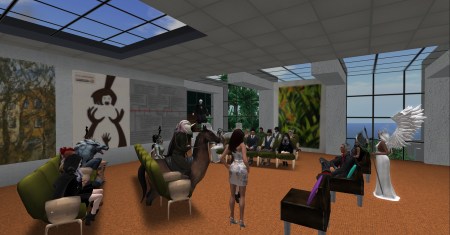
A collection of angels, a horse, werewolf, witch, unicorn, vampire, some warriors and normals gather for the first class of the semester.


With almost 30 participants turning up for the first class this semester looks like being the busiest yet (for John, at any rate!). Everyone arrived in good time and ready to engage. Despite the fact that nobody identified as gamers all appeared comfortable and relaxed in the virtual environment.

We started with some basic housekeeping as John identified each participant and linked your avatars with your student identities. One interesting thing that emerged was the anonymity of participants – many of you chose avatar names that are different from your real names and want to retain that anonymity. John agreed not to reveal real names unless you agree in advance! We will use avatar names throughout the semester. We all ‘friended’ (is that really a word?) each other so we can keep in contact and you can see who else from our class is logged in to SL at any time. It also allows you to send private instant messages (IM) to each other, even when you are in different locations in SL – very useful if you cannot find the DIT campus or get lost somewhere in SL.

John will add everyone to the DIT Module group over the next few days. You should remember to activate this group when joining the class on Wednesdays: think of it as your virtual student card. It gives you special privileges in virtual DIT (more on that in later classes) and facilitates closed group conversations.

We discussed the most suitable social media platform to facilitate conversations outside SL. It seems to come down to two choices: WhatsApp or Facebook. A quick poll suggested Facebook as the favourite but we agreed to think about it over the week and make decision in the next class. Recent classes have set up a private Facebook page – it is useful for asking questions about the module, sending notifications about changes in meeting times, for John to post links to these class summaries etc. Perhaps a volunteer will come forward to set up the page?

John explained that class time will be discursive and interactive during the semester. Reading material will be set in advance to inform the discussion so please ensure you make time to review it, starting with the link below; read before next week’s class! Please engage in the class discussion, either by voice or text chat: the more you do so the more you will learn. You will also need to spend some time in SL between classes to complete tasks and activities. Specific activities will be set for the first few classes to get you started.

Each of you will need to create a blog in your avatar’s name. You will be expected to post to it at least once per week for the duration of the semester. Once again, you will be given specific topics for the first few weeks to get you started. If you keep this habit and post weekly you will avoid the burden of having to write a complete paper at the end of the module. John also explained that you will divided randomly into groups next week to work on a project which will be presented at the final class of the semester. You are encouraged to read through the pages listed in the right hand column of this website to get full details of the project, see examples of previous student blogs and get an idea of what to expect in the rest of the course.

THINGS TO DO BEFORE THE NEXT CLASS:

  1. Explore: SL with some colleagues from the class. Visit at least 3 different locations. Find them in search or ask other residents for recommendations, or simply select places at random.
  2. Read: How to Write a Blog People Want to Read by Susan Gunelius in Lifewire, 23 June 2018.
  3. Set up your blog: using bloggerwordpresstumblr or any other blog site. Complete the ‘About Me’ page (read some of those pages on other blogs first) and remember it is different from the first post on your blog. Write from the perspective of your avatar: the persona you will be using to explore in this module. Send a link to your blog to John by email or post it in the FaceBook group.
  4. Write the first post: to your blog reviewing the locations you visited. Describe the places and include photos, if you can. Explain what you liked and disliked about the locations and describe any interaction you might have had.
  5. Visit the following: Dolce Merda, Brain PickingsIllustration Friday, Chris Brogan. Think about how you would identify these blog authors…what impression do you get of the person behind the blog?
h1

Autumn semester 2018

September 27, 2018

Welcome to the module ‘Virtual Environments: Is one life enough?’ being offered as an elective module to second and third year students in the Dublin School of Creative Arts.

The first class meeting will be on Wednesday 27th September at 8:00 pm. We meet online every week at DIT in Second Life. Please note: you will need a Mac or PC desktop or laptop to access SL – you cannot do so with a mobile device. If you are new to Second Life, known as SL, then start by reading Getting into Second Life to find out how to access the class. You should then visit SL and find the DIT campus, learn how to get around the virtual world and familiarise yourself with the environment and how to control your avatar. This will take a few hours so give yourself plenty of time before class starts.

Please read pages 1 to 9 in the column on the right also. If you would like to find out more about what to expect during the semester read the posts in this blog: all class since 2009 have been summarised.

If you have any problems email John O’Connor.

h1

Class 8: Content creation

November 29, 2017

Class began with a discussion around reputation, and in particular, reputational damage, arising from the texts given for reading last week. We started by considering the difficulty in conveying subtlety in the online environment where text alone makes things like humour, emotion and empathy difficult to create. Emojis, CAPS, bold and italic can only go so far! In addition, we have to be careful of auto-correct, reply-all and the plethora of time-saving options that can cause untold problems if triggered accidentally. The examples discussed show that while our digital history coming back to haunt us may seem unfair, it is a very real phenomenon.

This led on to a discussion about creating and generating ‘content’. Content was described as anything we make: text, image, illustration, photograph, graph, chart, music, recorded speech, etc. Ascribing value to this content is not a science but an art. The beauty of the web is that its scope and span means there is nearly always someone somewhere who will value the most obscure content.

However, copyright is an issue. It was somewhat simpler to protect copyright when the means of copying required skill, access to tools, time and funding. Now, digital copying is instantaneous and simple. It is becoming more difficult to protect our work.

THINGS TO DO BEFORE THE NEXT CLASS:

  1. Write the sixth post: to your blog describing the final preparations for the presentation of your project. Concentrate particulary on your own contribution and how it aligns with that of your fellow team members.
h1

A word about copyright

November 26, 2017
487553210

Copyright law can be complex in today’s world but the concept originated in 6th Century Ireland when books were created from vellum.

Some of you have been asking about copyright, in the context of using images for your projects. Copyright is an automatic right and it means that anybody who creates an image or a text that can be copied is the automatic owner of the right to copy that creation. Therefore, if you want to copy something created by somebody else you need their permission first.
Nevertheless, some people are happy to allow others the use of their work, in fact they may want wide exposure and so encourage the use of their creations, so long as the user doesn’t earn any money for it. You may have seen such work listed as Creative Commons – this blog is covered by Creative Commons for example. In addition, many copyright owners do not mind if their work is used in an educational context by students, so long as it is not for profit, or wide circulation.
Copyright provides limited protection because it is not enforced by the state. Any individual who believes their copyright has been infringed has to take a private case to court and prove it – this can be costly and risky.
However, copyright runs out in time. Once an image or text is out of copyright anybody may use it freely.
Copyright originated in Ireland in the 6th Century when a dispute about the ownership of a copied vellum (calfskin) manuscript led to the judgement that ‘To every cow belongs her calf, therefore to every book belongs the copy.’ You can read more about copyright in the wikipedia History of copyright law. For more on copyright law see wikipedia on Copyright.
So, the best guidance is that if you use images from the web be careful that you are not using copyright images unless absolutely necessary. There are many images to choose from that are free of copyright. Also, it is always a good idea to credit anybody else’s work so you cannot be accused of passing it off as your own.
h1

Class 7: Personal branding

November 22, 2017

John was unable to get his voice working this week so the class had to be conducted entirely through text chat. This slows the conversation down considerably and forces everyone to be more precise in what they say, using the minimum amount of words – a little like conducting a class entirely in twitter.

We started off with some feedback on the participants blogs. John gave the following pointers:

  • Include your About Me profile in your blog.
  • Make sure it is easy to follow your blog – approach it as a first time visitor.
  • Tidy up your blogs – delete the template pages and widgets.
  • Caption your pics and illustrations.
  • Include references to the reading and cite them correctly.
  • Be reflective – discuss what you are learning (or not learning!)
  • Proof read before you post.
  • Make sure you approve any comments. Comment on your peers’ blogs.
  • Some of you need to ensure your have written all the required posts – don’t be a mean writer!

These comments will be supplemented by more specific comments for each student that will be sent by direct message in Facebook.

John also reminded the class that one blog post per class is the minimum requirement for assessment. From now on you should be writing about how your team is functioning on the group project. Refer to the talk on team work by Sitearm Madonna and describe you own contribution to the group in particular. Be constructively critical and remember this is a learning exercise not an exercise in perfection. In fact, you are likely to learn more from what goes wrong than what goes right.

We then discussed the reading from the last week in the context of our own online personas. The issue of ethics and morality surfaced almost immediately. Identity theft, catfishing (using social media to pretend you are someone you are not), trust and gender were discussed in similar terms to the issue of privacy, transparency and opacity last week. Glenn suggested there is no essential self to find… much in the way that it is not possible to have true transparency. But, he went on to suggest that trust is very important. We considered how difficult it can be to build trust yet how easy it is to shatter it. barrrttyy suggested that developing a personal brand might be important when we consider it may last longer than a single job or career.

John asked everyone to consider the difference between our personal identities and our professional ones in the online environment. Do we always distinguish between the two? Should we? How might we do so? This is where the importance of digital literacy becomes clear. We need to be aware of our online behaviours to ensure our current behaviour doesn’t exclude us from future opportunities.

THINGS TO DO BEFORE THE NEXT CLASS:

  1. Read: about the girl who resigned her position as UK police youth commissioner in 2013 due to previous tweets. [Accessed on 27 November 2017.]
  2. Read: about another example of person losing their job over a racist tweet. [Accessed on 27 November 2017.]
  3. Read: User Generated Content and Virtual Worlds  from the Vanderbilt Journal of Entertainment and Technology Law, 2008. [Accessed on 27 November 2017.]
  4. Write the fifth post: to your blog about how you might convert your personal presence online into an identity for professional networking.
h1

Class 6: Opacity

November 15, 2017

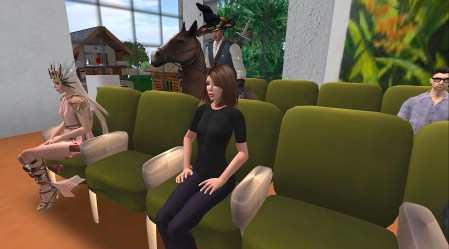
We don’t often see class participants on horseback at DIT…


Following on from last week’s discussion about the project Glenn introduced one of the text‘s from the reading list. Édouard Glissant is a poet from Martinique, a small island in the Caribbean, who in the late 20th Century formulated a demand for the right to opacity – ‘We clamour for the right to opacity for everyone’. He was writing from the context of a small island community where residents’ privacy is often violated – a perspective that will resonate with the Visual Arts participants from Sherkin Island. In addition, Martinique is a former French colony and Glissant is acutely aware of the post-colonial discourse. However, his thoughts are finding a new audience with the rise of social media and its implicit demand for transparency. Glissant suggests that the process of ‘understanding’ people from the perspective of Western thought is based on the requirement for transparency. Of course, total transparency is not possible and, according to Glissant, not even desirable. Difference must be recognised and opacity acknowledged. The opaque is not the obscure though, it is that which cannot be reduced.

This apparent conflict between transparency and opacity is also explored in the TEDx talk by Tranberg and the film by Krotoski also.

This led to a very lively debate with a range of views expressed and many concerns about the quantity and nature of data gathering by social media corporations such as Facebook, Google, YouTube among others.  We talked about how easily we gave away our rights in exchange for the convenience of using online apps, frequently without even reading the terms and conditions before ticking the box. We need to be careful because if something appears to be free then it generally means we are the product.

Glenn referred to a symposium After the Future…of Work and a presentation by his colleague Conor McGarrigle in which he explores how we are training our own AI (artificial intelligence) replacements in the workplace by using digital applications.

We also touched on the generational difference in response to these issues; the notion of data in a ‘cloud’ whereas in reality it is stored in very grounded physical locations; the range of legislative jurisdictions versus the ubiquitous internet and the impact on governance and oversight; the use of anonymised big data versus data on specific individuals.

THINGS TO DO BEFORE THE NEXT CLASS:

  1. Read: Digital Identity Development is a Process. [Accessed 17 November 2017.]
  2. Read: Syrian lesbian blogger is revealed conclusively to be a married man. [Accessed 17 November 2017.]
  3. Read: Your Employee Is an Online Celebrity. Now What Do You Do? a Wall Street Journal article about employees developing their personal brand and implications for their employer. [Accessed 17 November 2017.]
  4. Look at: the infographic Personal Branding: 10 Steps to a New Professional You. [Accessed 17 November 2017.]
  5. Write the fourth post: to your blog describing your contribution to bringing the group project team together.
h1

Class 5: The group project

November 8, 2017

Glenn and John started the class by thanking you all for your attendance on Thursday last week and apologising for the change in schedule to those who were unable to make it. Then Locks Aichi joined us for a discussion about the brief for the group project #MeToo.

We started by asking you to reflect on last week’s discussion about Marshall McLuhan which had strong contributions from class members as everyone had read the assigned texts. This was informative in the context of the project so John asked for feedback on what the class felt was expected of them for the project. As you were a little shy to contribute at first we asked for thoughts on what the title #MeToo might mean.

Some of the points raised were that it was easier to engage in this debate online as you only needed the hashtag; and how the medium made a difference in a single month when the issue had been raised originally many years earlier, prior to the coming of online social media. It was pointed out that the anonymity of the internet gives a certain level of comfort to speak up on issues where people might usually have been less ready to speak out. It also can be easier to type than to speak and many are more comfortable about coming forward that way: the greater the momentum the greater the impact. There was a sense that the internet supports greater transparency while at the same time results in greater opacity.

For some of you the hashtag aroused different feelings – #MeToo raises the question of the difference between harassment and assault and whether the use of the hashtag, as part of disclosures of both, conflate the issues unhelpfully. The use of the hashtag was also identified to have removed the taboo around talking about this. Strikingly, Uma Thurman demonstrates a particularly sophisticated understanding of the medium when she responds about standing with those who are affected but not being ready to give a ‘tidy soundbite’. Clearly, she is aware of the permanence of whatever might be said and is not prepared to respond in anger. The impact of the medium is becoming obvious and is a cause for concern when people are ‘tried’ by the masses rather than an objective process. The danger of the bandwagon effect also becomes obvious.

So in considering all this, where is the accountability…? The court system supports due process; the tradition of mass media is only to publish articles when facts have been verified. Whether or not we see this being adhered to there is, at least, an agreed process. The question now is where are the checks and balances on the web? The legal profession struggles to address the age of social media…. the question of who is responsible for defamatory remarks on social media is constantly evolving. As the discussion reached this critical point Glenn referenced the movie Circle (2015) which considered this issue.

THINGS TO DO BEFORE THE NEXT CLASS:

  1. View: Fake It – to control your digital identity. In a 2013 TEDx Oxford presentation Danish journalist Pernille Tranberg, who wrote the book Fake It – Your Guide to Digital Self-defense with the German journalist Steffan Heuer, explains what happens with your data, what it can cost you now and in years to come. [Accessed 12 November 2017.]
  2. View: The Power of Privacy. In this 2016 film by The Guardian, Aleks Krotoski travels the world to undergo challenges that explore our digital life in the 21st century. Watch her be stalked and hacked, fight to get leaked documents back, dive into open data and live in a futuristic home that monitors her every move. [Accessed 12 November 2017.]
  3. Read: Who’s watching me on the internet? Technology Correspondent for the BBC, Rory Cellan-Jones writes about our digital footprint and explains data trails in iWonder 2016. [Accessed 12 November 2017.]
  4. Read: Poetics of Relation (1997) by the philosopher Édouard Glissant. He argues against the ‘obviousness of a transparency’ from a post colonialist perspective but it seems to resonate with the discussion in class. Or, you can read a summary of the argument here. [Accessed 12 November 2017.]
h1

Class 4: Media and messages

November 2, 2017

As we moved into November a few scheduling clashes and misfortunes (coupled with this being reading week at DIT) led to the class being held on Thursday this week rather than the usual Wednesday. In addition, the class summary is being posted very much later than usual. Apologies from John and Glenn for disturbing the normal routine but it could not be helped (and thank you for your understanding).

All of you had read the blog post about ‘painfully coming to grips with The Medium is the Message’ and some of you even went on to read the more academic text describing Marshall McLuhan’s influence on ‘reshaping our sensorium’. This led to a lively and informed discussion about McLuhan’s philosophical ideas as expressed in his 1967 collaboration with graphic designer Quentin Fiore, The Medium is the Massage.

We arrived at an understanding of the basis of his theory that mankind is defined by the ability to develop tools – tools that then reshape and redefine the very nature of man and society. Furthermore, we noted that language, and communication in general, is really a tool that has had, and continues to have, the greatest influence on our society. The rapid development of communication technology throughout the 20th Century, culminating with the mass entertainment format of television, was identified by McLuhan to be as significant as the development of speech, writing and printing.

It is clear that we cannot know in what way our tools will affect society. But, McLuhan goes further and suggests that these very tools ‘massage’ us into believing they are merely neutral channels of communication while in fact the tools are having a greater impact on our development than the messages they carry. This development is incremental and not easy to perceive. We cannot predict the future so at best we should try maintain an awareness of the influences of our tools.

We suggested that the digital revolution currently playing out seems to be even more evidence in favour of McLuhan’s theories. His concept of the Global Village coming to life with virtual reality and social media. We will look at this again next class in the context to the group project.

No activities were set for the following week.

h1

Class 3: Team working

October 25, 2017
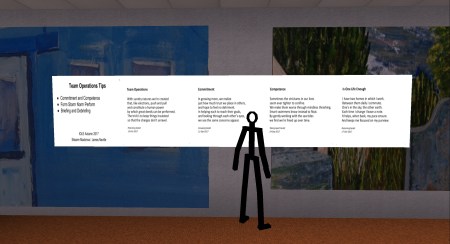
Sitearm Madonna on team working

Guest speaker Sitearm Madonna talks about team work through poetry!

This week we were rejoined by the second year group of students on the BA in Visual Art and their course leader Joseph Jacotot (aka Glenn Loughran). This group took the module last semester and enjoyed it so much they wanted to return! They were made welcome by the current group and we had one of the highest numbers of students ever to gather for a class in SL.

Guest speaker Sitearm Madonna (a veteran on this module) spoke about team working, both in Real Life (RL) and in online and virtual environments. His slide deck Team Operations Tips can be reviewed again and, indeed, it is recommended due to the richness of the content. There was only time to touch on it in class. Site speaks from a lifetime of experience working on various teams – some of which he didn’t wish to be a member, others where he was happy to participate and many of which he led. For me the take away point was about the need for constant confirmation that every member of the team is on the same page. Never assume that people agree when it comes to understanding either the project on which the team is working or the decisions that emerge from meetings. This is evident in team work in RL but it is exacerbated in the online environment where our usual human communication cues are missing. Glenn touched on a point that many of you discussed in your blog posts: the importance of voice in online communication. In RL much of our understanding is based on body language, often unconsciously interpreted, which lets us know when individuals in a group reach understanding, consensus and agreement. In the online environment all of this has to be transmitted through voice and text. Therefore, regular reflection as a group is necessary to prevent difficulties.

The issue of leadership in groups and how to encourage it was addressed and Sitearm emphasised the importance of understanding all the roles necessary for group development and progress. He reminded us that members need to flexible when it comes to stepping in and out of the roles as needed. So, the burden and responsibility of leadership actually falls on each member of the group and should be exercised when needed. Here also, the importance of ensuring that the whole groups is aware of the roles they are inhabiting at any time is critical. Negotiation around roles will help this process.

Sitearm provided entertainment during the question and answer session as he changed avatars from The Saint to Sitearm Madonna the elegant lady to a butterfly to artwork and, finally, burning man.

John referred to the #MeToo group project brief asking you all to read both the brief and the assessment criteria very carefully. By now the class was running a little over time so there were no questions directly on the project. We can discuss it in more detail next week. Referring to the first task to be undertaken before the next class John talked about the range of online tools that are available, many free of charge, to support teams and make up for the lack of fact-to-face (F2F) engagement. They cover all aspects team work from communications (Facebook, WhatsApp, We Chat etc), to project management (Trello, Padlet, Google sheets etc), collaborative note taking and writing (PBwiki, Google documents etc).  You should review some of them and there may be others you are familiar with or have used before. Share you experiences with the group.

THINGS TO DO BEFORE THE NEXT CLASS:

  1. Decide: among your group what tools you will use for planning your project (how you will stay in touch and share information, etc.).
  2. Write the third post: on your blog explaining your choice of communication tools and reflect on how the group arrived at the decision.
  3. Read: Living Structures in Second Life Virtual Worlds Projects by Sitearm Madonna. [accessed 27 October 2017].
  4. Read: Painfully Coming to Grips with The Medium is the Message an amusing and accessible introduction to the philosophy of Marshall McLuhan. [accessed 27 October 2017].
  5. Supplementary reading: Extrapolating on McLuhan: How Media Environments of the Given, the Represented, and the Induced Shape and Reshape Our Sensorium provides a deeper analysis of McLuhan. [accessed 27 October 2017].
h1

Group project: #MeToo

October 23, 2017
alyssa-milano

Actor Alyssa Milano initiated the phenomenal response to the revelations around Weinstein.

The interweb, internet or web as we know it today is one of the most powerful tools of our time. Infact, when we consider it as a medium it is almost impossible to reflect on how much is has impacted our lives and influenced how we interact, with whom we engage and when. As far back as 1977 Marshall McLuhan declared that ‘the medium is the message’ which has been highlighted in many topical occurrences.

Watch: this two-minute introduction to McLuhan’s basic thesis from the Open University

To explore the mechanisms of this still new medium of the web, we will use the topical #MeToo meme created last month by actor Alyssa Milano following the revelations concerning unacceptable behaviour towards women by Hollywood motion picture producer Harvey Weinstein. His behaviour has resulted in his sacking by the company that carries his name and his expulsion from the Academy of Motion Picture Arts and Sciences. Closer to home and earlier this year George Hook, radio presenter on Newstalk, was suspended from his job following his comments on a live broadcast concerning the rape of a young woman.

The multiple abuse allegations against Weinstein have led to #MeToo trending as women report that sexual abuse is a common experience in their lives. The hashtag has become a rallying point for those who remained silent, sometimes for years.

Perhaps the darkest aspect to emerge from these revelations is that Weinstein has been behaving in this manner for decades and it was pretty much common knowledge in entertainment circles. Put this together with Hook’s question about ‘women who put[s] themselves in danger’; the American President excusing his lewd and vulgar comments as acceptable ‘locker-room banter’; and the revelations some years ago concerning the former Italian Prime Minister’s ‘bunga bunga parties’; and it is difficult to avoid the conclusion that our society supports a culture of men who secretly prey on women.

The #MeToo hashtag is an example of how rapidly a topical incident can trend globally on social media. MeToo was originally founded by US activist Tarana Burke in 2007 when she started the campaign to serve sexual assault survivors in underprivileged communities. Now, it has been transformed into a global phenomenon. The aim of this project is to explore how the internet and its components impacted the emergence of the story and its increasing reach.

  1. Track how a local Los Angeles issue became a global phenomenon in a matter of days and present a timeline of its evolution.
  2. Demonstrate how it tapped into, or reflected the zeitgeist.
  3. Explore how it resulted in women around the world saying ‘me too’ and how this has been amplified, why they are doing so and what outcome is expected.
  4. Consider how the zeitgeist could be leveraged to change the latent acceptability of such behavior in society using the medium of the internet and it’s components.

Present your findings in an entertaining, informative and lively manner using whatever medium and format you wish as long as it can be stored for later review (e.g. a talk, short film, narration+visuals). Each team will also present its project live in Second Life. The presentation should be no shorter than five minutes and no longer than ten minutes. You are encouraged to use visual, audio or any other aids to support the presentation during which each member of the team must take part.

Each participant must also describe the progress of the project in a weekly blog post with particular emphasis on their contribution to the project. (What are you bringing to the group and how does it fit into the team’s work?) Discuss the details of the project and also the issues that arise in working collaboratively online. How easy is it meet up virtually and plan the project? What difficulties arise in development? How easy or difficult is communication? What particular problems arise and how do you deal with them? Focus on the experience rather than writing a ‘correct’ post or having an answer for every difficulty.

See page 6 Module assessment for assessment criteria applying to this project.

Important note: If you use images or sound be mindful of copyright, particularly as presentations will be posted to the module blog.

Presentations should be no less than 5 minutes and no more than 10 minutes in duration.

Your presentation can be made in the DIT campus or any appropriate venue selected by the group. Presentation date is normal class time on Thursday 6th December.

Reading list:

Explore one of the responses to #MeToo such at #HowIWillChange created by Australian journalist Benjamin Law. The meme #NotAllMen, which predates #MeToo and has been appropriated by various groups for their own ends, is also worth exploring. [accessed 22 October 2017].

Harvey Weinstein, Hollywood’s Oldest Horror Story. Maureen Dowd delves into the story for the New York Times, 14 October 2017. [accessed 22 October 2017].

George Hook should be challenged not silenced. Kitty Holland writes in The Irish Times that difficult as it might be such opinions need to be challenged so that society can improve, 14 September 2017. [accessed 22 October 2017].

Trump recorded having extremely lewd conversations about women in 2005. David Fahrenthold reports for the Washington Post on 8 October 2016. [accessed 22 October 2017].

#MeToo. Wikipedia traces the origin of the trend. [accessed 22 October 2017].

The Woman Who Created #MeToo Long Before Hashtags. Tarana Burke was originally inspired to develop the ‘Me Too’ campaign in the US when she met a thirteen-year-old girl who had been sexually abused in 1997. [accessed 22 October 2017].