h1

Class 4: Team Project – Future Work

February 28, 2019

John started the class by reminding you all of the deadline for your first assessment item next week. It must be submitted in Brightspace before 5.00 pm next Thursday, 7th March. But, don’t wait until the last moment – get your submission in early. It’s easy: just provide the link to your blog. Full details are given in the ‘Assessment’ section of the module in Brightspace. Remember, you must make the submission in Brightspace so that it is registered and John can provide feedback.

The University is carrying out a survey of staff and students using Brightspace for this pilot phase. Please take this Brightspace Mid-Pilot Review (Students). Your feedback is important so that improvements can be made before the full rollout in September.

It is important that you login to Brightspace regularly during the course of the week. The Essential Reading given for each class is a necessary preparation for our meetings but also provides background material to the subject of your blog posts. You need to be reading and viewing it so that you can cite appropriate examples in your writing. Take the short Quizzes to check if you understand the content. Although they don’t count for assessment purposes they are a useful way of identifying content you might not have fully understood. If you have any suggestions for improving the content please let me know.

Then we turned to the Team Project. In response to John’s query about whether you had arranged team meetings it seems that some have met and some have not yet met. It is important that you start meeting this week. You will remember from Sitearm’s talk last week that teams need time to form. So start working together from now on – visit SL, work on your class assignments, and begin thinking about the project. Give yourselves as much time together as you can to get to know each other.

There is a lot of detail in the brief and plenty of reading to guide your thinking and help develop your approach to the project. Use the time you have without classes next week to get started and become familiar with the material. Another important guide you should review carefully is the assessment rubric for the project. That gives you the criteria on which you will be assessed. There is no point in being busy on work that is not relevant so study the criteria for guidance on how to proceed.

Here is a short (viewing time is less than two minutes) extract from the class discussion:

h1

Class 3: Teamwork and Collaboration

February 21, 2019

Guest speaker Sitearm Madonna talks about partnership team building.

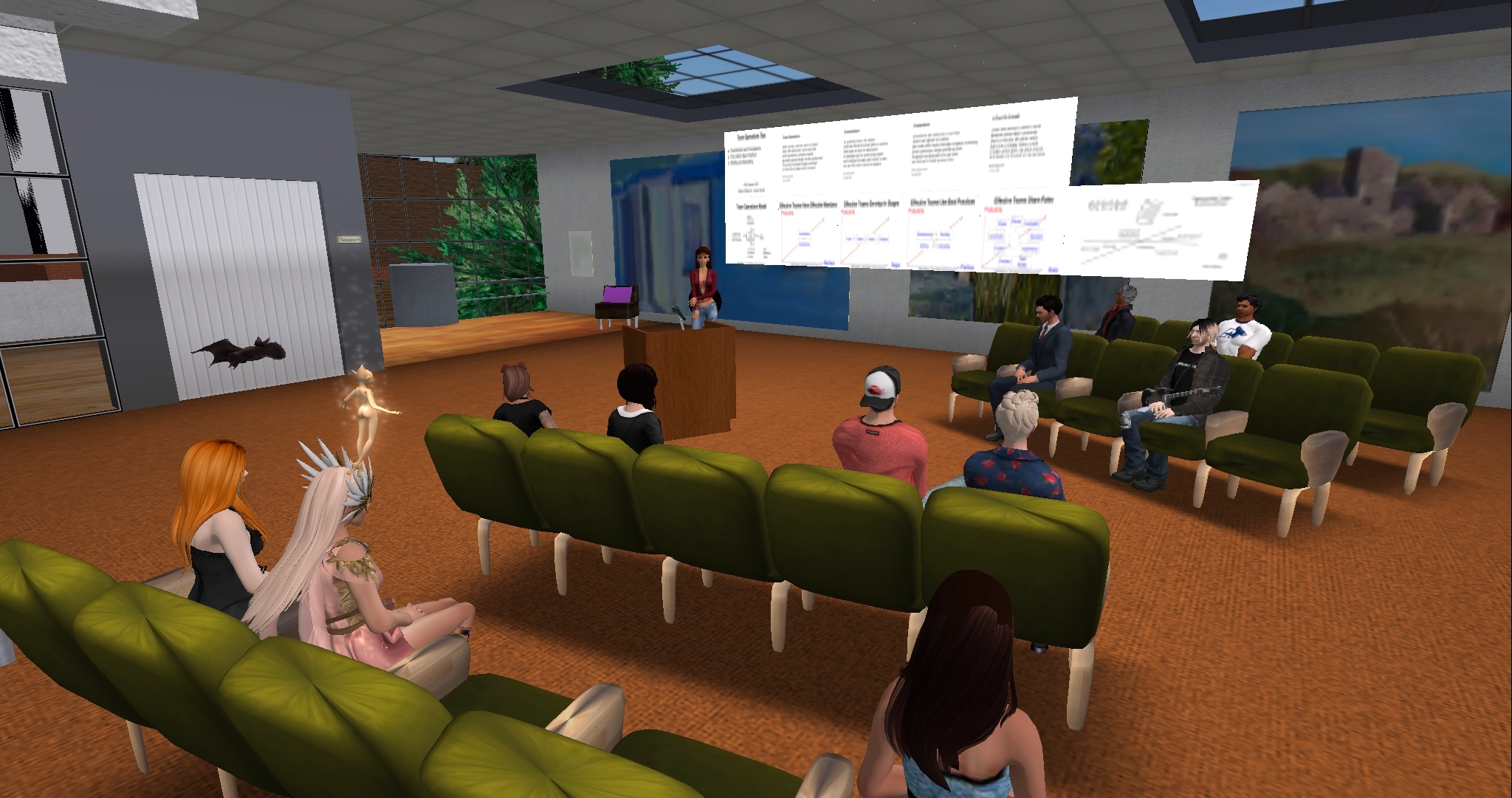
We were joined by guest speaker Sitearm Madonna this evening. Sitearm is a graduate of the module, a former engineer in the US oil industry, expediter of projects in virtual worlds and musician, with extensive experience of team work. He spoke to the slides that will remain in the classroom for the rest of the semester. We were also joined by Dudley Dreamscape, another graduate of the module, professor at the University of Akron and guest speaker in a later class. John noted that both Sitearm and Dudley had performed so well on the module that they scored the highest marks ever awarded.

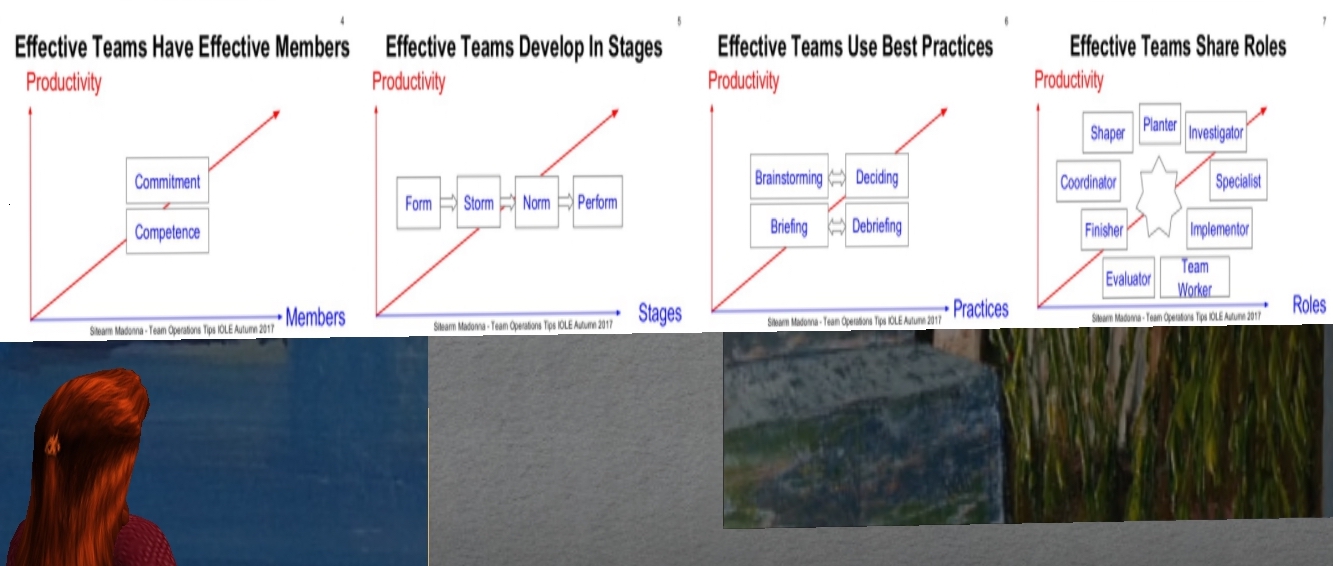
Sitearm started by asking us all to think of a time when we felt good about working on a team and to write down one word that would remind us of the experience later in the class. We were also asked to repeat the exercise for a time we had negative memories of a team. He emphasised that teams generally get projects completed, no matter how badly they perform. The aim is to continually strive to achieve better outcomes by supporting team development. This starts by building commitment and competence. Team members need time to get to know one another informally, in addition to the formal engagement, so they can perform effectively together.

Best practice for building teams that produce results.

Recognising the stages of team development is essential for managing time and ensuring that all members can contribute meaningfully. Each stage requires a different type of input and engagement. For example, when the team is in the ‘forming’ stage members may need to spend more time working together to develop cohesion whereas the ‘performing’ stage might require each member to complete their own contribution independently. Sitearm also described the practices of team work: brainstorming, deciding, briefing, and debriefing – explaining when and how to activate each one. Throughout all of this team members will constantly play different roles. When decisions need to be made it is important to have someone in the role of ‘coordinator’ or ‘shaper’ whereas ‘specialists’ and ‘team workers’ are essential to putting the project into production.

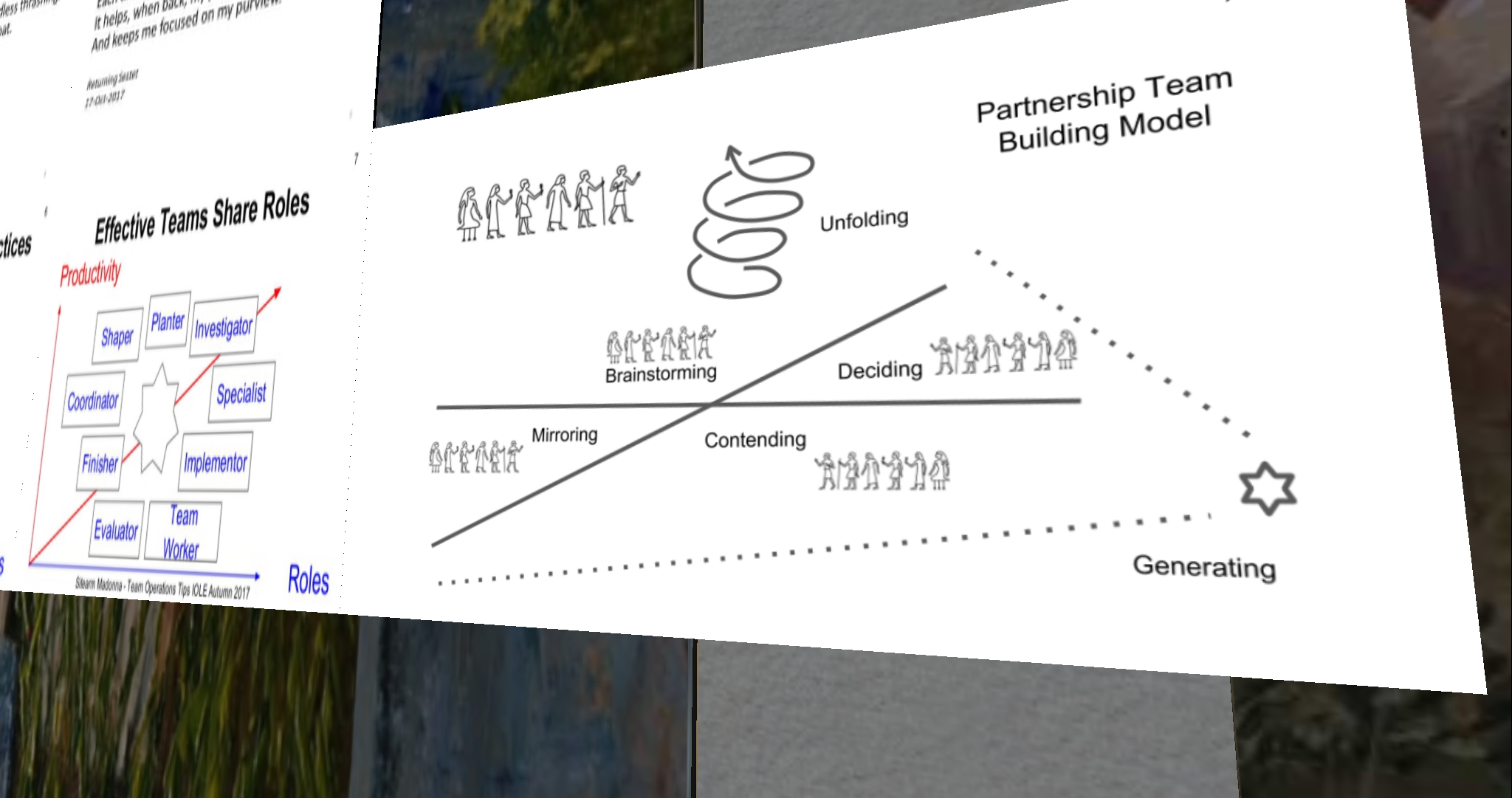
Partnership team building model.

Sitearm concluded by showing us his newly developed Partnership Team Building Model. It demonstrates the work a team needs to do in order to reach the goal of generating an outcome.

Following his presentation Sitearm asked for contributions based on his questions at the beginning of class. There were many good examples given such as Aestheicant’s experience of a team that worked well because everyone felt able to amend and improve on ideas; EvaKKCara’s satisfaction when a committed and hard-working team gained a tangible outcome at the end of the process; hummush’s comment that all members helped each other on different aspects of the project brief so all felt very well informed on the aim of the project; and JCraig1988’s discovery that his opinions and ideas tended to broaden out the more he worked on a team. Equally enlightening were the examples of negative team experiences: Alik98 recalled the embarrassment resulting when the lack of communication among team members led to a disjointed and terrible presentation; robadamson was dumbfounded when team members that didn’t show up for any meetings were shocked when they received no credit for the final piece of work; YuwenXing remembered the huge amount of additional unnecessary work that resulted from an unclear division of tasks. Everyone shared experiences and examples that demonstrated the importance of preparing appropriately for team projects and continually monitoring the health of the team.

John thanked Sitearm for a very interesting and informative talk and complemented the students on your engagement with insightful examples and reflective responses. Sitearm provided this link to the slides he used for the talk. Here is an edited version of Sitearm’s talk:

Many of you hadn’t picked up on the Project Teams announced on Brightspace this week so here are the details again. Please make contact with each other and read the preparatory material for next week’s class where we will consider the brief for the Team Project.

Project Teams.

h1

Class 2: Blogging to the world

February 14, 2019

This week’s class started with John asking if anyone had visited SL since the last class to complete the assignment. Everyone said they had done so. Then you were reminded that you should send a link to your blog to John. Remember that the first assessment takes place after Class 4 and counts for 20% of your final mark so it is worth getting your posts written on a weekly basis.

We continued by talking about writing to your blog. John explained that regular posting will help your confidence in writing and at the conclusion of the module you should have experience of writing in an accountable manner. We discussed the different voices available: descriptive, narrative, reflective, critical and analytical; along with the importance of references and citing from the module reading lists. Finally, the importance of proof-reading before publishing was emphasised.

Then John asked if some of you would present your bios (About me pages from your blogs) just to get some experience expressing yourselves with voice in SL. Aestheticant volunteered and after sharing a considered bio told us she would be updating it for next week. Nobody else had a bio prepared so it was agreed that you would be ready for next week.

After that we all left the classroom and moved out to the garden to talk about the practicalities of work in on online environment. You agreed that while avatars gave some animation and life to our engagement they fall far short of providing the kind of cues we are used to in Real Life. The ability to read body language is completely missing, as is the subtlety of mood changes and loss of attention. Therefore it is very important to make up for this by presenting cues explicitly. The use of emojis and emoticons arose in response to this realisation. In SL we have already seen that giving regular feedback is necessary. The point to remember is that any virtual space is much less conducive to accurate communication than Real Life so we need to make a conscious effort to address the shortcoming. Each environment will have its own conventions and etiquette and we need to be aware of the importance of learning these and abiding by them.

h1

Class 1: Welcome to SL

February 8, 2019

A new year, a new university and a new class group.

Everyone gathered promptly at 8:00 pm in TU Dublin’s SL campus for the first class of 2019. All students were set up with their shiny new avatars, voices activated and ready to learn – a really great start to the module!

We started off by making friends with each other. This enables us to see if class members are online in SL and to communicate by text when someone is in a different location in SL. John also invited you to join the module group so you are registered as module participants. This will allow you to access the classroom building and also supports notifications and other group communication. John also confirmed everyone’s SL name and matched it to your Real Life (RL) name and student number.

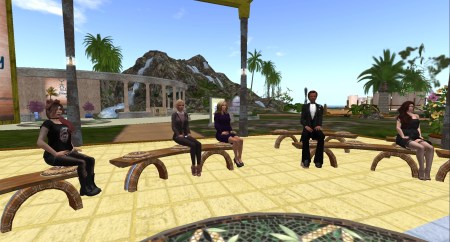
Then we all trooped out to the balcony to stretch our legs (well, our avatars’ legs) and took the class photo. This demonstrated that you all have a high level of avatar dexterity – you would be surprised how difficult it can be to get avatars to post for a photo!

When we settled back into class John talked about the format of the module. Class time is for discussion and, to prepare for that, you will need to read the assigned texts (or view the videos) in advance. This will ensure the discussion is informed and reflective. You will also need to plan for visiting SL between classes to complete the assignments and, after class 4, work on the Team Project.

While we didn’t discuss online etiquette explicitly you were all very good at giving confirmation of your presence, for instance, typing ‘Y’ when asked if you understood what was being said. Avatars do not do body language very well so positive reinforcement is something you need to be aware of constantly. One of the easiest and most immediate ways of providing feedback is through text messages in ‘local chat’. For example, you can type ‘Acuppa Tae nods in agreement’ or ‘coldtoesies has a puzzled look on her face’. This approach supports the discursive nature of the class and ensures everyone remains engaged.

The new Virtual Learning Environment at TU Dublin, Brightspace, is being piloted for this module so John asked for feedback on how it is working – feel free to be as critical as you need to be. Review the section for the next class well in advance to familiarise yourself with the content. Use the short quizzes to check if you understand the topic and don’t forget to do the assignments set after each class meeting.

Finally, John reminded you that while these class summaries are useful they do not replace class attendance!

h1

Spring semester 2019

January 31, 2019

Welcome to the module ‘Virtual Environments: Is one life enough?’ being offered as an elective module to students of the Dublin School of Creative Arts.

The first class meeting will be on Thursday 7th September at 8:00 pm. We meet online every week at TU Dublin in Second Life. Please note: you will need a Mac or PC desktop or laptop to access SL – you cannot do so with a mobile device. If you are new to Second Life, known as SL, then start by reading Getting into Second Life to find out how to access the class. You should then visit SL and find the TU Dublin campus, learn how to get around the virtual world and familiarise yourself with the environment and how to control your avatar. This will take a few hours so give yourself plenty of time before class starts.

Please read pages 1 to 9 in the column on the right also. If you would like to find out more about what to expect during the semester read the posts in this blog: all class since 2009 have been summarised.

If you have any problems email John O’Connor.

h1

Class 11: Project presentations

December 13, 2018

Locks Aichi joined the class for the presentations by each team this week. A variety of approaches was taken including YouTube videos, Google Slide show to illustrate presentations in the classroom and finally, a visit to another location in SL which did not turn out as expected. The group gave us a link to a shopping centre to open their talk with a demonstration. Unfortunately, the owner was online when all thirty of us teleported there simultaneously and she assumed it was a griefing attack! After some serious confusion and much swearing on her part we returned to DIT. An explanation was sent to the shopkeeper by IM and the incident was concluded without any further rancour. It provided an excellent learning opportunity for the final meeting of our group – always ask permission before visiting someone else’s virtual space with a group – much as you would in Real Life. To be fair to the student team it had visited the location during the week and found it deserted and quite reasonably expected the same for our visit.

All teams presented with confidence and obvious preparation. Some presentations seemed more of a team delivery while others came across as a collection of individuals’ ideas but in each case the content was considered, coherent and relevant. Following the presentation each team answered a few questions from John and Locks and explained what tools they used to facilitate their group work.

THINGS TO DO TO COMPLETE YOUR ASSIGNMENT:

  1. Write the tenth post: to your blog reflecting on your team project presentation.

Blue team: PSS12, sarahmurph, RahaJamal, mclmichelle, LukeBob75 and EvoCall.

Green team: LouHug, haithanhnguyen, EmKoz1, NadsCore18, ShaunaHarkin and RoseDuong.

Red team: bennagle, ollyrobyn, Ruifeng Wang, clionabray, PeterKeane and hughkavanagh.

Mauve team: CiaraHoward, OPrincess, zoeobyrne, J98Carey, Assesi and marevatin.

Yellow team: Muriel001, JonathanBK, Whimseyy, maeveobrienny, JeromeZZC and Cmragasa.

h1

Class 10: Preparing your presentation

December 6, 2018

Uploading images to Second Life

This week we looked at how you might present your projects in next week’s class. John suggested that you may do this in the classroom in SL simply through voice, with each team member delivering part of the presentation in order; or you could do it in any other location you choose in SL (but be careful to ensure voice works – it can be shut off in some locations); you could include slides to illustrate the presentation; you might create a video in YouTube or Vimeo and give us a link on which to view it next week; you might act out the presentation in SL; or decide on any other approach that you think gets your message across.

We looked at importing images into SL to use on slides. Firstly, you need to ensure you have selected the module group. This gives you permission to build in the classroom. We created slide boards. Then John gave some of you L$200 so you could import images. Don’t worry, this is worth less than US$1! It costs L$10 to import an image which can then be dragged from your inventory folder to the presentation board, as required. We tried this out a few times to make sure everyone could do it. You were asked not to litter the room with too many boards and to clean up after you are finished.

If anyone else needs some L$ to import images just let John know via the Facebook page. And, indeed, if you have any other questions about the presentation ask them on Facebook too – that way everyone will benefit from the answer.

We agreed on the following order for the presentations:

Red Group; Green Group; Blue Group; Mauve Group; Yellow Group

Each group has between five and ten minutes, so including set up time and allowing for the inevitable glitches, it would be wise to allow some extra time for class next week – we might run on until 9.30 pm.

John reminded you all that you will be required to write two more posts to your blog. One this week describing your final preparations for the presentation and the final one after the presentation, describing how it went and your final reflections on the project.

Some participants have not yet submitted a link to their blogs. If your blog is not listed here it means I have not seen it and will be unable to assess it so send me your link immediately.

THINGS TO DO BEFORE THE NEXT CLASS:

  1. Write the ninth post: to your blog describing your final preparations for the group project presentation.
h1

Class 9: Walking away…?

November 29, 2018

Ursula K Le Guin, author of The Ones Who Walked Away From Omelas, 1973. Photograph by Benjamin Reed in 2008 from the obituary by Margaret Atwood in the Guardian 24 January 2018.


Glenn Loughran, lecturer in Fine Art and Programme Chair of the BA in Visual Art on Sherkin Island joined us this week. He took us through Ursula K Le Guin’s short story The Ones Who Walk Away From Omelas in a way that gradually revealed the rich ideas contained in the story. Glenn suggested that there are many questions to work through in the text but began by asking for  reflections on the first part of the story and the sense of the world presented by Le Guin. What is the atmosphere, the underlying theory presented? It was agreed that it is a happy and peaceful world; it feels like a fairytale and has an old-fashioned quality. The community lives a simple life but could have technology if it wanted to – it seems to have consciously rejected that option. Did anything in the description give a sense that it is too good to be true? What is the philosophy of the community? Glenn suggested that it could be seen as an expression of Utilitarianism described by 18th Century English philosopher Jeremy Bentham and developed in the 19th Century by John Stuart Mill.

The relationship between the narrator and the text in the story is not fixed, with the narrator seeming to slip in and out of the story. This literary technique keeps the timeframe ambiguous: it could be past, present or future while also not revealing who the narrator is. It even sets up an ambiguity about who the reader might be. Why does the narrator say that the people are happy but also sophisticated? They are not banal but complex human beings living in a highly-developed society. Some of you felt that Omelas is a fake perfect world because it is one-dimensional but it was agreed that it is a society that has determined its own way of being.

Then Glenn asked what the turning point of the story is, suggesting that the community is conditioned by something. It took a while to arrive at the conclusion that the introduction of The Child turned the utopia into a dystopia. The child is kept in a degraded way and its situation never changes. Most importantly, everyone in Omelas is aware of the child’s existence. This is the condition on which the perfect society is founded. While everyone is shocked initially they eventually come to accept the condition. Why do they accept it? The Deal.

The moral dilemma at the heart of the text is how the community resolves the condition of the child on which its comfort is based. If we review this element of the story as an analogy to the world in which we live today the child becomes, for example, the slave labour that produces the commodities we use daily. They are frequently manufactured in conditions of oppression and dejection by what Marx described as alienated labour.

Are we aware of this? Do we know? Should we know?

On another level the analogy may be read as the dominance of one country over another or one continent over another – the Western World over Africa, for instance.

In conclusion, is it wrong to walk away? Many of you felt it is wrong and suggested it is refusing to take responsibility. The story makes you ask yourself if you would stay or walk away. It is not an easy decision. Nor is is easy to consider the consequences of either action.

Returning to the opening question of the text – can we escape technology? Again, many of you felt we are too used to it and would be reluctant to give it up. But, you did go on the demonstrate an awareness the impact of digital technology and, indeed, are taking action to limit your engagement. You talked of taking deliberate breaks from your phones, closing down computers so that you can read undisturbed and free from distraction, and you spoke of being aware of the influence of technology over your emotional state.

Glenn explained that many digital devices have inattentiveness built in. They are designed for a certain kind of hyper-attention which is why they can be difficult to turn them off. He referred to Stiegler (who we met in class 4) and his proposition that technology is both a poison and a cure, describing it as a pharmakon. The point is that technology is inherently neither positive or negative: we negotiate this position on an ongoing basis through our choices on when to engage and disengage.

After thanking Glenn for leading a very stimulating discussion and complimenting you all for engaging so thoroughly John suggested that it would help inform your preparation for the project. There were some questions about how the project might be presented. It is entirely your own choice. You may have your avatars present verbally, as we do in class; or through a written text; you may take us all to any other location in SL or use the classroom; you can direct us to a slideshare webpage or even produce a YouTube video. It is also possible to bring images into SL to support your presentation. It was agreed that we will devote next week’s class to discussing your options and describing how to achieve some of the effects you might want to try out.

THINGS TO DO BEFORE THE NEXT CLASS:

  1. Read: the summary of last year’s class discussion on this story and some insightful analysis by Mook Wheeler.
  2. Work: on the presentation for your Group Project.
  3. Write the eighth post: to your blog describing your final plans and preparations.

ADDITIONAL READING:

  1. For some context on Karl Marx’s theory of alienated labour read Anatomy of an AI System, by Kate Crawford and Vladan Joler. Their essay uses the Amazon Echo to describe an anatomical map of human labour, data and planetary resources [accessed on 29/11/18].
  2. To read more on the effect on attention by digital devices see Hyper and Deep Attention: The Generational Divide in Cognitive Modes by N. Catherine Hayles in 2007 [accessed on 29/11/18].
  3. Relational Ecology and the Digital Pharmakon, 2012, by Bernard Stiegler is a good introduction to the author’s ideas.
h1

Class 8: Content and the Produser

November 22, 2018

One of the links to the reading material for the week was broken so John gave the class some time to catch up before getting into the discussion around content creation and the concept of ‘produsage’ proposed by Prof Axel Bruns.

We spoke of the changes brought about by the migration from the print medium to digital. One of the principal outcomes is the shift from mediated content, where ‘gatekeepers’ such as newspaper editors, publishers and so on, commissioned and controlled the flow of information to the public. Digital media has eliminated this necessity – authors are now free to connect directly with their readers and viewers through blogs, YouTube and even sites like Wikipedia where the public is invited to edit contributions. As a result, consumers of news and information are required to be their own editors. We need to be more discriminating in our consumption, unable to rely on the frame of reference that was previously provided by knowing the perspective of the newspaper we read, for instance.

Bruns’ proposal is that the web has facilitated the rise of new types of collaborative communities that require a new word to describe their activities:

Produsers engage not in a traditional form of content production, but are instead involved in produsage – the collaborative and continuous building and extending of existing content in pursuit of further improvement. –produsage.org

John suggested that your own blogs are another example of content creation. The ubiquity of the internet supports the niche interests in a way that mass media publishing never could. The extremely low cost base means that anyone with access to the web can share their interest with like-minded individuals and develop a community.

Finally, I referred to the question of value. Does all content have value? How can content developers monetise their material? How can you protect it? For more on copyright read the post from this time last year A Word about copyright.

THINGS TO DO BEFORE THE NEXT CLASS:

  1. Read: the short story The Ones who walk away from Omelas by Ursula K Le Guin, 1973 [accessed on 24/11/18].
h1

Class 7: Privacy

November 15, 2018

We started this week with a discussion about your blogs with some general feedback on how you are getting on. John presented the assessment criteria given in the rubric again describing each one and drawing your attention to the weighting in particular. I stressed the benefit of smart working – don’t spend time doing work that will not contribute marks in your assessment. Be clear on what the criteria are and address them in your work. In this context the the content and creativity of your blog is weighted at 40% with your voice (or writing style) and design both weighted at 20%. Remember that.

We also considered what you should be writing about. You identified the instructions given in the ‘Things to do before the next class’ section of the class summaries. Each week you are given a topic to write about and these are usefully numbered from one to six (so far). This is the minimum number of individual posts you need to write. You should also be writing about the discussion topic for each class and the progress your team is making on the group project. I complimented you on the use of illustration in your blogs. This adds variety and keeps your posts interesting. Don’t forget to caption and credit any images. While the writing style common to blogging is conversational don’t allow it to be too casual. Remember to maintain an academic rigour in your references and vary your style from descriptive to reflective and critical as necessary.

There was a request for individual feedback on your work to date and I offered to meet you in SL after class or at another time that suits you. Let me know through email or the Facebook page and we can make arrangements. The first meeting was scheduled to take place after this class.

The topic for the second part of class was that of privacy. We spoke about the enduring nature of online activity and how things that you might have forgotten can return at the most unexpected times. The individuals referenced in the reading from last week lost their jobs as a result. I was a little surprised to learn that in your social circles you don’t appear to have conventions concerning the appropriate use of social media although, a few of you said that sometimes a group might agree not to post photos of an event without permission.

Image 16-11-2018 at 12.39

Social media app that offered privacy.

I mentioned the social networking app Path which was marketed on the basis of its respect for privacy. Working along the lines of Facebook but limiting the number of friends to 50 it was a good solution for families, providing a safe and secure space for networking. Strangely, it was unable to monetise this USP sufficiently and was forced to close down last month after eight years in operation.

THINGS TO DO BEFORE THE NEXT CLASS:

  1. Lecture: watch From Prosumer to Produser: Understanding User-Led Content Creation by Prof Axel Bruns (Creative Industries Faculty at Queensland Institute of Technology) who explains his theory of user-led collaborative content creation [accessed on 16/11/18].
  2. Read: Produsage– A Working Definition by Prof Axel Bruns [accessed on 16/11/18].
  3. Write the seventh post: to your blog with an update on the progress (or lack thereof) your team is making with the group project.