Author Archive

h1

Class 11: The crit

April 26, 2017

The show of student art work this week was very successful. Each student exhibited one piece of art and, led by Glenn, presented it to the class; explaining the origin, inspiration, context and production.

Treasure Ballinger and her colleagues from Virtual Ability Island and Cape Able Gallery joined us and shared their responses to the work. The range of work was impressive, as was the relationship with the theme of the module this semester.
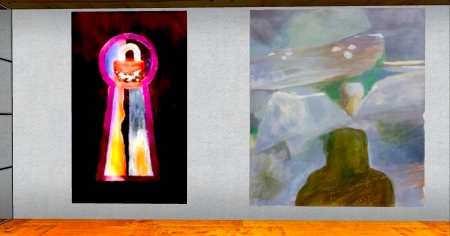
Snapshot_002

From left: AlxMway’s acrylic is a view of Schull from Sherkin through a keyhole; Yashurdoshur painted her reflection looking down on a still pool of water as a symbol of Utopia.
Snapshot_001

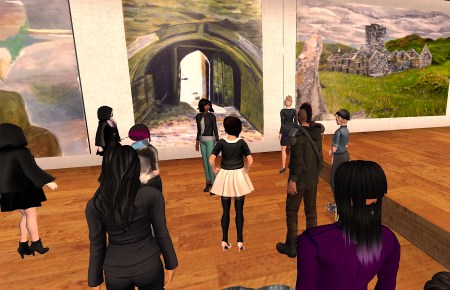
jackmittens’ painting of the archway within the walls of the Abbey on Sherkin Island – you are neither outside nor inside.
Snapshot_005

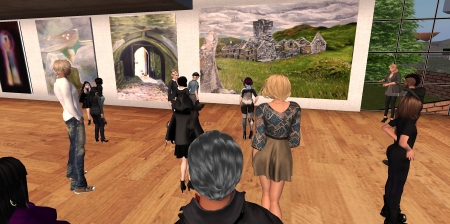
Fayebubba painted the Abbey from a photo – measured by points on the buildings.
Snapshot_013

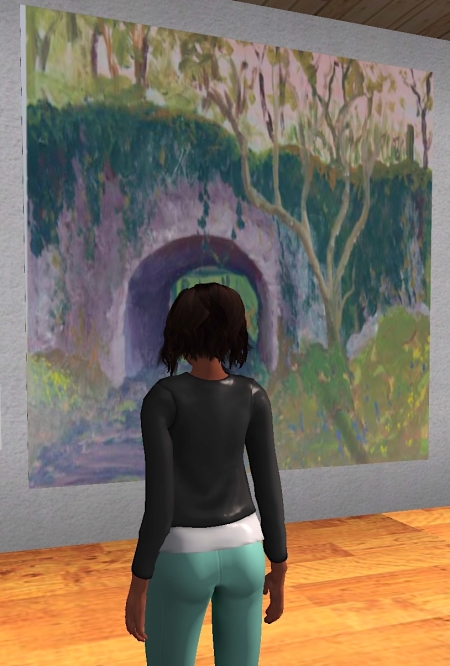
Shadidame seems to be walking under Saoise’s fairytale bridge over a stream near her house. The fact that it seems like a road yet is a river gives it a heterotopic quality.
Snapshot_003

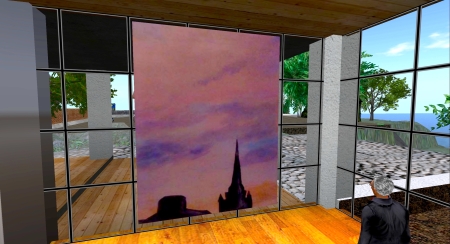
Unfortunately Inchydoney was having trouble with the internet connection and was logged out before she could present her intriguing painting.
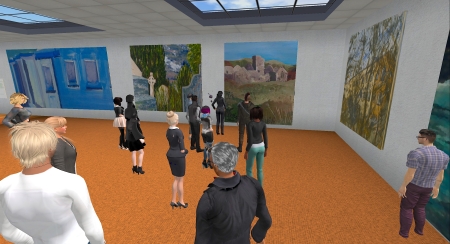
Snapshot_016

From left: ChipVanCorner’s painting of the community hall in Sherkin; whatyamacallit’s Mocollop graveyard in Co Waterford; Burnsygirl’s painting of the Abbey is a reminder of her great grandparents buried in a similar place.
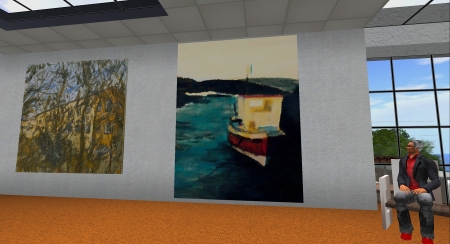
Snapshot_007

Left: Shadidame’s heterotopian space of crisis and deviation – Retirement Home. Right: freddymcfreddy’s Boat.
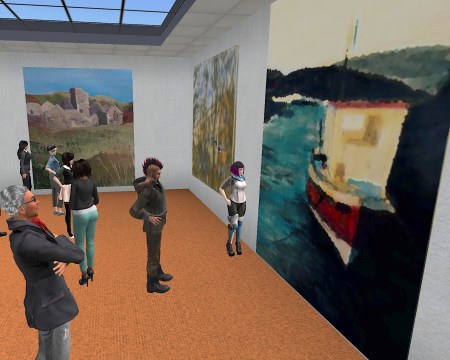
Snapshot_020

freddymcfreddy was inspired by Foucault’s description of a boat being the ultimate heterotopia: a floating piece of space, a place without a place, that exists by itself, that is closed in on itself and at the same time is given over to the infinity of the sea.
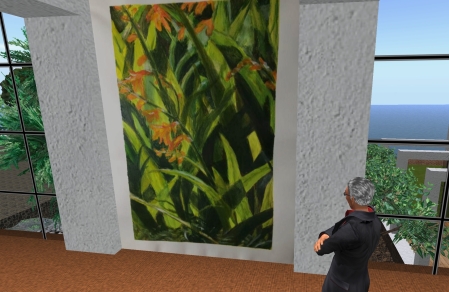
Snapshot_006

Deeuwan’s acrylic of her garden, a heterotopic ‘other’ place for festivities apart from our home.

Glenn, John and Locks complimented you all on the show – it was very impressive that you were able to mount it so successfully. The work was a thoughtful response to the readings this semester and you all presented confidently. Well done!

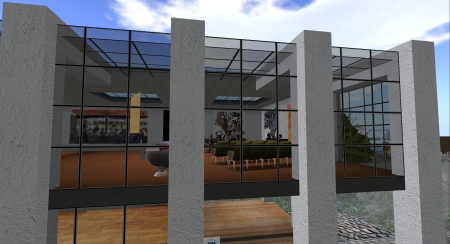
Afterwards we all teleported to Cape Able Gallery where Suellen Heartsong’s SL photography show is on. Gentle Heron was there to greet us and Slatan Dryke razzed some of his moving photographs and dynamic sculpture on the lawn (see more on his website). iSkye Silverweb showed us one of her interactive sculptures, more of which can be seen at Ethnographpia in SL.
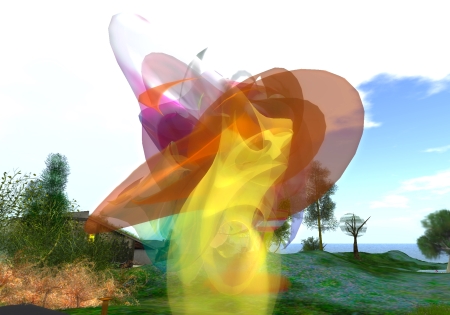
Snapshot_021

A moving airborne sculptural work by Slatan Dryke.

h1

Class 10: Teamwork

April 19, 2017

There was a healthy turnout for class this week, despite the Easter break. The issues affecting voice in SL appear to have been resolved, although some participants were still having difficulty.

John explained that due to an unexpectedly busy period before Easter he had been unable to make arrangements for Sitearm Madonna to join the class this week. Site has frequently presented on teamwork, particularly in the online context. We will try to arrange a visit from him before the end of the semester. In the meantime, John presented the lecture on teamwork based on Site’s slides for Team Building Tips. If you missed the class review the slides and talk about the content with your team partners.

We had an interesting discussion based on our own experiences of team working. We compared that to the theory and put particular emphasis on the fluid nature of collaboration. The stages of team development are not necessarily linear and so teams can move between Forming, Storming, Norming and Performing and back again in almost any order. Similarly, the roles required for a successfully performing team may be taken on by different team members at times. The theory is useful to guide teams as it provides a structure but it must be seen as a useful guide rather than a rigid set of rules.

h1

Group project: Digital Skies

April 6, 2017

For this project you are required to create a single artwork as a member of a team – a large-scale group canvas. Each individual team member will research and generate their own images which will be combined by the team into a final composite image for exhibition in Cape Able Gallery. The exhibition will open in late May on a date to be announced.

Digital Skies

Digital Skies: Art and Utopian Thought

For the opening of the exhibition each group give a short talk to present their work, and discuss the experience of working in a team, virtually, collaboratively. This will be followed by a crit.

Each participant must also describe the progress of the project in a weekly blog post with particular emphasis on their contribution to the project. (What are you bringing to the group and how does it fit into the team’s work?) Discuss the details of the project and also the issues that arise in working collaboratively online. How easy is it meet up virtually and plan the project? What difficulties arise in development? How easy or difficult is communication? What particular problems arise and how do you deal with them? Focus on the experience rather than writing a ‘correct’ post or having an answer for every difficulty.

See page 6 Module assessment for assessment criteria applying to this project.

h1

Class 9: Assessment

April 5, 2017

Glenn and John took the class through the requirements for assessment, which is divided into two parts. Firstly, the group project and secondly, the individual blogs.

Firstly, each participant will be producing a series of digital paintings as part of their main module. For the SL module you will produce a large-scale group canvas (in the groups given in week 3). We are asking you to collaborate on a canvas to give you the experience of working on an online collaborative project. You will bring the finished canvas into SL for a group crit and exhibition.

The exhibition will take place in Cape Able Gallery on Virtual Ability Island in May (provisional dates are 17 or 24 May). A team from the class (burnsygirl, freddymcfreddy and whatyamacallit) will coordinate the exhibition with the curator of the gallery and will also invite residents of Virtual Ability Island to take part.  Part of your learning in this module is figuring out how to work virtually with people you have never met in RL.

Each group will give a short talk to present their work and discuss the experience of working in a team, virtually, collaboratively. This will be followed by a crit.

There will be a dry-run in DIT on 26 April. You will show your work in progress more to get a feel for exhibiting in SL than anything else. John suggested that you should review the module website to see how past student groups have presented their work.

Secondly, you will be assessed individually on your blogs. You need to ensure that you have made the five mandatory posts as described in the ‘Things to do before next class’ section of each class summary. Following that you should have at least five more posts describing your engagement in the group project.

Finally, 50% of the marks for this module go on the group project and 50% go on the individual blogs. For full details see page 6 module assessment.

h1

Class 7: Akron Island

March 22, 2017

The class visited the University of Akron island in Second Life this week. We were hosted by Prof Dudley Turner (aka Dudley Dreamscape) who took the module some years ago and then co-taught it with DIT for a number of years. Many of you also met Dudley at the seminar for National Digital Week in the West Cork Arts Centre last November. Unfortunately the problems with voice in SL have persisted so the class was conducted in nearby chat text.

Dudley described the origin of the island. When it was planned the faculty wanted to make sure there were a variety of areas for small group gatherings. These are scattered around the island. Originally there weren’t any big classroom spaces but Dudley built the larger lecture hall type space for larger meetings as the requirement grew. The learning spaces include a tree house and a glen with its own waterfall. Glenn noted that the rural design was reminiscent of the hedge schools that sprang up around Ireland under the Penal Laws.

Akron

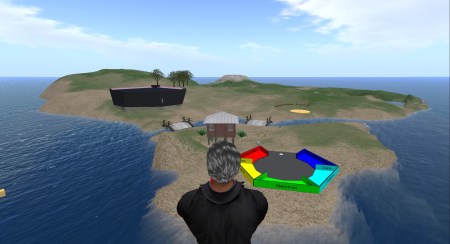
Akron Island with the life-size pie chart maker in the foreground.

We moved to the life-sized pie chart maker for a discussion on virtual identity. As we were forced to chat through text this was a useful to device to encourage debate. The facilitator (me, in this case) asks a question. Participant avatars then move to the appropriate section: Strongly Agree, Agree, Neutral, Disagree, Strongly Disagree and a pic chart is built in the centre. We worked with the following questions:

  1. Do you think you share too much online?
  2. Do you know who is watching you online?
  3. I would be happier not to have social media apps
  4. I keep my business and personal stuff separate online.

The second question resulted in discussion around free apps and the ‘price’ we may unwittingly pay. Chip Van reminded us that if it is free we are the product. In response to John’s question if people feel in control of their online information Inchydoney suggested we tend to throw caution to the wind for the sake of convenience. However, there was an acknowledgement that different age groups are behaving in different ways online.

The discussion around social apps resulted in many comments about ‘addiction’ to the buzz from them. Yet everyone agreed they were useful for keeping in touch when physical distance is an issue. Once people have met in RL the online engagement can be more satisfactory.

The class meeting finished with thanks to Dudley for hosting us at Akron Island and an invitation for him to join us in Dublin anytime.

h1

Class 6: Discussion

March 15, 2017

Following on from last week the group discussed the visit to Virtual Ability Island. It seems that this experience had a deeply affective impact on most of the group and for whom the second life environment has taken on a whole new meaning. There was a lot of discussion about the benefits of the virtual world for individuals with disabilities, how the community has created a social space that supports engagement with others, conversations, showing art, providing information and to move about freely. Whilst many in the group felt that Virtual Ability Island was like a utopia for the community that engage with it, it was also suggested that it could be seen as sad that the participants needed to create an alternative social life due to the limitations in real life. Another way to think about this issue might be that instead of feeling sorry for themselves or complaining about their limitations or lack of access the community has been affirmative and residents get on with their lives creatively and constructively in SL as opposed to accepting limitations. In many ways, this might be one of the most therapeutic aspects of Virtual Ability Island, that it is an active creative space, a space of human subjectivity and agency against the odds.

Within this discussion, the group touched briefly on the possibility that the aesthetic dimension of SL might also have a complex sensorial value for the Virtual Ability community, and it was on the back of this conversation that the group proposed a brief exhibition of their Digital Skies work in the Gallery in Virtual Ability Island. John has agreed to discuss this possibility with Gentle Heron and it would be a great event to share with that community. Burnsygirl, freddymcfreddy and whatyamacallit volunteered to liaise with the community and see if artists from Virtual Ability would like to take part also.

Finally, the group briefly discussed Richard Noble’s Lecture: The Politics of Utopia. Some of the key discussion points revolved around the tensions in utopia artistic practices between autonomy and instrumentalisation, which provoked questions concerning the use of art as a social-political form and the function of art and aesthetics as political in and of itself.

h1

Class 5: Virtual ability

March 8, 2017
Snapshot_008

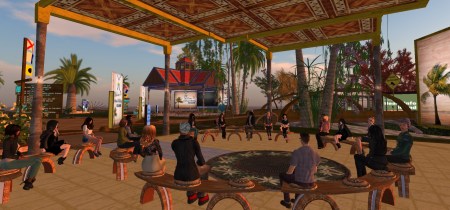
Gentle Heron introduced the class to Virtual Ability Island.

This week the class was hosted by Gentle Heron in Virtual Ability Island. Comprising three islands, the community (of over 1,000 people from six continents in RL, and growing all the time) supports and enables people with a wide range of physical and mental abilities to thrive in online virtual worlds. For many, SL has become integrated with their RL. Gentle introduced us to some members of the community who spoke of this experience, Mook Wheeler, camaro and Eme Capalini. Although disability may be less apparent in SL where, for example avatars can walk even though their human counterparts may need a wheelchair, those with visual or hearing impairment require particular consideration.

The principles of universal design and access for all underpin the development of the environment so that colour schemes, landscaping, materials and access all promote integration – there is no segregation between the able and the disabled. You won’t find any stairs here, only ramps, colour schemes are soothing to promote calm stress-free engagement and support those with visual disability, while speech is accompanied by text in local chat so those with hearing impairment are not disadvantaged. The Virtual Ability website is worth a visit if you would like to read about the history and development.

Snapshot_010

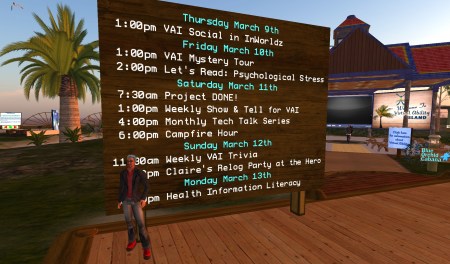
There are many activities, supports and exhibitions in Virtual Ability Island.

Mook, a former academic with a doctorate in a social science field, has Aspergers and manages clinical depression and anxiety. Mook described ‘being an autistic social scientist as somewhat of a paradox: trying to understand the production/politics of subjectivity without being able to negotiate it in a personal or practical sense, for the most part.’

Eme and Mook told us that in SL they can leave the ‘difficult’ parts of their lives behind in RL. In fact, Mook’s avatar has evolved away from human form to become a sphere with various attachments and bubbles because ‘being human brought too much of RL’s physical difficulties and memories into SL.’ In fact, a lot of people in SL are not aware of Mook’s autism whereas they would be fully aware of it in RL.

We had a fascinating and enlightening discussion exploring and comparing experiences. Gentle commented that people with disabilities often experience a lack of respect in RL and asked if it also happened in SL. Burnsygirl told us of her experiences as a teacher with a disability organisation in RL and how people would pat her students on the head as if they were pets.

Acknowledging the theme of the module Mook said that ‘SL is perfect for me, as close to a social and communication utopia as any medium can be for me, because I can talk (in type) to people without having to deal with their physical presence or eye contact … I can adjust all of SL’s settings, avatars, environments, visuals and sounds to accommodate my sensory needs. SL is a space of pleasure, interaction and comfort to me which RL cannot duplicate.’

Mook also shared her insightful and searing analysis of Le Guin’s short story The Ones Who Walk Away From Omelas which is well worth reading! [Note: this has been updated with with additional comments on 30 November 2018]

We all appreciated the generosity of Gentle, Mook, Eme and camaro for taking the time to welcome us to their community and share their experiences. It really exemplified the possibilities and opportunities offered by this technology. Gentle said we were welcome back anytime – the islands are open to the public. Many of us remained after class to explore and chat.

THINGS TO DO BEFORE THE NEXT CLASS:

  1. View: The Politics of Utopia by Richard Noble, professor and lecturer in Fine Art at Goldsmiths. From Utopia Revisited conference at ARKEN Museum of Modern Art, 2011.
  2. Write the fifth post: to your blog reflecting on our visit to Virtual Ability Island and the notion of a virtual Utopia.
h1

Class 4: Walking away

March 1, 2017
snapshot_004

Looking in on the discussion from the outside.

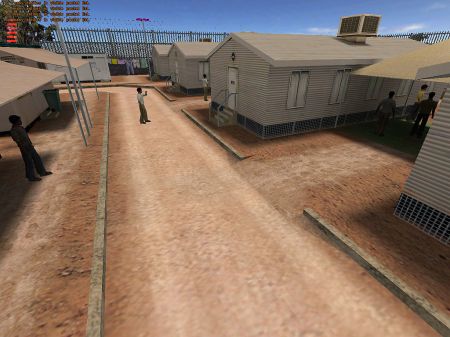
Last night was the fourth Digital Skies session with the group and it was the second theory-based session after we looked at Stephen Duncombe’s intro to Sir Thomas Moore’s Utopia in the first one. This week we updated the concept of Utopia by reading Ursula Le Guin’s text: The Ones Who Walk Away From Omelas (1973). A deeply provocative rendering of a Utopian society that is conditioned by a darker reality, the picture painted by LeGuin in the text falls between Utopia and Dystopia. By implying that a perfect society will always be structured by some kind of exclusion or exploitation, Le Guin draws a parallel between the fantasy of Omelas and the social economic order that has dominated since the industrial revolution. It seemed that for most of the participants in the group the story was an analogy of contemporary democracy and the ethical challenges of living in a globalised economy. Whilst much of the discussion focused on the moral dilemma faced by those citizens in Omelas there was also an ambivalence towards their final response, the act of ‘walking away’. In many ways we could argue that this is a negative response to the situation, an abandonment, however by refusing to be a part of the situation, to leave it and go towards the unknown, we could say it also is a utopian act. It may not be Utopia in the macro sense of the word, as in the creation of a new society, but rather in those micro acts of freedom that happen in everyday life and that have the potential for greater change. Anyone interested in following this train of thought could look into the work of Avery Gordon who is developing the Hawthorne Archive which sets out to ‘record the living and intellectual history of the arrival and existence of a group of runaways, secessionists and in-differents who form autonomous zones and settlements and have receded from living as obedient (and also resistant or resisting) subjects’. Further within this discussion, an important point was raised about how one might even begin to imagine resisting in an overwhelmingly oppressive situation, such as the Nazi Regime, and a reference was made to the White Rose student movement, as an example of non-violent resistance, which led to a discussion on a more contemporary (and virtual) act of resistance in the online critical game Escape from Woomera.

Escape_from_Woomera_3.jpg

Escape From Woomera. 2004

As can be deduced from this summary, the session got a little dark as the group entered into a deeper discussion on the politics of the utopian imagination. We will lighten this discussion a bit in the next session by looking at a lecture by Richard Noble on ‘The Politics of Utopia’. All being well, we will be joined in this session by German Artist Susanne Bosch who will talk about her residency at the Utopia Festival in Austria in 2015.

Finally, each student was asked to send in some landscape photos of their travels in second life, these will be used on Sherkin Island to develop a series of visual investigations around the question: what is nature? We might try to show some of these works in second life in the next theory session.

It was really great to get over most of the technical issues the group have been having and to focus on the content of the course. Last night was a very impressive discussion to have on a Wednesday evening with a bunch of weird looking avatars (No Offence!!).

Next week will be led by John and below are the requirements for this session:

THINGS TO DO BEFORE THE NEXT CLASS:

  1. View: Fake It – to control your digital identity. In a 2013 TEDx Oxford presentation Danish journalist Pernille Tranberg, who wrote the book Fake It – Your Guide to Digital Self-defense with the German journalist Steffan Heuer, explains what happens with your data, what it can cost you now and in years to come.
  2. View: The Power of Privacy. In this 2016 film by The Guardian, Aleks Krotoski travels the world to undergo challenges that explore our digital life in the 21st century. Watch her be stalked and hacked, fight to get leaked documents back, dive into open data and live in a futuristic home that monitors her every move.
  3. Read: Who’s watching me on the internet? Technology Correspondent for the BBC, Rory Cellan-Jones writes about our digital footprint and explains data trails in iWonder 2016.
  4. Write the fourth post: to your blog reflecting on the discussion of The Ones Who Walk Away From Omelas. Ursula K Le Guin. 1973.
h1

Class 3: Teamwork and collaboration

February 22, 2017
snapshot_001

Open discussion about places students visited in SL since the last class.

Locks Aichi, formerly of the DIT Learning Teaching and Technology Centre and who has been teaching the module since it started, joined the class this week. She will be around to provide support and guidance from now on.

We began class by explaining the thinking behind our SL avatars names. Some people have chosen to model their avies (as they are known in SL) on their RL selves and consequently the name reflects this choice. Others have developed new ‘en ligne’ personalities that may reflect previous engagements or suggest future exploration, with correspondingly thoughtful names. John explained that when he started in SL in 2006 residents had to choose a surname from a existing list, which gave him Tae. Forenames could be freely invented so Accupa was impossible to resist. However, when SL changed its policy to allow any name to be allocated to an avie he reverted to John O’Connor. Maintaining two identities was too time consuming! So, if anyone is unhappy with their initial choice it can be changed but make sure to let everyone know.

The discussion moved onto a report on the locations everyone had been visiting since the last class. You have been very adventurous exploring pubs, museums, shopping malls, clubs and even some venues of dubious repute. Many have tried dancing, with varying degrees of success; chatting with other residents; flying; teleporting; and generally trying to get a feel for the environment. You are noticing the nuances of etiquette in this particular virtual space and, despite the occasional embarrassing moment, settling in very well.

The opportunity to observe your own responses to being in this strange new environment, one where you feel awkward and clumsy as you try to control your avie, and struggle to understand the conventions around acceptable behaviour, are not lost on you – everyone is reflecting on this. But, John reminded the class not to become too caught up in SL as an end in itself – the module merely uses SL to explore online behaviour in its broadest context, particularly for how teamwork and collaboration can be facilitated and supported. Keep that in mind while you inhabit the space.

We had hoped to look at Teamwork and Collaboration in more detail but time ran out. We did, however, present the teams you will break into for the main project, and in which you should continue your online exploration. Get used to working together online.

Group 1: shadidame; freddymcfreddy; ChipVanCorner.
Group 2: AlxMway; Burnsygirl; whatyamacallit.
Group 3: Saoise; jackmittons; amarcordcat.
Group 4: Deeuwan; Fayebubba; Inchydoney.
Group 5: Yashurdoshur; Agendasm; Yogitea.

John also said he would give each avatar L$300 for pocket money – instantly transforming from lecturer to Dad! Don’t get excited and spend it all at in the first shop – you will need some of it to upload images into SL for your project (at a cost of L$10 per image). By the way, your pocket money is the equivalent of about US$1. Your ‘bank balance’ appears in the menu bar at the right hand side.

THINGS TO DO BEFORE THE NEXT CLASS:

  1. Meet: at least two residents of SL and try to engage them in conversation.
  2. Write the third post: to your blog describing your encounters.
  3. Read: (if you haven’t done so already) the very short story The Ones Who Walk Away From Omelas. Ursula K Le Guin. 1973.
  4. Prepare: one question about the text to propose to the group at the next class.
h1

Class 2: Art and Utopia

February 15, 2017
snapshot_007

Exploring the changing light from the balcony of the DIT campus in SL.

This week we met three times! On Tuesday Glenn did a technical support session to resolve access to SL, activating voice for everyone and generally getting used to residing in SL. John followed this up on Wednesday to ensure everyone had joined the module group. We looked at changing the orientation of the sun for capturing dramatic photos and tried out flying. We also agreed to use the Sherkin Class 2016 private group for communication outside class time.

Only a few participants had checked the post from last week’s class so much of the activities were not completed. Please read them carefully and get them done for next week. It is particularly important that you start your individual blogs immediately so you can reflect on the issues that arise in class. If you wish to retain a sense of anonymity set up the blog with your avatar’s identity: there is no obligation to reveal your true self online!

We also spoke a little about how conventions in SL differ from Real Life (RL). For instance, it is perfectly acceptable to approach complete strangers in SL and initiate a conversation in a way that would be unthinkable in RL. More often than not, other residents are happy to engage. Sometimes they may ignore you or, indeed, may have stepped away for their pc – known as ‘away from keyboard’ or AFK – leaving their avatar abandoned and unable to respond! It is not possible to tell whether or not an avatar is inhabited merely by looking at it. Similarly, we don’t receive the subliminal confirmation that somebody has heard and understood what we have said because the RL facial gestures and expressions are missing. So, remember to provide deliberate cues during class discussion to confirm you are still in attendance and understand what is being spoken of. Type a comment in ‘Nearby Chat’ or even just a simple ‘y’ to indicate agreement. Better yet, type a question. Typos and poor spelling are perfectly acceptable in SL, as are txt words and acronyms – it is poor etiquette to correct another’s spelling or grammar! Familiarity with all this will develop as you  spend more time in SL.

Screen Shot 2017-02-17 at 16.53.17.png

Class 2. Continued…

Good start to the second session this week. We have most of the technical issues worked out at this stage, everyone is on the Facebook page and it seems that almost everyone has a voice and can hear when others speak. The room was arranged into a more informal setting to allow for the second part of the module, which will be based around the close reading of key texts on Utopia and Art. This week Glenn gave a broad introduction and overview of Thomas More’s Utopia text. The group was asked to read the introduction to Stephen Duncomb’s text: Open Utopia. This introduction is quite lengthy and quite dense, however, it provides two important ways of thinking about More’s Utopia. Firstly it addresses the idea of Utopia in the present and after a century of failed and violent attempts that led to Fascism and Communism. As a result of these attempts, the concept of Utopia has become a difficult somewhat closed or static concept. However, referring to Francis Fukuyama’s thesis on the ‘end of history’, Duncombe also suggests that while we may be at the end of large-scale social projects, the status quo is very far from perfect for most of the populace. It is within this context that the concept of Utopia is being considered anew, as a way to begin to look forward to the future in a way that has been somewhat barred since the fall of the Berlin wall in 1989. At a more technical level, Duncombe makes some interesting arguments about the relationship between criticism and utopia, suggesting that criticism is utopias antithesis. This argument is made in a more general sense and then in a way that is much more particular to More’s Utopia, and it was quite illuminating to read Duncombe’s interpretation of the book as a critique of the function of criticism. This critique leads Duncombe to assert the role of the artist in mediating the present-ness of criticism and the future orientation of Utopian projection. This articulation of the artist as the proposer of alternative modes of social formation will be picked up in the next session. The rest of the session looked at other examples of utopian literary exposition such as François Rabelais (1483– 1553) Abbey of Thelema from his novel Gargantua.  Finally, we looked at a couple of concrete experiments such as  André Godin’s  Familistère complex in 1859 and the Worgl Experiment in Austria in 1932.

THINGS TO DO BEFORE THE NEXT CLASS:

  1. Explore: SL with some colleagues from the class. Visit at least 3 different locations that are new to you. Find them in search or ask other residents for recommendations, or simply select places at random.
  2. Write the second post: to your blog reviewing the locations you visited. Describe the places and include photos, if you can. Explain what you liked and disliked about the locations and describe any interaction you might have had – relate this to the concept of a Utopian place.
  3. Read: the very short story The Ones Who Walk Away From Omelas. Ursula K Le Guin. 1973.
  4. Pose one question about the text to the group.
  5. Read: 5 steps to build a productive and tight knit remote team
  6. Read: 10 Rules of Professional Etiquette for the Digital Workplace
  7. Supplementary reading about SL and virtual worlds:
    in Virtual Worlds Magazine, Virtual Anthropology and the Prometheus myth.
    Interview with Rod Humble, former CEO of Linden Labs, owners of Second Life, Forget Playing Games. Meet the Man Who Wants to Empower You to Make Games.