The Team Project presentations were hosted by Çağ University in the auditorium. John received slide shows from each team and set them up on the platform in advance. There was full attendance from each team and they presented in the following order:
No technical problems arose and each presentation went off smoothly and efficiently. John complimented the participants on their submissions and thanked them for their attendance throughout the semester. He also thanked the Çağ students who had come along to class along with their supervisors and teahers and all the guest speakers.
The United Nations Sustainable Development Goals are a universal call to action in the face of global poverty and the impact of climate change on our planet. Seventeen goals were agreed by all member states in 2015 as part of the 2030 Agenda for sustainable Development. We have nine years left to achieve success and secure the future of humanity on Earth.
The United Nations call follows a Warning to Humanity issued by the Union of Concerned Scientists as long ago as 1992. They ‘feared that humanity was pushing Earth’s ecosystems beyond their capacities to support the web of life’. Five years ago the warning was updated as 15,000 scientists from around the world published World Scientists’ Warning to Humanity: A Second Notice.
Virtual reality (VR) has been in development since the last century but the coronavirus pandemic with its attendant public lockdowns and social distancing has resulted in a rapid growth in virtual engagement as reported in Forbes Magazine and in Newsweek recently. This, in turn, has led to significant development in the supporting technology.
Second Life was one of the first and remains one of the most successful platforms in the social and community development arena that also has significant educational and academic engagement. As an immersive environment with a functioning economy, creative building tools and a large active population it appears to be a self-sustaining world. According to the online magazine, Mic, residents have ‘full Second Life lives, filled with many of the same hobbies and activities one might enjoy in their first life’.
The platform is particularly relevant for online collaboration because it supports persistent chat, offline email, text chat, voice chat, group versus subgroup chat isolation, virtual to real world currency exchange (a precursor to bitcoin), inworld collaborative three dimensional build, three dimensional avatar self representation and interaction, and three dimensional environment immersion.
Second Life can be seen as a mirror to the real world, or an extension of the world. Does this virtual environment have a responsibility to also mirror the demand for sustainable development?
Assuming the answer is a resounding ‘Yes!’ the question becomes: how does Second Life measure up in terms of sustainability and responsible practices?
The Brief
Your task is to examine this question in the context of the UN Goals and report on the platform itself, the communities that it supports and the activities of the residents. Identify good practices and shortcomings; recommend possible improvements in operation; and present your conclusions. In researching this project draw on examples from your own culture, or the culture in which you are now residing. Compare this to what you observe in Second Life.
In short, your presentation should answer the question:
How does Second Life measure up in terms of sustainability and responsible practices ?
You will be assigned to a team to work on the project. Each team will be assigned one of the following three key topics: Economy, Society, or Environment and you will attempt to answer the question in the context of the sub topics listed for each theme below.
During the final class, at the end of the semester, each team will make a presentation in an entertaining, informative and lively manner, live in Second Life. The presentation should be no shorter than five minutes and no longer than ten minutes. You are encouraged to use visual, audio or any other aids to support the presentation during which each member of the team must take part.
Here are the three key topics, with the sub themes for each:
Economy
Society
Environment
All teams will also address the following sub topics:
Deliverables
Participation in the rehearsal of presentations.
Participation in the presentation of your Team Project.
Following the Team Project presentations write the sixth section of your essay reflecting on your contribution to the presentation, the reaction from the audience and the overall success (or otherwise) of your group work.
Assessment Criteria
It is important that you read and understand the Assessment Rubric (you will receive a copy from your lecturer in class) given for this assignment so that you understand the basis on which the assessment will be made. There are 6 assessment criteria in total. Each member of your group will receive the same mark for the first 2 criteria, For the other 4 criteria you will receive an individual mark.
Group Mark:
Communication with the audience: establishing a connection with the audience to deliver a coherent presentation.
Content: addressing the theme of the brief coherently.
Individual Mark:
Tools for Collaboration: selection of appropriate tools for group planning and effective use of the tools.
Teamwork: contribution to the team and demonstration of understanding of team dynamics.
6th section of your essay: ability to describe activity coherently, reflect on experience and present a critical evaluation of the process of developing the project, citing appropriate references.
Quality of Presentation: individual contribution to the presentation of the project.
The Project Team presentations for the VWEC Student Challenge were recorded on the final day of class this semester and this formed part of their submissions. The presentations were well delivered with participants making a strong showing. The collaboration between Turkish and Irish students was excellent. All video recordings are courtesy of Sitearm Madonna.
The Purple Team:
The Yellow Team:
The Red Team:
At the presentation of awards for the VWEC Student Challenge. Photo Acuppa Tae
Each of the four student groups presented their final Team Projects in the final class of the semester. The work was excellent and very well presented. Each of the students spoke during their team’s presentation and everything went off without a hitch. Many of the guest speakers during the semester were in the audience, along with many others who have an interest in online and virtual education.
Video courtesy of Sitearm Madonna.
Francisco Koohaven from Whole Brain Health made a video of the Student builds supporting their presentations. This video fly-through of each project shows the amount of thought and effort the students put into the supporting work for their presentations.
Sitearm Madonna presented on the theory of teamwork at today’s class. This was followed by a briefing on the Team Project No One is too Small to Make a Difference by John / Tae.
Our friends from Çağ University joined us for the first time today and Sitearm Madonna gave us a gentle introduction on how to work together in teams in a virtual environment. The Turkish students and their facilitators joined in seamlessly as if they had been working in Second Life since the beginning of the semester.
Video courtesy of Sitearm Madonna.
After the talk Sitearm gave the class an immersive collaborative experience through music. It was tremendous fun and we were sorry not to have more time to engage with his brilliant instruments.
The student Team Project presentations were as impressive as ever this semester. We loved the creativity demonstrated in the project builds and the detailed research undertaken by the students and presented in the class. Well done to all the participants on reaching the end of another semester. Huge thanks to all our supporters, guest speakers and student facilitators.
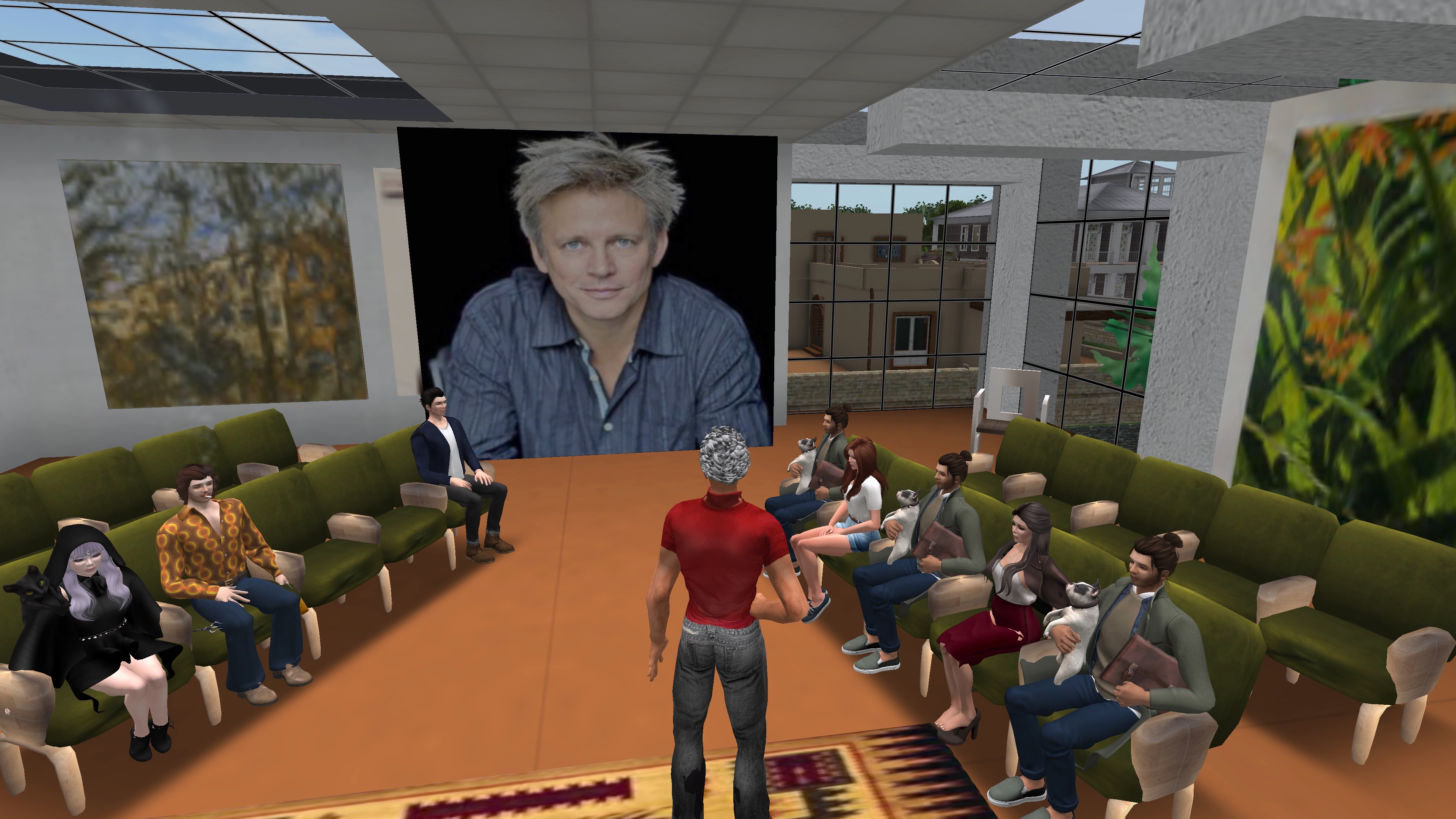
John welcomed Sitearm Madonna to the class introducing him as a graduate of the module and subsequent guest speaker since then. Sitearm, a retired engineer and currently a consultant in online applied collaboration, has vast experience of team working and has developed a theoretical framework to support online teamwork. He has been refining the presentation each semester and delivered this class in voice with a subtitles. There was also space for input from the class and participants with a live demonstration of briefing, brainstorming, and debriefing. You were very cooperative and engaged enthusiastically, making the content far more meaningful while practicing the application of the theory.
Engaging with Sitearm in demonstrating teamwork in action.
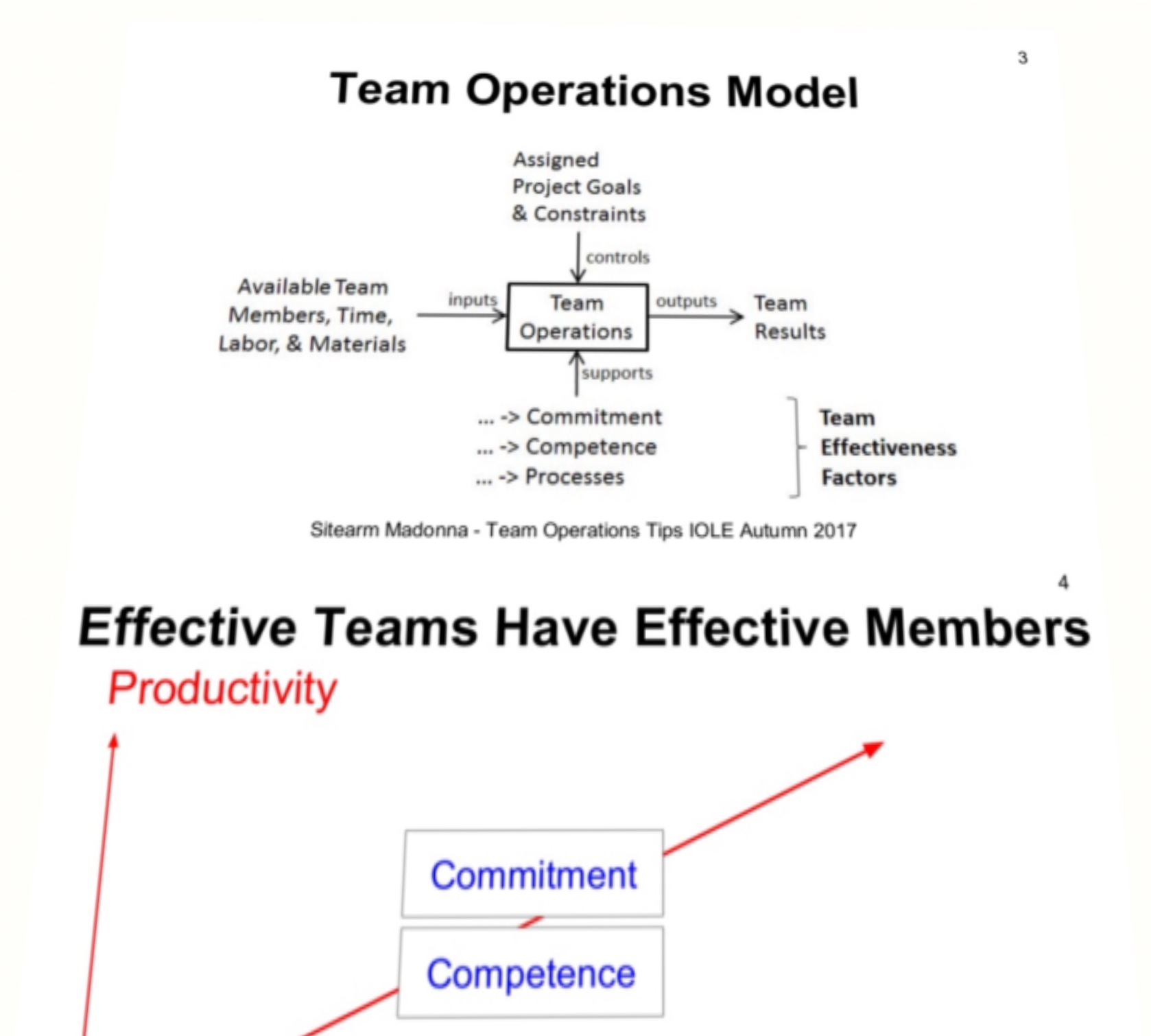
Sitearm accompanied his talk with comprehensive explanatory slides.
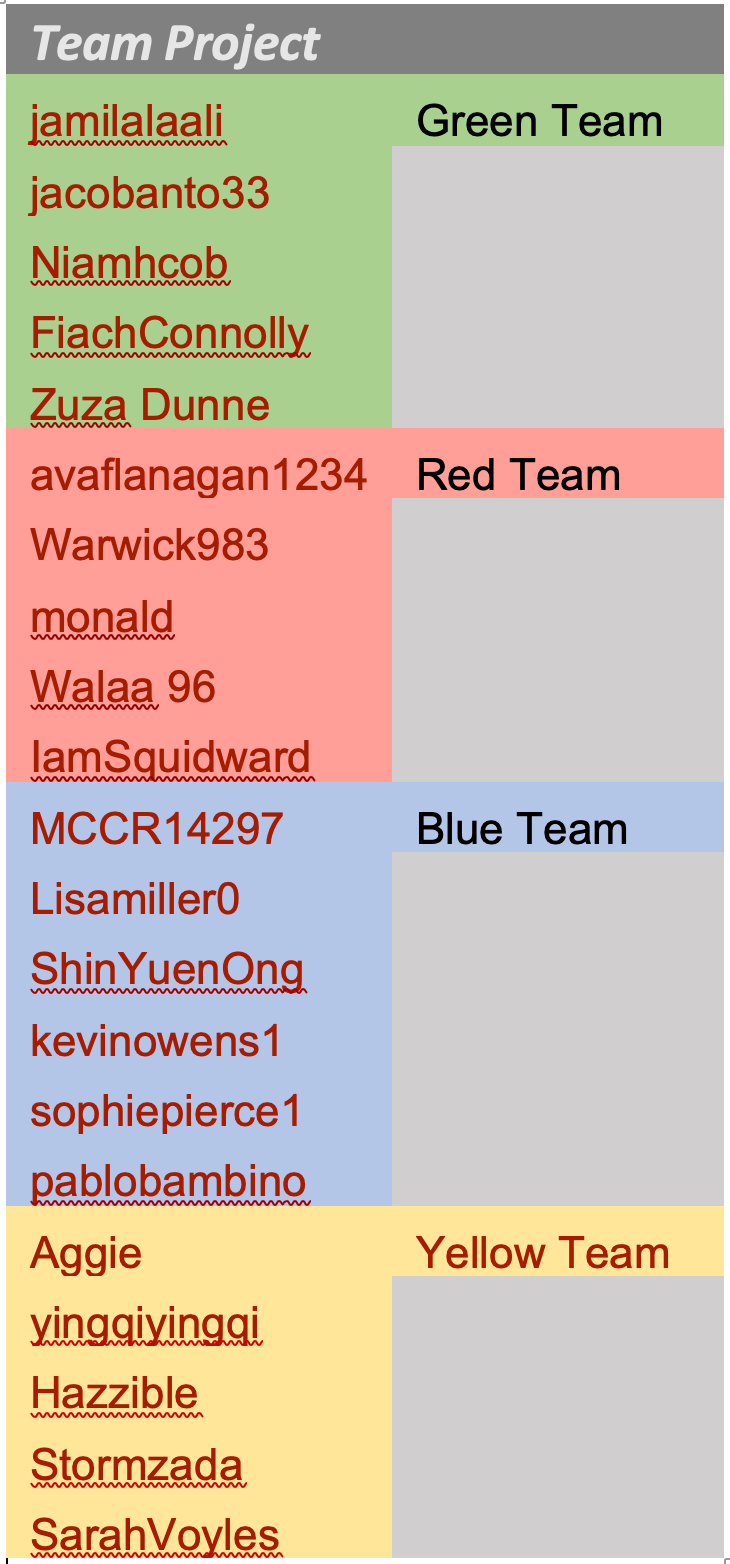
John finished the class by thanking Sitearm for a most engaging class. You will be putting the theory into practice immediately as the Team Project will be introduced next week. In advance, please review the brief in Brightspace and have your first team meetings before next week’s class. Here are your assigned teams:
Team assignments for the Team Project – Tomorrow’s Office
This class is normally given by Sitearm Madonna but, regrettably, John was unable to make the arrangements in time this semester. So, he reviewed the key points in the hope that it might be possible to have the full presentation from Sitearm at a later date, perhaps with some students from other universities teaching in SL.
Sitearm placed convenient posters around the classroom (check the roof also).
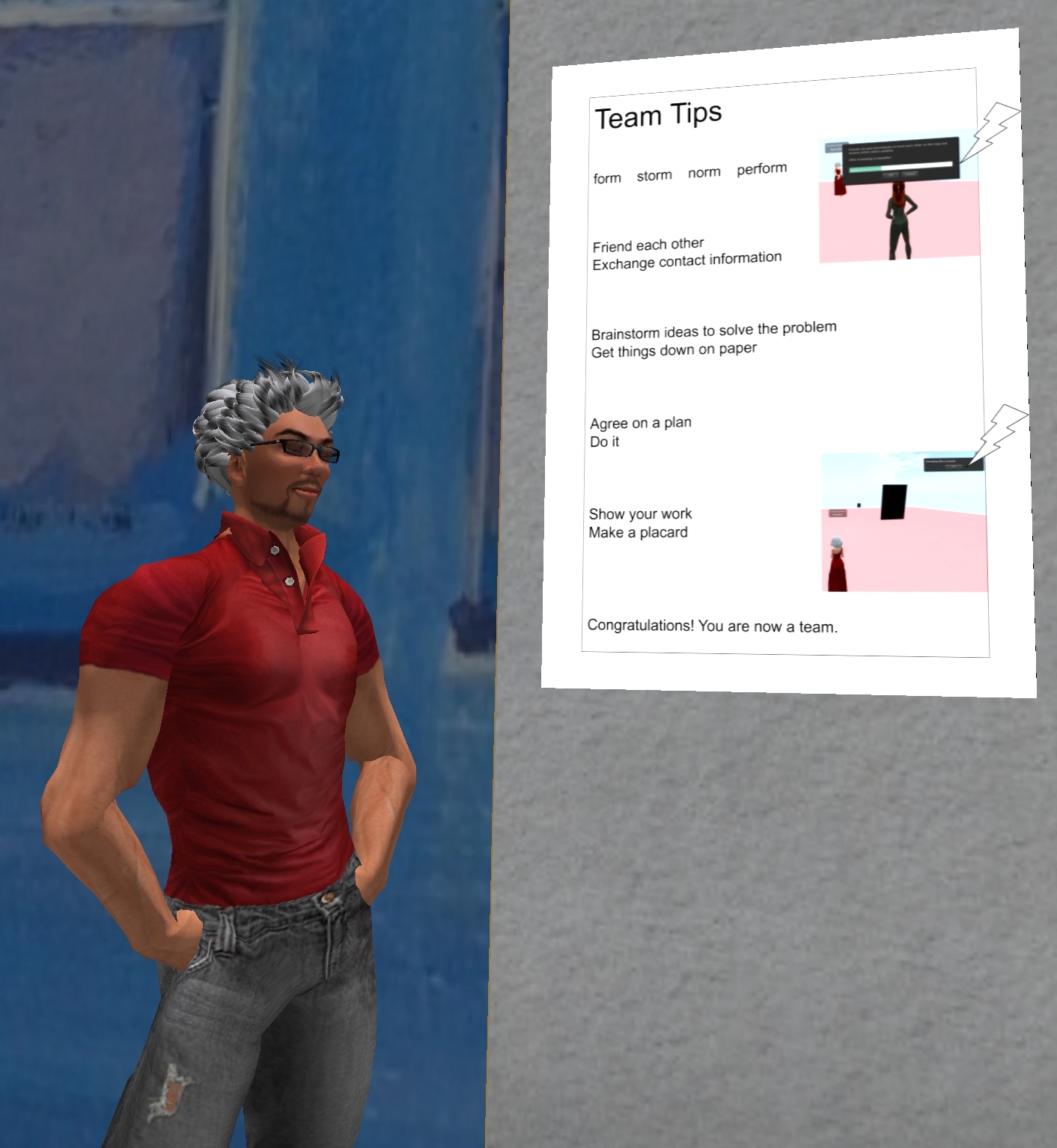
Sitearm had placed some very useful posters around the room which helped illustrate the dynamics of teamwork which, he suggests, is like breathing: more of a process than a one-time event. There are four aspects to understanding how teams function. Firstly, teams have effective members. Each of us brings some commitment and some level of competence. You can compensate for the lack of either in team mates to ensure a positive outcome. Secondly, effective teams develop in stages. Starting with the forming stage where members are getting to know each other and find their place before moving onto what can be the most difficult stage known as storming. This is where everyone is pitching ideas and working out how to proceed. Then teams usually move on the norming stage when the members are beginning to work together comfortably and settle down to performing and getting the project done.
Thirdly, effective teams use best practices. For example, using brainstorming to generate ideas and then agreeing a protocol for deciding how to progress: majority vote, consensus or some other way. You will find that you move back and forth between brainstorming and deciding until the project begins to take shape. When you meet in your teams get into the habit of briefing yourselves. Ask questions like: what are we going to do in this meeting? Then do it. At the end of the meeting leave some time for debriefing: record any decisions made or what happened. Also ask each to member to say what they liked about the meeting and what they wished had happened. This helps your team meetings to become more efficient, effective and enjoyable.
Finally, effective teams share roles: research shows that there are nine key roles for highest performance and success in teamwork. As many teams don’t have nine members it is often necessary for people to take on more than one role. Each of us has a natural affinity to some roles but you can practice taking on new roles also. The disadvantage of this is the discomfort as you move into unfamiliar territory and the extra work involved but the advantage is seen in performance and success on both the personal and team levels.
Collaboration is a technology – proven and time tested with a vast number of academic papers describing the process. Think of it like that and you will find it less daunting.
John reminded the class that it is very important to practice your presentation before the final delivery. You need this dry-run to iron out any difficulties that may arise in moving from a plan or script to the real presentation. Working with technology is not always reliable so it is a good idea to expect catastrophe and have at least one back-up plan, if not two: don’t get caught out! Prepare fully and you will be successful no matter what happens.
Despite (or perhaps, due to) the current restrictions on physical meetings as a result of the Coronavirus pandemic we had good attendance at class.
John began by reviewing the structure of the Brightspace VLE (virtual learning environment) support for the module. In particular, the unit on assessment was considered. It is important that you understand precisely what is expected of each submission and you know where to find the details and supports for your assignments. If you have any questions on any aspect of assessment please contact me by email or after class in SL.
Clearly, not everyone understood the need to submit your work for assessment in Brightspace so, the option to do this for the Website Blog, part 1 will be extended to the end of the Easter break. Once again, if you don’t understand what is expected just email me and we can go over it in detail.
When asked how the Team Projects are progressing everyone responded very positively. You have all been able to continue meeting up despite despite the circumstances. Each team has engaged with the brief and begun to plan the presentation.
In response to questions John demonstrated how to upload images and ‘project’ them in the SL classroom. He noted that it costs L$10 to upload each image and gave each of you a gift of L$300. The initial appearance of extreme generosity was somewhat diminished when he revealed that this is roughly equivalent of US$1. However, it will enable you to download sufficient images for the presentation. You should consult the SL support pages on the web for details of image format (ie, jpg; png; tiff etc) and file sizes that are suitable for uploading.
If you are considering video it is better to use YouTube than to attempt streaming into SL. You can simply post a link in SL for the audience to play. This works more effectively than streaming.
In closing, John suggested that you use the break to catch up on your blogging, ensure you submit on Brightspace and continue planning the Team Project presentation. You should also use the break to get some rest and time away from virtual learning!








 Virtual Environments: Is one life enough?