Posts Tagged ‘online presence’

h1

Class 4: Metaliteracy and digital citizenship

November 6, 2024
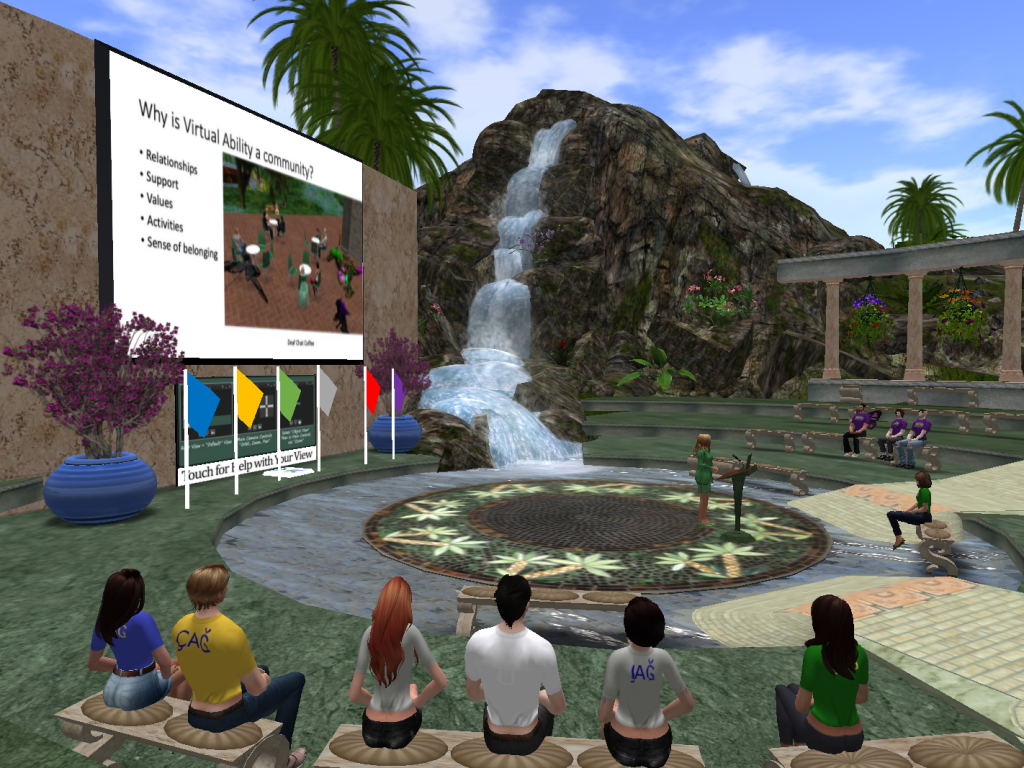
Valibrarian talks about literacy in the digital age and digital citizenship. Photo Barbara Collazo

We were joined by the Turkish students from Çağ University for this week’s class. Valibrarian presented on metaliteracy and digital citizenship introducing us to the topics addressed in her 2020 book book Metamodernism and Changing Literacy: Emerging Research and Opportunities. Following the main presentation we teleported to a ‘dark room’ to learn about the dark side of digital existence. Then, to finish on a bright note Val invited us to the Community Virtual Library for a lively discussion on the issues raised in her talk.

The dark side of the metaverse… Photo Barbara Collazo
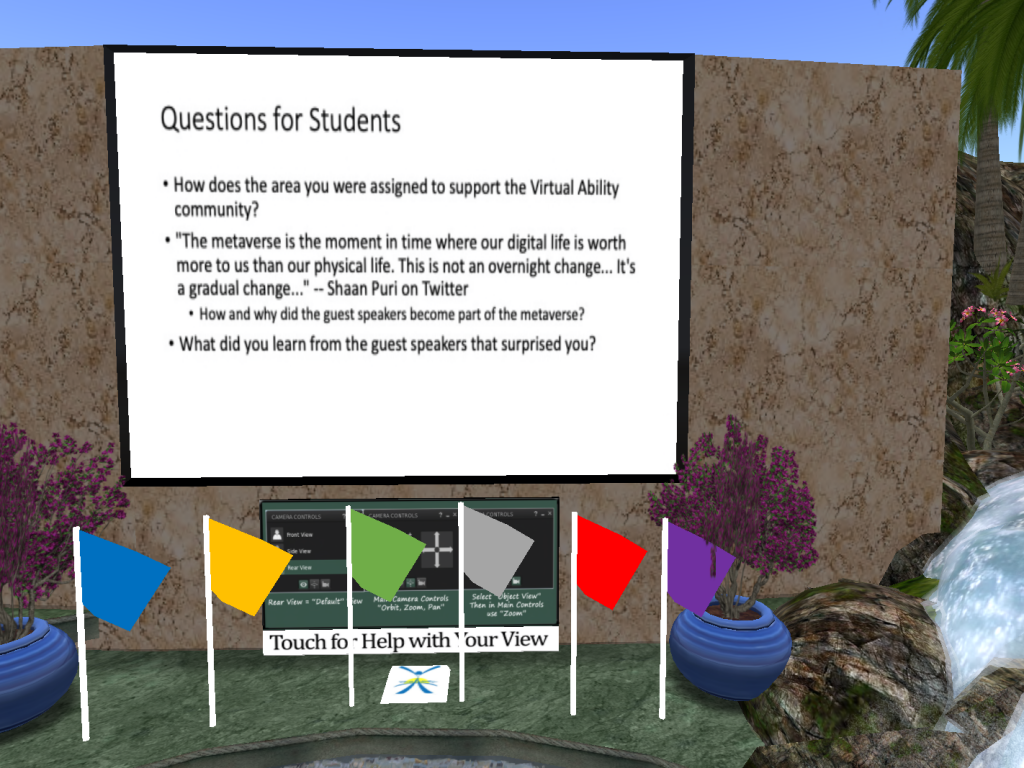
The class concluded in the Community Virtual Library with a lively Q&A session. Photo Barbara Collazo

We were joined by PhD reseacher from the University of North Carolina at Charlotte who is looking at education in the metaverse. She invited the students to take part in a focus group to provide data for her research.

h1

Class 1: Welcome to SL

October 2, 2024
Students settle in to their first class of the semester in Second Life. Photo by Barbara Collazo.

We got off to a good start this semester with a good show of students who all arrived well prepared. All had voice activated and were able to get their avatars sitting down ready to pay attention to the class content. This is not always an easy task and it demonstrated that participants had signed up for SL at least a few days before the class and had spent some time getting to know the basics – always a good sign of genuine interest and engagement. I also noted that participants were happy to use voice and IM to communicate and ask useful questions.

We quickly ensured that everyone had been added to each others friends lists, and that all joined the TU Dublin group so that we could keep in contact. There is some interest in upgrading from the basic avatars and students would like to customise them. We will return to that in the next class.

We were joined for some of the class by Barbara Collazo, a photographer, who was commissioned by The Avatar Scholar to record some images for the forthcoming issue which features an article I have written. We all went out to the deck to provide some variety for the photographs and to give us all a chance to stretch our legs (not that avatars get tired or stiff from sitting for long periods but, the people behind the avatars need to be stimulated by something different or there is a tendency to drift off and lose focus).

I explained the structure of our VLA, Brightspace, to the class and asked paticipants to spend some time reviewing the content – particularly the section for today’s and also the section on Assessment. It is important to be familiar with the assessment requirements because the work is spread evenly throughout the semester to ensure there is not too much pressure on students at the end of the semester, when all their other modules will require submission of work. I also reminded them that the schedule/timetable is available in the Introduction section and it is important to note that for reference. We will also welcome guest speakers joining to share their expertise on a range of topics and will go on site visits with some of them to see other places in Second Life.

John O’Connor / Acuppa Tae welcomes participants to the class in Second Life. Photo Barbara Collazo.

Then we made a brief visit to the campus of Çağ (pronounced ’Chá‘ in English) University where we will meet students from this Turkish university during the semester. We will also meet here for some of the talks by guest speakers. Following that we went to the VWEC Eduverse plaza where many of the academic institutions that have a presence in Second Life meet to share experiences and knowledge. There are many interesting events held in the plaza with a schedule giving the full listing. I particularly recommended the Expert Talks series on Friday evenings at 9:00 pm Irish Time.

Concluding, I gave the class their assignment to be completed before the next class: Explore Second Life with some colleagues from the class. Visit at least 3 different locations. Find them in ‘Search’, or ask other residents for recommendations, or simply select places at random. Participants were also asked to review the section in the Brightspace VLE on Class 2: Team Project – Virtually Sustainable?

h1

Class 6: Online communities and relationships

March 14, 2022

The visit to Virtual Ability Island (VAI) is always a highlight of the semester. Unfortunately, many students didn’t make it to class as this is reading week (despite the timetable clearly indicating there would be class this week!)

Gentle Heron introduced us to the Virtual Ability Island community.

Gentle Heron welcomed everyone and spoke about the origins and activities of the community on VAI. In addition to hearing Gentle speaking her words were transcribed automatically in ‘nearby chat’ by means of the SpeakEasy HUD she uses on such occasions. This facilitates members of the community who cannot hear. You can view the video recorded by Sitearm Madonna from last semester’s visit or read about the previous semester’s visit to find out more about VAI.

Following Gentle’s introduction Magua and John divided the students into four groups who were sent to four different breakout locations for small group discussions led by members of the VAI community. We are really grateful to Suellen and James Heartsong, Mook Wheeler, The Tinys Slatan Dryke and iSkye Silverweb, Lorivonne Lustre for leading these sessions and sharing their insights and experiences in Real Life and in SL.

When we came back from the breakout sessions Gentle Heron posed three questions…

After the breakout sessions we gathered back in the meeting space where Gentle Heron posed three pertinent questions to the students who had equally perceptive responses before we concluded the visit with thanks to our friends in Virtual Ability Island.

h1

Class 6: My Avatar and Me – Virtual Identities

March 18, 2021

Due to the re-scheduling of last week’s class we met for class six this week. John began this discussion by asking if everyone had viewed the TED presentation by David Chalmers and the interview with Daniel Dennett. The topics were complex and required several viewings for some of you. It was agreed that consciousness is not easy to define. In fact, it was not so much defined in the material as spoken about. The manifestations of consciousness were considered in different contexts. Everyone recognised Chalmers’ description of a movie playing inside our heads: the narrator in our lives. You also suggested that the use of multiple personas is common. We behave according to the company we are in; family, friends, strangers and so on, but it is not clear whether this means we have one personality with different sides and layers to it or multiple personalities.

This led to us considering the nature of our avatars here in SL. Do we present ourselves in virtual worlds as we are in RL? For instance, last week many of the residents of VAI referred to the refreshing nature of SL where they are not subject to being identified with their disability. You may be confined to a wheelchair in RL but your avatar can walk, run and dance in SL. Is identifying with our avatar in SL very different from identifying with our physical body in RL?

John told the story of the the blog A Gay Girl in Damascus about a lesbian living in Syria during the 2011 uprising that arose from the Arab Spring. The blogger, Amina Arraf, came to worldwide attention after apparently being abducted by authorities. She wrote about the dangers of being gay in the Middle East and developed a large following ranging from those interested in her demand for sexual freedom to the supporters of the political cause espoused by the Muslim Brotherhood. The demands for her release eventually led to the revelation that Amina was actually Tom MacMaster, a US postgraduate student in Edinburgh. For the purposes of our discussion the interesting thing is that Amina formed several close relationships while presenting as a gay girl. She was utterly convincing for over a year.

Free Amina Arraf.
When Amina Arraf was supposedly abducted there was an international effort to secure her release before it emerged that the blogger was in fact Tom MacMaster and the photo of Amina was really a Croatian woman.

This raises the notion of ‘truth’, or at the very least, our expectation that others do not attempt to deceive us. But what happens if one of our individual personas does not match the expectation of somebody else? At what point might we be considered to have moved from a genuine attempt to present ourselves honestly as possible to becoming deceivers and liars?

Your generation has grown up with social media and you are familiar with how we present ourselves in that virtual space. You have become adept at deciphering profiles and cautious about revealing too much. It is unlikely that Amina’s blog would convince people today… or is it?

h1

Class 6: My Avatar and Me – virtual identities

November 12, 2020

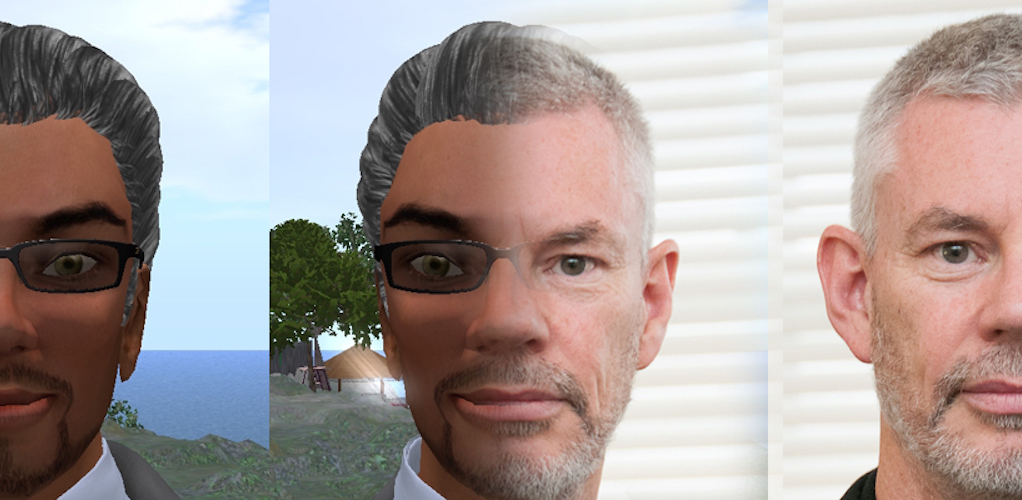
Real face merging with avatar

My avatar and me.


To establish some common ground for this complex subject John asked you all to think about how you would answer the question ‘who are you?’ in the context of the propositions put forward by Daniel Dennett and David Chalmers in the videos set for viewing in advance of the class. ‘How do you describe yourself?’ After you had given some thought to this we considered further questions: ‘Are your descriptions real?’ ‘Is it an illusion?’ ‘What makes yourself real?’ as we attempted to co-create an understanding as a group.

We acknowledged that how we present ourselves depends on the circumstances or the environment. So, the person we are at home is somewhat different from the person who goes into work or college, or who socialises with friends. Does this mean we have multiple personalities? This led to thinking about the difference between our ‘self’ and our ‘identity’ and the importance of establishing your ‘self’. The deep philosophical nature off this question is at the heart of what it means to exist, to be alive in the world, to be human.

It is also important on a more prosaic level. How we might wish to present ourselves professionally is important for our career development. It starts with coming to an understanding about the kind of image we decide to promote and then consciously projecting that through not only our work but also our professional engagements of all sorts. Social media is a key tool in this context – something we are all acutely aware of in the current situation where we are almost totally dependent on it.

h1

Class 6: My Avatar and Me – virtual identities

March 12, 2020

Discussing self and identity is more complex than it seems!

Very few of you had reviewed the reading/viewing material before coming to class this week so, John asked you do so before we began a discussion. It is pointless trying to have any discussion without some prior exposure to the concepts presented by Daniel Dennett and David Chalmers. This is quite challenging territory so we all need to start off from the same point of departure.

Although this took up a considerable amount of class time it was necessary.

Locks Aichi sent apologies and regrets that due to work commitments she was unable to join us as guest speaker this evening. However, she had done considerable preparation and sent notes to John to guide the discussion.

We started by remembering Sitearm’s introduction to the concept of ‘persona’ in class 3. John then asked everyone to answer the question ‘who are you?’ in the context of the two presentations, ‘how do you describe your self?’ The questions were more difficult to respond to than we might have thought but the following emerged after some prompting:

  • 20 year old male
  • student
  • a mind in a body
  • outgoing, extrovert
  • introvert
  • fair
  • fun
  • cheerful
  • honest
  • concerned
  • considerate
  • careful
  • curious
  • creative
  • musical
  • visual
  • aspiring (to greatness)
  • positive

Sitearm asked you about your skills, do they contribute to who you are? John wondered what impression you would like to give to someone you are meeting for the first time. How would you like them to describe you?

  • inventive
  • swimmer
  • process (eg, design process)
  • kind
  • good humoured
  • charming
  • open and approachable

Then John asked if you consider these descriptions to be real, or are they illusions? So, what makes your self real? You suggested that it is social interaction, how others reflect you back to yourself. One of you put it as ‘I am what other people think of me’. This led to the proposition that while we are one person we have many different layers. John asked if there is a core ‘you’ an unchanging sense of your self underneath all the layers? The response was that you have some core qualities that are more stable than others and that might change much more slowly than others.

You spoke of how your presentation of your selves is somewhat determined by the social situation. For example, your persona at home with your family is very different from your persona when out with friends.

Another interesting comment from one of you was that you don’t sit down and have a conversation with yourself.

Ultimately, it seems difficult to grasp exactly what our ‘real’ self might be. John suggested that the notion of an unchanging ‘you’ that lies at your core is what we tend to think of as our ‘self’ whereas the manner in which we present in different social situations is seen as a range of ‘identities’ that we can assume depending on the situation.

This led on to a discussion about social media and how we might present ourselves there. Do online environments give a greater opportunity for controlling our identities? Or does it simply result in a more detailed digital footprint that you leave behind? Instagram, SnapChat, WhatsApp, Facebook and LinkedIn we mentioned as the main apps used. Some of you use aliases when using them, just as we do here in SL. Your use of the apps reflected your earlier references to different identities.

Sitearm asked an interesting question about how your use of social media might also change over time. For example, if you were using social media before college have you felt the need to change your profile since leaving school? or do you anticipate having to change again when you enter the workplace? John wondered if you had heard of the phrase ‘the internet never forgets’? Are you aware of the nature of ‘digital footprints’?

This led the discussion to the difference between your personal identities and your professional identities. How do you present your professional skills in the digital online environment? John suggested that you need to take control of your social media – it is too important to simply allow your image to develop randomly. So, activities such as blogging can support the development of your ‘personal brand’. Your social media profile is an opportunity to demonstrate your professional attributes.

Before we concluded Sitearm asked for a quick ‘likes and wishes’ reaction to the class. The ‘likes’ included the opportunity to dig deeper into the topic; support for developing professional profiles; shared examples of our ideas on personality and identity; open conversation with no right or wrong answers; Sitearm appreciated how the everyone participated and shared their experiences. The ‘wishes’ included viewing the reading/viewing material in advance of class; and also doing the reading together during class!

h1

Class 6: My Avatar and Me – virtual identities

November 7, 2019

Who’s who in the digital environment and how do we know? The question posed by Locks Aichi in this week’s class.

Locks Aichi started the discussion by asking us ‘Who are you?’ She qualified it by suggesting we could respond as our avatars or our real selves. All the replies were short and to the point with some of you giving your avatar names and others your class name or the subject you are studying.

Locks continued by asking us to consider the pieces of data that make up your identities in the virtual space and this produces a range of replies:

  • what you post on your feed
  • putting out a reflection of yourself
  • in SL you can choose how to display yourself – the visual aspect makes it different from the limitations of text-based social media apps
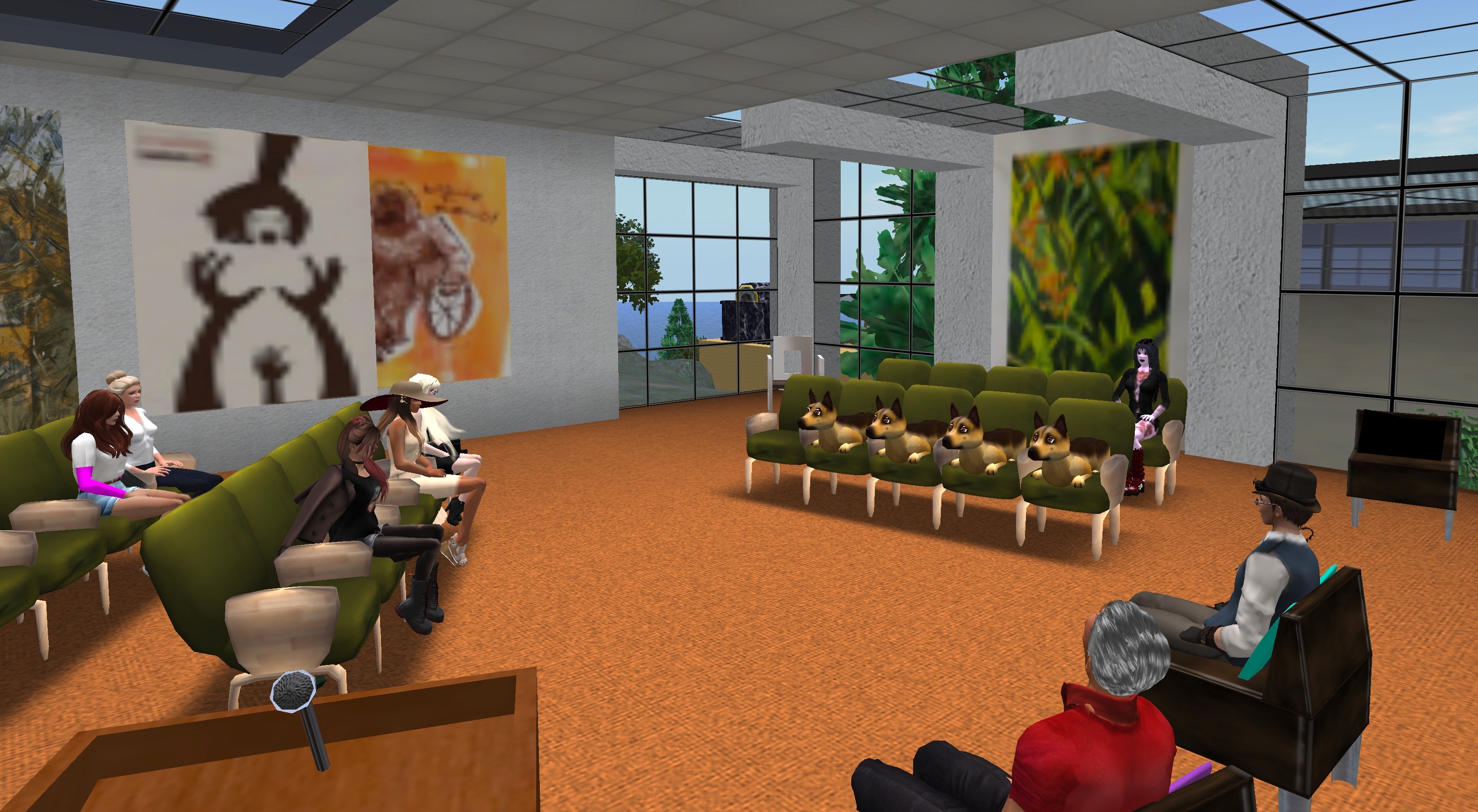
  • the Green Team noted their decision to share a single identity as dogs. (Is that your only identity? Is there anything beyond the pack?)
  • Exposing your identity
  • recalling Sitearms comments a few weeks ago you suggested that people can create different personas
  • present differently online from how you are in RL
  • present the best part of yourself.

It was suggested that social media provides a curated or crafted version of yourself, it also presents the highlights of your life. In RL we are so used to reading body language that it can be harder to hide aspects of yourself than it is online, which provides the opportunity to be more deceptive, perhaps.

Then Locks asked ‘Who owns your digital identity?’ You thought that there is much less privacy now than before – we tend to be more open and post everything that we do. We don’t really have privacy.

In RL who owns you? Nobody. Why is it different in the digital space? In the early days of social media we frequently heard the aphorism

if you are not paying for a service you are probably the product.

Data is sometimes referred to as the ‘new oil’ because of how valuable it can be. How often do we read the terms and conditions before signing up for an app or a service? Do we take the time to understand what data we are handing over? In Europe GDPR legislation (General Data Protection Regulation) has come about to protect our data. Organisations are not permitted to hold our data without permission, nor are they entitled to use it for any purpose other than the one for which we have given explicit permission. It also gives us the right to be forgotten – digitally.

By not making a choice we are actually making the decision to give our personal data away. If you share too much without giving consideration to the consequences it makes it harder to shape your online or virtual identity later. So, for instance, Locks made the decision to use her twitter account solely for professional purposes. It is not possible to glean anything of her personal life from it.

Do you think about the shape of your digital life: socially, personally, professionally?

LouHug said that he posts less online now than he used to two years ago – part of the reason for this is that he doesn’t want to appear foolish in front of his kids later on in life. Others suggested that you could use multiple accounts for different personas and/or purposes.

Locks suggested that it is becoming more difficult to live outside the digital world. So much commercial transactions are now carried on digitally that it has become necessary to link digital identity with our real world identities. For example, banking legislation is increasingly resisting anonymity to ensure trust and reliability and to counteract laundering and other illegal activity. The data trail is now becoming an asset.

Locks asked us to take five minutes to think about how you would present yourself as a professional online and post your response in 140 characters or less. When you had all posted your responses in local chat she asked how you had made the decision about what information to share?

  • started writing about the future but then reverted to describing the present
  • gave abilities rather than personal details
  • personal perspective – tried to look at it from a client’s perspective
  • professional – present as diligent, dedicated, reliable and experienced in team work
  • professional but with one personal trait for balance
  • look like the best professional possible
  • factual

Virtual identity is something you create. Given time and careful curation it can become a valuable asset. So, for instance, if somebody retires from an organisation their profile may well remain. The identity is transferrable – it has become a quantifiable asset. Therefore, we are now seeing an increasing interest in laws around privacy, intellectual property and ownership of digital assets.

Impersonation is also a greater problem because it can be easier to present a false identity in the digital environment. Hence the rise of accredited identities such as the blue tick used by Twitter, although the service has been put on hold.

All of this underlines the importance of trust in the digital landscape. You should decide what you are trying to achieve with your online digital or virtual identity and allow that to guide your approach to developing it.

h1

Class 6: My Avatar and Me – virtual identities

March 21, 2019

We were joined by Locks Aichi for class this week but, due to the vagaries of online environments, she was unable to materialise her avatar in SL so engaged remotely. Locks could hear us but was unable to move her avatar or communicate through text or voice. Instead she sent WhatsApp text to John who shared with the class.

We all teleported to a location that was large enough for you to break into your teams far enough apart to have a voice discussion without disturbing each other. However, it seems you mostly used text again! continuing to be somewhat reluctant to use voice. Each team was asked consider the question: ‘what is the basis for your visual identity?’ and come up with two key considerations – to be posted to a scrumblr board.

Scrumblr board recording team responses.

We then teleported back to the classroom to share our thoughts. John opened by suggesting that some consideration of what ‘self’ means is an important starting point when considering our personal identity. Chalmers talks about consciousness – a prerequisite for the idea of ‘self’ and Dennett posits a particular theory about the nature of ‘self’ being somewhat fluid to say the least. (Some of you hadn’t viewed the video material so it would be useful to do so now to get an insight into this thinking.)

Using the examples of our avatars John suggested that virtual identity gives us the opportunity to explore how we might present ourselves to others. His own avatar, Acuppa Tae, was originally designed to look as close to him IRL as possible because he felt it was appropriate in his role as a teacher. However, that requires the avatar to be updated as time passes! Sitearm Madonna’s decision to use a female avatar emerged from a desire to acknowledge his mother’s role in his development. Locks said that she chose to be a guy to be different from her RL self; not really because of how she wanted to be perceived but more to see if she would behave differently when aligned with a male avatar. She considers her avatar as a suit of clothes rather than an identity. Experimenting with your virtual self allows for fun to explore – just like dressing up. It poses the question that identity may be something transferable bringing to mind the movie Get Out.

We discussed the issues you noted on the pin board and attempted to identify the shift in thinking from consciousness of the self to the development of an identity and on to the promotion of a personal brand. The notion of authenticity began to emerge as we came to the end of the class and this would be an interesting point to pick up in your own blog posts. What influences our choice of avatar and how we present in SL? How do we identify with our avatars? What identity are we attempting to present in our website blogs?

h1

Class 6: Persona, identity, presence

November 8, 2018

This week John started by reminding the class of the importance of re-reading the assessment criteria for your blogs. You will notice that one criterion relates to ‘timelines’ and suggests that regular updates each week are required. So, those who have yet to submit a link to their blogs should do so on the Facebook page as soon as possible. Please check that your blog is listed on the Student Blogs page and let me know if it is not.

Many of you have not completed the ‘About Me’ section of your blogs. It it important to provide a short and appropriate bio to your readers so that they understand your background and perspective. In that context you should also review your blog – try to approach it from the perspective of a first time reader – to ensure it is coherent. Tidy up the layout, deleting any leftover template placeholders or widgets. You have all included photographs of your SL experiences in your blogs. Ensure they are appropriately captioned and, if you are using images from any other source, remember to credit the author/creator.

We also spoke about how the nature of your writing should be developing over the last two blog posts. For the first three posts your were asked to describe your experience of SL and the module but now you are being asked to reflect on the experience of team building. Write about how you are finding the application of the theory we discussed in the third class meeting, what you think you are learning (or not learning!).

Finally, it is important to proof read your writing before posting. This is to eliminate not only typos and errors but also to improve your communication style. The more you re-read your posts  before publishing the tighter the writing and, usually, the better the final outcome.

As we began to discuss the concept of personal branding it emerged that almost none of you had read the two short texts set from the previous class. John explained that they were essential for any meaningful discussion so class was adjourned for a short period to give you time to read them now. Then John asked you to consider your own online identities and how they are made manifest. You talked about using social media apps such as Instagram, Facebook and Snapchat. You are aware of the impact on your profile that posting to these apps is having. You also spoke of the need for compatibility between your Real Life (RL) and your online personas. While it was not explicitly declared there is also an implicit understanding of the need to differentiate between you personal and professional profiles. However, John spoke of the difficulty in doing this in the era of Google and Facebook: these global enterprises are very effective in eliminating boundaries. In addition to collecting as much information about you as they can they also seek to compare the data and combine it in order to build as full a picture of you as they can. They don’t respect the boundaries you might like to keep. As a result it is becoming increasingly difficult to remain anonymous. It is very important, therefore, to be aware of the nature of the online environment and to maintain a high level of digital literacy.

THINGS TO DO BEFORE THE NEXT CLASS:

  1. Read: the Guardian article Yourth crime commissioner Paris Brown steps down over Twitter row from 2013 (accessed on 08/11/18).
  2. Read: another Guardian article Justine Sacco, PR executive fired over racist tweet, ‘ashamed’ also from 2013 (accessed on 08/11/18).
  3. Write the sixth post: to your blog about how you might convert your personal presence online into an identity for  professional networking.  
  4. Read: the academic paper User Generated Content and Virtual Worlds (accessed on 11/11/08). From the Vanderbilt Journal of Entertainment and Technology Law, 2008.

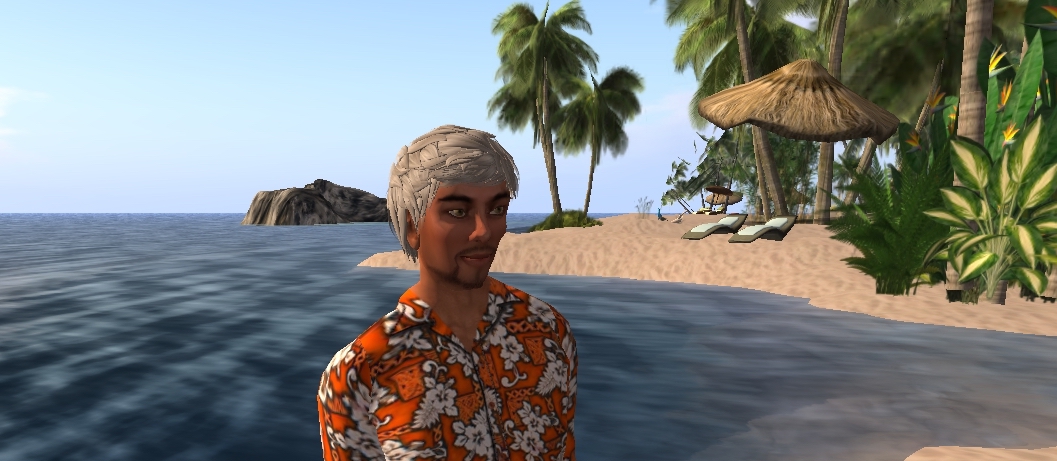
Beach bum in the sun!

POSTSCRIPT
John has often thought, since starting to teach this module, that the ultimate benefit of teaching online is that it affords the opportunity to teach a class from any location, with the ultimate ideal of doing so while sitting in the sun on a beach. Travelling to conferences has required me to deliver the module from places such as Nantes, Vilnius, Poznan, Florence and other locations around Europe. We have also has participants join the module from Sherkin Island off the west coast of Ireland and various countires around Europe, the US and Australia. But this class was the closest I have come to delivering from a beach: on holiday in the Indian Ocean island of Mauritius. Unfortunately, the vagaries of international time zones resulted in my having to teach this class at midnight local time! But at least my avatar got to wear a hawaiian shirt…

h1

Class 3: Team work and collaboration

October 11, 2018

We began class this week by reviewing the Elevator Pitch discussed last week. John admitted he had forgotten to refer to it in the main summary of the class so added it as a comment later, with a link to an article from the Harvard Business Review describing an elevator pitch. You should all prepare a 30 second pitch on any subject you wish. I will call on you at random to deliver it over the next few classes.

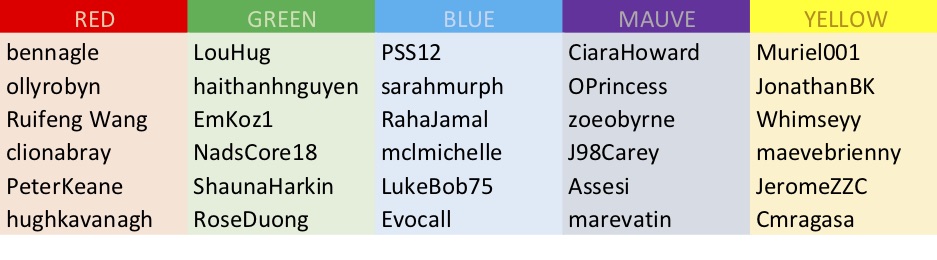
John went on to identify the groups in which you will work for the module project. He assigned you to one of five groups each with six members. You are asked to try working online and avoid working together in Real Life (RL) if you can, so that you get as full an experience of online collaborative working as possible.

JOC - 101318 - project groups
.

As class progressed it was noticed that some students are having a few problems logging in to SL or getting their voices working. John asked you to help each other sort out these issues outside of class, if you can.

Many of you have sent links to your own blogs to John and these have been posted to the module website – please have a look at the blogs and comment on each other’s posts. You can find a link to them to the right on this page. Those who haven’t yet sent a link to John should do so as soon as possible but at least before next week’s class. You were reminded that the first assessment of your blogs will be after that class – if you haven’t already done so make sure to read the page on module assessment.

LouHug shared the Facebook group he created for us to communicate outside of SL. Second Life 18 is a private group and will be active only for the duration of the module this semester.

John gave a talk on Team Building to the class. Normally, this is delivered by Sitearm Madonna, a graduate from the module with extensive experience of online collaboration but I didn’t have time to contact him in advance. Hopefully, he will be able to join us for a later class to share his wisdom. In the meantime I, rather cheekily, used his excellent slide show Virtual Collaboration Tips and Tools to illustrate my presentation. We discussed the content of slides 2 to 5 in some detail; we just touched on slides 6 and 7 and will revisit the content in the other slides in a later class when it will be more relevant.

For now, you are asked to review the Form, Storm, Norm, Perform paradigm in your own teams to help form a bond. Also, consider the roles within the team you may be best at playing.

THINGS TO DO BEFORE THE NEXT CLASS:

  1. Meet in SL: in your team groups.
  2. Write the third post: on your blog describing the first meeting of your team or, if the meeting did not occur, describe how you tried to facilitate the meeting and why, in your opinion, it didn’t happen.
  3. Read: Living Structures in Second Life Virtual Worlds Projects by Sitearm Madonna. [accessed 13 October 2018].
  4. Read: Painfully Coming to Grips with The Medium is the Message an amusing and accessible introduction to the philosophy of Marshall McLuhan. [accessed 13 October 2018].
  5. Optional reading: Extrapolating on McLuhan: How Media Environments of the Given, the Represented, and the Induced Shape and Reshape Our Sensorium provides a deeper analysis of McLuhan. [accessed 13 October 2018].