h1

Class 5: From Hammer to Pixel

October 24, 2019

Dudley Dreamscape led the class discussion on Marshall McLuhan.

This week we were joined by Dudley Dreamscape who led the class discussion about the influence of Marshall McLuhan on our thinking about digital media, online and virtual environments in the 21st Century. Introducing Dudley, John noted that along with Sitearm Madonna, he had a perfect score when he participated in the module some years ago. Not surprising, perhaps, for a communications professor at the University of Akron! Also joining the class was a fellow graduate of Dudley’s, Inish Karu who had a reputation as a fearsome SL pirate but, judging from her current avatar, has since mellowed somewhat.

Inish Karu, who participated in the module with Dudley some years ago.

After introducing McLuhan’s basic ideas to the class Dudley asked you to consider how they might be interpreted today. His remarkable prescience was noted – he foresaw the internet 35 years before it was developed – describing the transformation of our disconnected 20th Century world in a Global Village facilitated through an electronic nervous system. Of course all tools developed by humans can be used for good or ill. You gave many examples of the downside of our always-on society and the attention-grabbing power of connected devices. This can lead to the  echo chamber effect whereby our sphere of understanding and experience shrinks as the dissenting voices are silenced or eliminated.

Dudley explained McLuhan’s belief that while humans develop tools to help us with our tasks the same tools change us and our society. It is difficult to predict the type of change that will come about therefore vigilance is crucial. That is why it is so important not to overlook the medium while digesting the message. The medium (ie, the tool) has a longer lasting and deeper effect on our lives than the message it carries. Although McLuhan’s thinking can be difficult to grasp at times the basic concepts are quite clear and seemed to resonate with the class. This was due, in no small part, to Dudley’s generosity as he led us through the complexity, distilling the essence and encouraging a deeper engagement with the propositions. Please continue this as you begin work on your projects.

h1

Class 4: Team Project – Future Work

October 17, 2019

The discussion started with students reporting back on the Team meetings you held during the week. Most teams had been able to make contact and commence communicating using a variety of tools. It soon became clear that the different parts of team work demand the use of different sets of tools.

Brief for Team Project – Future Work

Forming and Storming: Finding your team mates and commencing a dialogue is the first hurdle. Second Life’s use of avatars with different names from your real selves resulted in some confusion as you tried to identify each other! Some of you asked me for email addresses to facilitate the first connection. You searched Facebook and other social media platforms for your classmates and, for the most part, did not resort to real world encounters.

The first meetings were arranged and this presented the next challenge. Some of you met in SL, some chatted on Facebook, Skype was mentioned as a useful platform but I am not sure if any team actually used it. The ‘forming’ stage of team work, developing the team and getting to know each other, is actually a social activity and therefore social media apps can be useful for virtual teams. They allow you to find out something about your colleagues and open conversations. As your teams coalesce and working together becomes normal tools such as SL and Skype will support the interaction needed to brainstorm ideas for your project and make progress.

Performing: Although this aspect of team work did not emerge until later in the discussion John asked you to consider how ensure your presentation will be completed in time for delivery. Managing your individual commitments on the project and the overall team success is a very specific activity. You need to ensure that the work is divided fairly among the team members and then ensure that everyone does what is expected. There are many productivity and management apps available to support this. For example, trello.com provides a simple yet effective platform that everyone can access without cost to monitor your commitment and progress.

Production: When it comes to producing your project you will need to create and/or source images, movies, sound recordings and so on. We will review these in later classes. In addition, creating the script is so much easier with online collaborative tools that work in real time. Google Docs allows many people to write and edit simultaneously.

Presentation: Finally, when it comes to the presentation of your project there is a wide range of tools from which to select. YouTube and SlideShare are just two of the most common and we will also look at them in more detail in a later class.

+ + +

Finally, we spoke about the project. Everyone had read the brief and was aware of the context. John referred specifically to the assessment criteria for the project noting that of the six, two were for the team and the other four were individual. He asked that you also read the assessment rubric very carefully and review it regularly to ensure you keep on the right track and don’t waste time doing unnecessary work.

h1

Class 3: Teamwork and Collaboration

October 10, 2019
Sitearm Madonna talks about teamwork

Sitearm Madonna shares his insights on teamwork with the class.

Sitearm Madonna joined the class this week to talk about teamwork and collaboration, both generally and virtually. His experience in the global oil industry and also in virtual worlds has enabled him to formulate a practical approach to collaboration which he supports with references to the vast amount of academic writing on the topic. As the graduate of the module who received one of the highest marks ever awarded he is well-positioned to understand your particular needs in working on the Team Project that will be introduced next week.

His developing interest in musical composition informed the opening of his presentation and he gave us a link to a YouTube video:

Sitearm went on to discuss the stages of a project and the roles required of the team members as the project work progresses towards completion. He asked for examples of good experiences of team work and poor examples and you had some great examples to share. The most common poor experiences were where one member tried to dominate and control the project, not letting others explore their contributions. Sitearm noted that where the dominator also has power and/or authority there is very little the other team members can do and the results of the project are going to fall very far short of the potential. The positive experiences were mostly concerned with successful brainstorming where the team relished new ideas and develop an approach that truly was better than any of the individual team members might have achieved on their own. You also noted that in a well-balanced team each person is supported in contributing according to their skill, leading to a satisfying experience for the whole team.

Sitearm also referred to the theory of persona. Speaking about the different personalities we might present in different social situations (eg, at home, in college, at work) and relating it to the avatars we use in SL, he suggested that the various roles that need to be filled for a successful team can be inhabited by any individual member – they are interchangeable and may be temporary – even though some people might be particularly suited to some roles. He also referred to the Greek origin of the term persona and how it relates to your purpose, asking you to consider ‘where your purposes come from?’ John reminded everyone that we will be picking up on this idea again in Class 16 when we look at virtual identities.

To conclude Sitearm told us about a recent paper he read suggesting that we all have 150 meaningful relationships in our lives. That breaks down into five people in our inner circle (family); 15 good friends; and 50 friends. It expands into 500 acquaintances and 1,500 people we can recognise. [This post was amended in December 2019 to include links to Dunbar’s Number in Wikipedia, Social Network Size in Humans by Hill and Dunbar 2003, and The Social Brain Hypothesis by Dunbar 1998.]

[Note: Sitearm Madonna has subsequently provided this edited video (47 minutes) of his presentation]

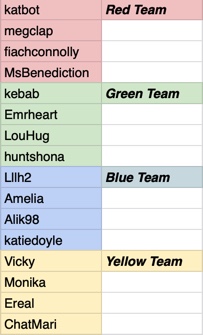
After thanking Sitearm for a most stimulating presentation, John directed you to Brightspace where the Team Project groups are listed. Here they are again.

Project Teams

You will work in these teams for the rest of the semester. John will introduce the Team Project in next week’s class.

h1

Class 2: Blogging to the World

October 3, 2019
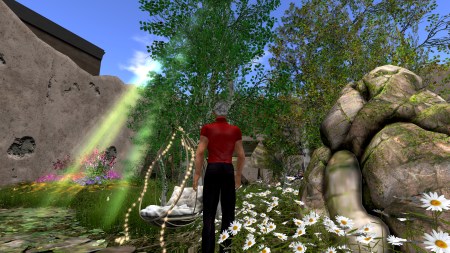
Forest walk

Strolling through a forest in Second Life

Many of you have submitted your blogs which are now listed on page 9 (see the link in the right-hand column). You should have a look at each others blogs and post comments on them. You might even have a look over some of the blogs by past participants on the module. John asked those who have not yet sent him a link to their blogs to do so now. He also reminded you to ensure you posted a bio (for your avatar) to the ‘about me’ page on your blog.

We discussed your experiences travelling around SL and visiting different locations. Many of you found interesting places but were struck by the lack of people there. This may be due to the time difference between here and North America, where the vast majority of SL residents are based, or it could just be that the places were built by residents who enjoy building for its own sake and are not interested in attracting visitors. Many of you remarked on the curiosity of avatars engaging in sunbathing and other ‘human’ activities which seem pointless for an avatar. This opened some musing on how and why people use SL: is it purely social? is there an opportunity for business activity? does the ‘reality’ of the environment help social lubrication? when you can teleport between locations why build roads and railways? are vehicles purely ornamental? why would anyone bother?

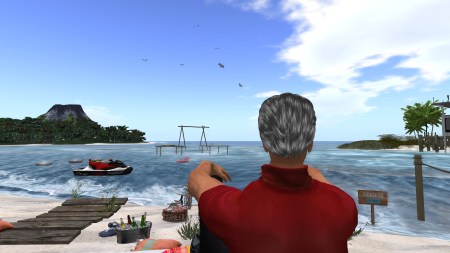
Beach

Do avatars enjoy sunbathing as much as people do?

Arising from the final point John suggested it would be worth considering why spaces such as SL, or other online environments, might be preferable social spaces for some people. For example, people who find it difficult to engage with others in RL due to shyness have found confidence in virtual environments where they have more control over the interaction.

We spoke about the need for clarity around our interactions: avatars don’t do body language (beyond some very basic movements) so that means we have to add the subtle layer of communication into our interactions very deliberately. Even reassuring each other that we are still online and paying attention is necessary. Giving regular feedback to indicate our presence is essential in all online engagement.

John introduced this week’s assignment to meet other residents in SL and try to engage in conversation. Some of you have already done this so you can record the results in your blog post. Be careful in this exercise because SL, just like RL, has all sorts of individuals wandering around. If you feel uncomfortable at any time just quit immediately. Don’t forget to set the classroom as your Home Location so you can return there easily.

h1

Class 1: Welcome to SL

September 26, 2019

We got off to an excellent start this semester. All of you found your way to the virtual classroom in SL on time and seemed well settled in by the time John arrived. In fact, it was John who had a little difficulty getting his mic working but before long everyone had settled down and making friends. In online virtual environments ‘making friends’ is a specific action rather than the vague relationship development it can often be in Real Life (RL). Whether you are active on Facebook, Snapchat or any other social media liking, following or otherwise hooking-up with others is an activity that requires an offer followed by acceptance or rejection. In spaces such as SL this gives you access to otherwise private conversations and locations. It also allows you to track each other’s location and communicate more easily.

John also gave you membership of the module group which confers additional privileges in the TU Dublin campus. More on this later in the module. We also shared real names so John can match your avatars with your student records. And after all that we had the class photo!

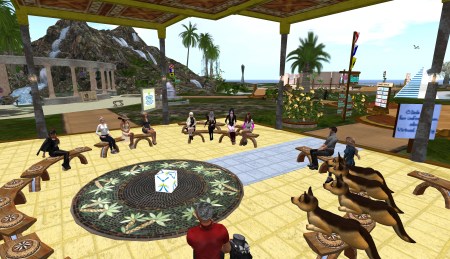
Class photo

Class photo – all eager to get started on our virtual journey …


The exercise of moving from the classroom to the balcony was useful as it provided practice in controlling your avatars, which is not as easy as it seems!

Following the photo John introduced the content of the module, explaining what to expect over the course of the semester. He emphasised the importance of independent learning in the module. We meet for only one hour a week but you need to put in the preparation to ensure maximum value can be extracted from that hour. Expect to devote an hour to preparing for class. You should also expect to put in at least another hour-and-a-half on the assignment for each class. This time will increase somewhat when you start working on the Team Project after the fifth week. If you put in a solid effort each week you won’t find yourself overwhelmed at the end of the semester.

The class meetings are intended to be discursive. In other words, we will be discussing the topic of the week, on which you have reading and viewing videos. Your input is what makes the class so be prepared to contribute.

The supporting material in Brightspace is essential to the module so make sure to use it regularly and wisely.

These class summaries are not intended as a replacement for class attendance. Experience indicates that if you attend regularly you can expect to do well in the module assessment. If you miss one or two classes this summary will help keep you up to date but any more regular absence will make it extremely difficult to understand what is required from the assignments.

h1

Autumn semester 2019

September 25, 2019

Welcome to the module ‘Virtual Environments: Is one life enough?’ being offered as an elective module to students of Technological University Dublin School of Creative Arts.

The first class meeting will be on Thursday 26th September at 8:00 pm. We meet online every week at TU Dublin in Second Life. Please note: you will need a Mac or PC desktop or laptop to access Second Life – you cannot do so with a mobile device.

Full details about the module are available to registered students in Brightspace, where you should self-enrol.

If you are new to Second Life, known as SL, then start by reading Getting into Second Life to find out how to access the class. You should then visit SL and find the TU Dublin campus, learn how to get around the virtual world and familiarise yourself with the environment and how to control your avatar. This will take a few hours so give yourself plenty of time before class starts.

Please read pages 1 to 9 in the column on the right also. If you would like to find out more about what to expect during the semester read the posts in this blog: all class since 2009 have been summarised.

If you have any problems email John O’Connor.

h1

Team Projects

May 23, 2019

There was a full gathering for the presentation of the Team Projects, including all of the guest speakers who joined us throughout the semester. The quality and content of each project was excellent. The level of engagement with the subject matter was clearly in evidence – the teams’ response was thoughtful and considered. The teaching team also noted that the slides and YouTube videos were impressively produced.

Red Team was the first to present:


Blue Team delivered in the classroom and, when the slides could not be projected into SL, the team gave us a link to Google Slides: https://docs.google.com/presentation/d/14Tc-nQLE3nzyz6odkb1u0QCJqf1JMtoYrBAC69GdW54/edit#slide=id.p


Green Team was third to deliver its presentation:


Yellow Team finished the evening:

h1

Class 11: Warning!

May 9, 2019

Guest speaker, Prof Noel Fitzpatrick, all alone in class this evening.

Today was extremely disappointing. Only one participant turned up for class. No apologies received from anyone else. You all know that I had a guest speaker scheduled and this was the final taught class of the module. At the very least your unexplained absence is discourteous. Even more of a concern is the fact that we have spoken about the importance of reliability in online engagement throughout the semester. I made it clear that if you couldn’t attend I am happy for you to catch up with the summaries in this blog and all I asked was the courtesy of being notified in advance.

It is not possible to have a discussion with a single student so class had to be abandoned.

The next class meeting in two weeks will be your turn to present your Team Projects. I hope to see full attendance.

You should also ensure your website blogs are up to date.

Acuppa Tae looks around in vain for some students to participate in the class discussion.

h1

Class 10: Content Produser

May 2, 2019

The poor attendance continues with only five arriving for class today and two apologies received.

John suggested we visit Lauk’s Nest, a nature park in SL and one of the first (and now oldest remaining) public places for SL residents and visitors to enjoy in the virtual world. Based on the idea of a ruined ancient Mayan village in a jungle by the coast, it was built originally by Laukosargas Svarog in the very early days of SL’s existence and uniquely, despite changing hands several times, retains its charm. At one stage Linden Lab took on responsibility for the site but it is now owned by a preservation group that fund its maintenance along with donations from visitors. In addition to the lovely views it has some nice interactive features such as a bird feeding table and playable musical instruments in a high tree-house. The video below records a tour of Lauk’s Nest from 2016.

Lauk’s Nest, unlike many public spaces in SL, has the advantage of being a quiet spot which supports voice so we held our class discussion in the inspiring surroundings. To begin we questioned the rationale behind recreating the environments that already exist IRL. What is the motivation? Familiarity? Accessibility? Relaxation? Emotion? Coccinella asked if you wanted something like real life why would you come to Second Life? We decided it must be a matter of perspective. Such vistas are not available to everyone and can be difficult to access; it may be that they provide a taster for the real thing; or perhaps they provide an opportunity for those who have no direct access IRL to have a virtual experience.

EvaKKCara argued that this form of expression is just as valid as any other – it is a form of art. Aestheticant and JCraig added that it is an example of co-creation by a network, or community, of individuals. EvaKKCara added that it has been created by the ‘produsers’ (as described by Bruns) of SL! This process of co-creation also supports the maintenance of a level of quality that in turn ensures the value of what is created.

As the discussion moved on to the creation of content we looked at possible indicators of value. How do we know what we create has value and how can we realise that value? Is it simply about followers and income generation? What is the difference between social influencers, who can be seen as pedlars, and those who generate original content? John suggested that the class in which we looked at identity and personal branding throws some light on the emergence of value. He asked you to consider these in the context of your own blogs and ponder these questions as you move into you own professional careers.

Before we broke up John reminded the class that there is only one more meeting before the Team Work project presentation. You all confirmed that your teams are making good progress! John also suggested that if you don’t have your blogs up to date you should work on doing so immediately – before the end of semester rush to submit portfolios and essays becomes too much of a burden.

h1

Class 9: Walking away…?

April 11, 2019

Unfortunately, the low attendance at class continues this week.

Glenn Loughran joined us today in the guise of Feilimy. John didn’t recognise his avatar and ejected him from the classroom when he first arrived! But we soon settled down, identified those who could use voice and those who, like robadamson travelling on a bus and using the less-than-reliable-wifi signal, would be relying solely on text chat. John introduced Glenn, course chair for the BA Visual Art delivered in Sherkin Island, and attending today from Ecuador, where he is delivering a course, presenting papers at conferences and working on a collaborative research project looking at the idea of islands with Universidad de las Artes. As there was one student whose voice was not working at all John said he would provide a text chat commentary this week.

Glenn suggested that the discussion begin with your ideas about the text and to start off looking at the first half of the story. What is it about? What kind of society does it present?

The responses suggested it was a perfect place, a utopian community, it didn’t have kings or leaders – all are equal, without hierarchy where everyone is happy. Glenn referred to the origin of the Utopian concept from Thomas More’s novel published in 1516. He asked who you think the narrator might be? What is the narrator’s relationship with the community? It was agreed that the narrator’s is an external voice providing, in the first half, a positive yet clinical and objective description. The community is in harmony with nature and has no need or desire for anything but the simplest technology.

Then Glenn asked us to think about the second part of the story. It seems to describe a democracy rather than a utopia: a democracy that is built on the suffering of a child in order to provide happiness and comfort to the rest of the community. Your response was unequivocal: the place now seemed unfair, more dystopian than utopian and reminded you of our world; its wealth reliant on the suffering of the innocent, often children; the rich exploiting the poor. It reminded you of class conflict, racial inequality, exploitation of the developing world by the developed.

Glenn spoke of an island he visited in Ecuador this week and showed us some photos. In the last 15 years rising sea levels are beginning to have a noticeable impact. Buildings are being washed out to sea and the island is slowly disappearing. It is a real example of climate change. The tragedy for those in the region is the inaction of the rest of the world. The idea that we in the West have the opportunity to watch this happening so that we can confirm climate change as a reality before deciding to do something about it is described in Wishful sinking: Disappearing island, climate refugees and cosmopolitan experimentation.

The sinking island off the coast of Ecuador visited by Glenn.

Buildings are being washed out to sea.

A bridge to somewhere…?

Returning to our short story Glenn asked if it is the right thing to do, to walk away from Omelas? Your answers included: yes, because living at the expense of others is not right; reforming the society would disrupt its utopian nature; the community’s happiness must be sacrificed for the good of the suffering child; this is a philosophical question rather than a real one; we have a duty to take part in this discussion and question our privileges.

We concluded by suggesting that the text challenges us to face up to what we actually know and to consider an ethical response. It is about deciding on a course of action for our own lives – knowing that the right thing to do may be difficult. We also considered the story in the context of SL and virtual worlds in general. Do they offer an escape from an unpleasant reality? There are many movies, such as Ready Player One, that support this notion. But, what does it take to maintain a virtual world and can it ever be a replacement for RL? How does our visit to Virtual Ability Island inform our thinking in that space?