Author Archive

h1

Class 5: The group project

November 8, 2017

Glenn and John started the class by thanking you all for your attendance on Thursday last week and apologising for the change in schedule to those who were unable to make it. Then Locks Aichi joined us for a discussion about the brief for the group project #MeToo.

We started by asking you to reflect on last week’s discussion about Marshall McLuhan which had strong contributions from class members as everyone had read the assigned texts. This was informative in the context of the project so John asked for feedback on what the class felt was expected of them for the project. As you were a little shy to contribute at first we asked for thoughts on what the title #MeToo might mean.

Some of the points raised were that it was easier to engage in this debate online as you only needed the hashtag; and how the medium made a difference in a single month when the issue had been raised originally many years earlier, prior to the coming of online social media. It was pointed out that the anonymity of the internet gives a certain level of comfort to speak up on issues where people might usually have been less ready to speak out. It also can be easier to type than to speak and many are more comfortable about coming forward that way: the greater the momentum the greater the impact. There was a sense that the internet supports greater transparency while at the same time results in greater opacity.

For some of you the hashtag aroused different feelings – #MeToo raises the question of the difference between harassment and assault and whether the use of the hashtag, as part of disclosures of both, conflate the issues unhelpfully. The use of the hashtag was also identified to have removed the taboo around talking about this. Strikingly, Uma Thurman demonstrates a particularly sophisticated understanding of the medium when she responds about standing with those who are affected but not being ready to give a ‘tidy soundbite’. Clearly, she is aware of the permanence of whatever might be said and is not prepared to respond in anger. The impact of the medium is becoming obvious and is a cause for concern when people are ‘tried’ by the masses rather than an objective process. The danger of the bandwagon effect also becomes obvious.

So in considering all this, where is the accountability…? The court system supports due process; the tradition of mass media is only to publish articles when facts have been verified. Whether or not we see this being adhered to there is, at least, an agreed process. The question now is where are the checks and balances on the web? The legal profession struggles to address the age of social media…. the question of who is responsible for defamatory remarks on social media is constantly evolving. As the discussion reached this critical point Glenn referenced the movie Circle (2015) which considered this issue.

THINGS TO DO BEFORE THE NEXT CLASS:

  1. View: Fake It – to control your digital identity. In a 2013 TEDx Oxford presentation Danish journalist Pernille Tranberg, who wrote the book Fake It – Your Guide to Digital Self-defense with the German journalist Steffan Heuer, explains what happens with your data, what it can cost you now and in years to come. [Accessed 12 November 2017.]
  2. View: The Power of Privacy. In this 2016 film by The Guardian, Aleks Krotoski travels the world to undergo challenges that explore our digital life in the 21st century. Watch her be stalked and hacked, fight to get leaked documents back, dive into open data and live in a futuristic home that monitors her every move. [Accessed 12 November 2017.]
  3. Read: Who’s watching me on the internet? Technology Correspondent for the BBC, Rory Cellan-Jones writes about our digital footprint and explains data trails in iWonder 2016. [Accessed 12 November 2017.]
  4. Read: Poetics of Relation (1997) by the philosopher Édouard Glissant. He argues against the ‘obviousness of a transparency’ from a post colonialist perspective but it seems to resonate with the discussion in class. Or, you can read a summary of the argument here. [Accessed 12 November 2017.]
h1

Class 4: Media and messages

November 2, 2017

As we moved into November a few scheduling clashes and misfortunes (coupled with this being reading week at DIT) led to the class being held on Thursday this week rather than the usual Wednesday. In addition, the class summary is being posted very much later than usual. Apologies from John and Glenn for disturbing the normal routine but it could not be helped (and thank you for your understanding).

All of you had read the blog post about ‘painfully coming to grips with The Medium is the Message’ and some of you even went on to read the more academic text describing Marshall McLuhan’s influence on ‘reshaping our sensorium’. This led to a lively and informed discussion about McLuhan’s philosophical ideas as expressed in his 1967 collaboration with graphic designer Quentin Fiore, The Medium is the Massage.

We arrived at an understanding of the basis of his theory that mankind is defined by the ability to develop tools – tools that then reshape and redefine the very nature of man and society. Furthermore, we noted that language, and communication in general, is really a tool that has had, and continues to have, the greatest influence on our society. The rapid development of communication technology throughout the 20th Century, culminating with the mass entertainment format of television, was identified by McLuhan to be as significant as the development of speech, writing and printing.

It is clear that we cannot know in what way our tools will affect society. But, McLuhan goes further and suggests that these very tools ‘massage’ us into believing they are merely neutral channels of communication while in fact the tools are having a greater impact on our development than the messages they carry. This development is incremental and not easy to perceive. We cannot predict the future so at best we should try maintain an awareness of the influences of our tools.

We suggested that the digital revolution currently playing out seems to be even more evidence in favour of McLuhan’s theories. His concept of the Global Village coming to life with virtual reality and social media. We will look at this again next class in the context to the group project.

No activities were set for the following week.

h1

Class 3: Team working

October 25, 2017
Sitearm Madonna on team working

Guest speaker Sitearm Madonna talks about team work through poetry!

This week we were rejoined by the second year group of students on the BA in Visual Art and their course leader Joseph Jacotot (aka Glenn Loughran). This group took the module last semester and enjoyed it so much they wanted to return! They were made welcome by the current group and we had one of the highest numbers of students ever to gather for a class in SL.

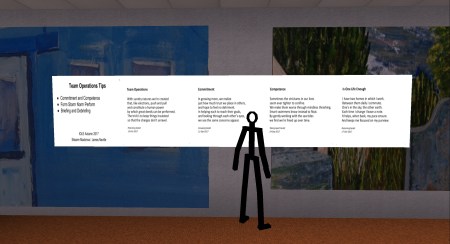
Guest speaker Sitearm Madonna (a veteran on this module) spoke about team working, both in Real Life (RL) and in online and virtual environments. His slide deck Team Operations Tips can be reviewed again and, indeed, it is recommended due to the richness of the content. There was only time to touch on it in class. Site speaks from a lifetime of experience working on various teams – some of which he didn’t wish to be a member, others where he was happy to participate and many of which he led. For me the take away point was about the need for constant confirmation that every member of the team is on the same page. Never assume that people agree when it comes to understanding either the project on which the team is working or the decisions that emerge from meetings. This is evident in team work in RL but it is exacerbated in the online environment where our usual human communication cues are missing. Glenn touched on a point that many of you discussed in your blog posts: the importance of voice in online communication. In RL much of our understanding is based on body language, often unconsciously interpreted, which lets us know when individuals in a group reach understanding, consensus and agreement. In the online environment all of this has to be transmitted through voice and text. Therefore, regular reflection as a group is necessary to prevent difficulties.

The issue of leadership in groups and how to encourage it was addressed and Sitearm emphasised the importance of understanding all the roles necessary for group development and progress. He reminded us that members need to flexible when it comes to stepping in and out of the roles as needed. So, the burden and responsibility of leadership actually falls on each member of the group and should be exercised when needed. Here also, the importance of ensuring that the whole groups is aware of the roles they are inhabiting at any time is critical. Negotiation around roles will help this process.

Sitearm provided entertainment during the question and answer session as he changed avatars from The Saint to Sitearm Madonna the elegant lady to a butterfly to artwork and, finally, burning man.

John referred to the #MeToo group project brief asking you all to read both the brief and the assessment criteria very carefully. By now the class was running a little over time so there were no questions directly on the project. We can discuss it in more detail next week. Referring to the first task to be undertaken before the next class John talked about the range of online tools that are available, many free of charge, to support teams and make up for the lack of fact-to-face (F2F) engagement. They cover all aspects team work from communications (Facebook, WhatsApp, We Chat etc), to project management (Trello, Padlet, Google sheets etc), collaborative note taking and writing (PBwiki, Google documents etc).  You should review some of them and there may be others you are familiar with or have used before. Share you experiences with the group.

THINGS TO DO BEFORE THE NEXT CLASS:

  1. Decide: among your group what tools you will use for planning your project (how you will stay in touch and share information, etc.).
  2. Write the third post: on your blog explaining your choice of communication tools and reflect on how the group arrived at the decision.
  3. Read: Living Structures in Second Life Virtual Worlds Projects by Sitearm Madonna. [accessed 27 October 2017].
  4. Read: Painfully Coming to Grips with The Medium is the Message an amusing and accessible introduction to the philosophy of Marshall McLuhan. [accessed 27 October 2017].
  5. Supplementary reading: Extrapolating on McLuhan: How Media Environments of the Given, the Represented, and the Induced Shape and Reshape Our Sensorium provides a deeper analysis of McLuhan. [accessed 27 October 2017].
h1

Group project: #MeToo

October 23, 2017
alyssa-milano

Actor Alyssa Milano initiated the phenomenal response to the revelations around Weinstein.

The interweb, internet or web as we know it today is one of the most powerful tools of our time. Infact, when we consider it as a medium it is almost impossible to reflect on how much is has impacted our lives and influenced how we interact, with whom we engage and when. As far back as 1977 Marshall McLuhan declared that ‘the medium is the message’ which has been highlighted in many topical occurrences.

Watch: this two-minute introduction to McLuhan’s basic thesis from the Open University

To explore the mechanisms of this still new medium of the web, we will use the topical #MeToo meme created last month by actor Alyssa Milano following the revelations concerning unacceptable behaviour towards women by Hollywood motion picture producer Harvey Weinstein. His behaviour has resulted in his sacking by the company that carries his name and his expulsion from the Academy of Motion Picture Arts and Sciences. Closer to home and earlier this year George Hook, radio presenter on Newstalk, was suspended from his job following his comments on a live broadcast concerning the rape of a young woman.

The multiple abuse allegations against Weinstein have led to #MeToo trending as women report that sexual abuse is a common experience in their lives. The hashtag has become a rallying point for those who remained silent, sometimes for years.

Perhaps the darkest aspect to emerge from these revelations is that Weinstein has been behaving in this manner for decades and it was pretty much common knowledge in entertainment circles. Put this together with Hook’s question about ‘women who put[s] themselves in danger’; the American President excusing his lewd and vulgar comments as acceptable ‘locker-room banter’; and the revelations some years ago concerning the former Italian Prime Minister’s ‘bunga bunga parties’; and it is difficult to avoid the conclusion that our society supports a culture of men who secretly prey on women.

The #MeToo hashtag is an example of how rapidly a topical incident can trend globally on social media. MeToo was originally founded by US activist Tarana Burke in 2007 when she started the campaign to serve sexual assault survivors in underprivileged communities. Now, it has been transformed into a global phenomenon. The aim of this project is to explore how the internet and its components impacted the emergence of the story and its increasing reach.

  1. Track how a local Los Angeles issue became a global phenomenon in a matter of days and present a timeline of its evolution.
  2. Demonstrate how it tapped into, or reflected the zeitgeist.
  3. Explore how it resulted in women around the world saying ‘me too’ and how this has been amplified, why they are doing so and what outcome is expected.
  4. Consider how the zeitgeist could be leveraged to change the latent acceptability of such behavior in society using the medium of the internet and it’s components.

Present your findings in an entertaining, informative and lively manner using whatever medium and format you wish as long as it can be stored for later review (e.g. a talk, short film, narration+visuals). Each team will also present its project live in Second Life. The presentation should be no shorter than five minutes and no longer than ten minutes. You are encouraged to use visual, audio or any other aids to support the presentation during which each member of the team must take part.

Each participant must also describe the progress of the project in a weekly blog post with particular emphasis on their contribution to the project. (What are you bringing to the group and how does it fit into the team’s work?) Discuss the details of the project and also the issues that arise in working collaboratively online. How easy is it meet up virtually and plan the project? What difficulties arise in development? How easy or difficult is communication? What particular problems arise and how do you deal with them? Focus on the experience rather than writing a ‘correct’ post or having an answer for every difficulty.

See page 6 Module assessment for assessment criteria applying to this project.

Important note: If you use images or sound be mindful of copyright, particularly as presentations will be posted to the module blog.

Presentations should be no less than 5 minutes and no more than 10 minutes in duration.

Your presentation can be made in the DIT campus or any appropriate venue selected by the group. Presentation date is normal class time on Thursday 6th December.

Reading list:

Explore one of the responses to #MeToo such at #HowIWillChange created by Australian journalist Benjamin Law. The meme #NotAllMen, which predates #MeToo and has been appropriated by various groups for their own ends, is also worth exploring. [accessed 22 October 2017].

Harvey Weinstein, Hollywood’s Oldest Horror Story. Maureen Dowd delves into the story for the New York Times, 14 October 2017. [accessed 22 October 2017].

George Hook should be challenged not silenced. Kitty Holland writes in The Irish Times that difficult as it might be such opinions need to be challenged so that society can improve, 14 September 2017. [accessed 22 October 2017].

Trump recorded having extremely lewd conversations about women in 2005. David Fahrenthold reports for the Washington Post on 8 October 2016. [accessed 22 October 2017].

#MeToo. Wikipedia traces the origin of the trend. [accessed 22 October 2017].

The Woman Who Created #MeToo Long Before Hashtags. Tarana Burke was originally inspired to develop the ‘Me Too’ campaign in the US when she met a thirteen-year-old girl who had been sexually abused in 1997. [accessed 22 October 2017].

h1

Class 2: Settling in

October 18, 2017

Class started with a little tidying up: making sure everyone had friended each other; you all are members of the module group; and everyone’s voice is working. Sometimes, if voice is not working you can fix it by logging off and then logging in again – it doesn’t always work but it’s worth trying. Otherwise it may be a slow connection – voice is generally the first thing to drop out when the bandwidth or connection speed drops.

Almost everyone had sent in a link to their new blogs. John posted the links on this website (see the link in page 9 in the column to the right) and also to the Facebook group. Some of them that came in later in the afternoon will be posted today. Well done to you all! John noted that the blogs were well presented and written. You all recorded your adventures exploring SL with a critical eye and interesting reflection on some of the issues around choosing how to present your avatars, the loss of anonymity arising from using your own voice, the effect of different time zones on the population of SL. You took lots of pics and illustrated your blogs liberally! Some of you have not yet included a bio so you should do so this week. We had a short discussion about establishing credibility with the bio and using it to signal to the potential reader why they might like to read your work.

We looked at the different voices of the sample blogs (Dolce Merde, Brain Pickings and Chris Brogan) and analysed when and why you might read them. We also tried to determine the purpose of the blogs. So, for example, Chris Brogan is essentially reinforcing his reputation as a thought leader in online marketing whereas Dolce Merde is playfully offering eye candy. The discussion incorporated a review of your own reading habits: where you go for topical news; how you verify the facts presented to you; your unconscious trust in some media sources compared with others etc. An observation arose concerning the tendency for often repeated stories to gather credibility – this highlighted the importance of having confidence in your sources.

You should be cautious around your consumption of information and practice analysing sources to develop discrimination.

John commented that the tone adopted in your blog posts last week was appropriate for the content. It was mostly informal and informative, using a chatty style. You will find that you need to vary this tone from week to week depending on the topic you are writing about. You should also remember the basic principles of academic writing and apply them appropriately during the semester. Probably most important is that you refer to your sources and cite them appropriately. There are many different styles that can be used for citations but the main thing to remember is the purpose: your readers needs to be able to check your source for themselves. The College favours the APA Style so it is usually best to use it. Here are some useful links on the subject.

During the class two strangers wandered in and sat down. After allowing them some time to hear what was going on John invited them to introduce themselves. The most vocal of the pair said he was website developer and designer, mostly working online. He mostly worked on a one-to-one basis with clients and found that working online continuously could be difficult. He recounted that his experience in SL was largely negative, he is regularly trolled and griefed. John responded saying that during the last eight years delivering this module in SL he had met mostly helpful and considerate people and been introduced to many interesting communities that were mostly welcoming and happy to share their experiences with others. We will meet some of them as the semester progresses.

Finally, John said he would issue the list of team members before the next class.

THINGS TO DO BEFORE THE NEXT CLASS:

  1. Make contact: with two or three residents of Second Life. Introduce yourself and engage them in conversation.
  2. Write the second post: on your blog describing your encounters.
  3. Read: 5 steps to build a productive and tight knit remote team [accessed 18/10/17]
  4. Read: 10 Rules of Professional Etiquette for the Digital Workplace [accessed 18/10/17]

OPTIONAL ADDITIONAL READING ABOUT VIRTUAL WORLDS:

h1

Class 1: Introductions

October 11, 2017

The semester got off to a good start with the first class. Everyone found their way into Second Life (SL) and the DIT campus. It was a big surprise to find you all already seated with voice activated when I arrived at 8.30 pm. Well done – I think that is a first! One or two participants had a little difficulty logging into SL or making voice work but hopefully you can iron that out between yourselves in time for next week’s class. Don’t worry, it always takes a little time to settle in.

We got some basic housekeeping done firstly. John ensured he had all participant’s Real Life (RL) names matched to your avatar’s names. Everyone added each other to their ‘friends’ lists so that when you log on to SL you can see who else from our class is already here. It also allows you to send private instant messages (IM) to each other, even when you are in different locations in SL – very useful if you cannot find the DIT campus or get lost somewhere in SL. Everyone was added to the DIT Module group too. You should remember to activate this group when joining the class on Wednesdays: think of it as your virtual student card. It gives you special privileges in virtual DIT (more on that in later classes) and facilitates closed group conversations.

We also agreed to set up a closed FaceBook group to facilitate conversations outside of class. John will use it to notify you all when the class summary is available and we can use it for making arrangements around class, notifying each other if we can’t make it any week etc. Thanks to Bartek for getting this done so rapidly – it is already up and running!

Untitled

Thanks to Bartek for setting up our FaceBook page with such alacrity and Stephen for providing the pic.

John explained that class time will be discursive and interactive during the semester. Reading material will be set in advance to inform the discussion so please ensure you make time to review it, starting with the link below to be read before next week’s class! Please engage in the class discussion, either by voice or text chat: the more you do so the more you will learn. You will also need to spend some time in SL between classes to complete tasks and activities. Specific activities will be set for the first few classes to get you started.

Each of you will need to create a blog in your avatar’s name. You will be expected to post to it at least once per week for the duration of the semester. Once again, you will be give specific topics for the first few weeks to get you started. If you keep this habit and post weekly you will avoid the burden of having to write a complete paper at the end of the module. John also explained that you will divided into groups next week to work on a project which will be presented at the final class of the semester. You are encouraged to read through the pages listed in the right hand column of this website to get full details of the project, see examples of previous student blogs and get an idea of what to expect in the rest of the course.

THINGS TO DO BEFORE THE NEXT CLASS:

  1. Explore: SL with some colleagues from the class. Visit at least 3 different locations. Find them in search or ask other residents for recommendations, or simply select places at random.
  2. Set up your blog: using bloggerwordpresstumblr or any other blog site. Complete the ‘About Me’ page (read some of those pages on other blogs first) and remember it is different from the first post on your blog. Write from the perspective of your avatar: the persona you will be using to explore in this module. Send a link to your blog to John by email or post it in the FaceBook group.
  3. Write the first post: to your blog reviewing the locations you visited. Describe the places and include photos, if you can. Explain what you liked and disliked about the locations and describe any interaction you might have had.
  4. Visit the following: Dolce Merda, Brain PickingsIllustration Friday, Chris Brogan. Think about how you would identify these blog authors…what impression do you get of the person behind the blog?
  5. Read: How to Write a Blog People Want to Read by Susan Gunelius in Lifewire, 20 March 2017.
h1

Autumn semester 2017

September 28, 2017

Welcome to the module ‘Virtual Environments: Is one life enough?’ being offered as an elective module to second and third year students in the Dublin School of Creative Arts.

The first class meeting will be on Wednesday 4th October at 8:30 pm. We meet online every week at DIT in Second Life. Please note: you will need a Mac or PC desktop or laptop to access SL – you cannot do so with a mobile device. If you are new to Second Life, known as SL, then start by reading Getting into Second Life to find out how to access the class. You should then visit SL and find the DIT campus, learn how to get around the virtual world and familiarise yourself with the environment and how to control your avatar. This will take a few hours so give yourself plenty of time before class starts.

Please read pages 1 to 9 in the column to the right also. If you would like to find out more about what to expect during the semester read the posts in this blog: all classes since 2009 have been summarised.


Email John O’Connor if you have any difficulties.

h1

Digital Utopia: the show

May 17, 2017
Snapshot_022

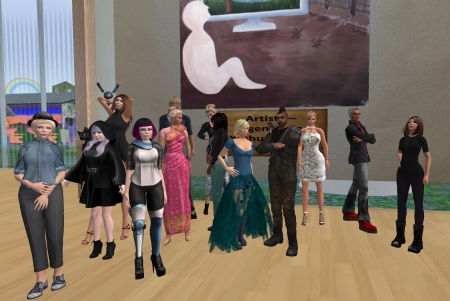
The class photo, with everyone in their finery!

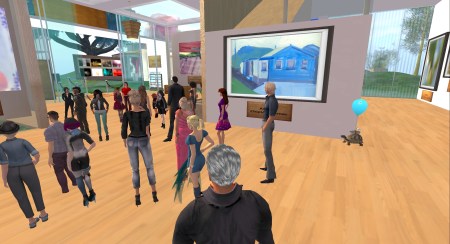
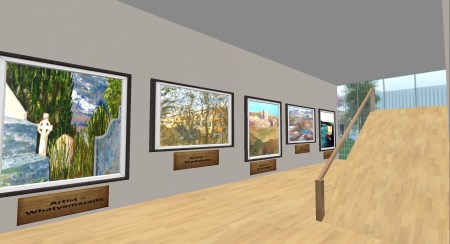
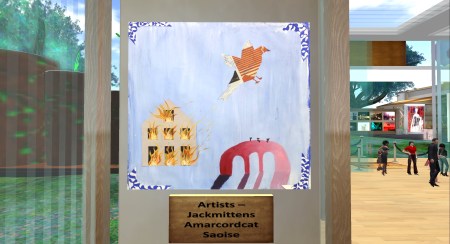
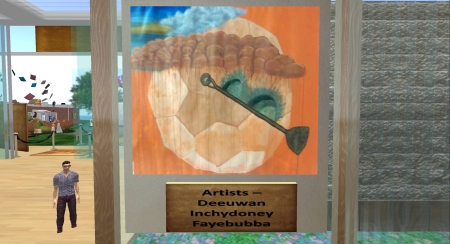
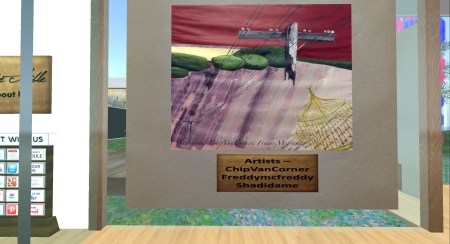
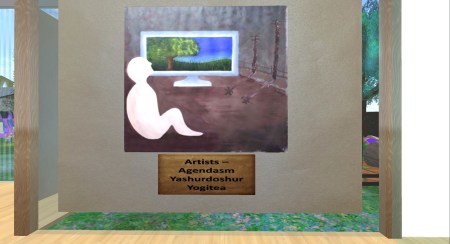
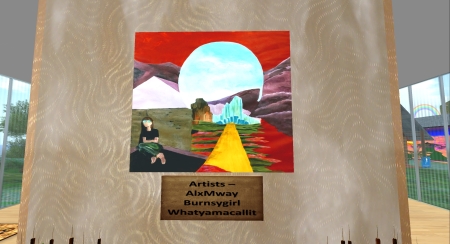
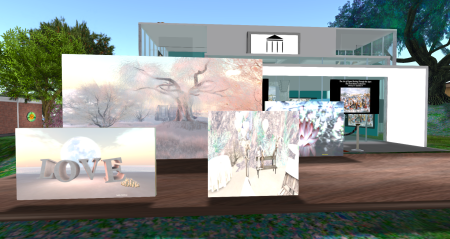
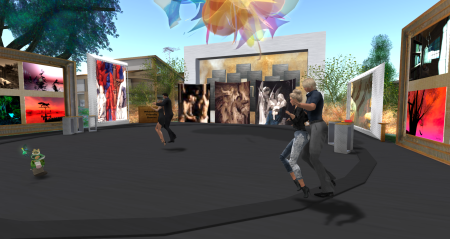
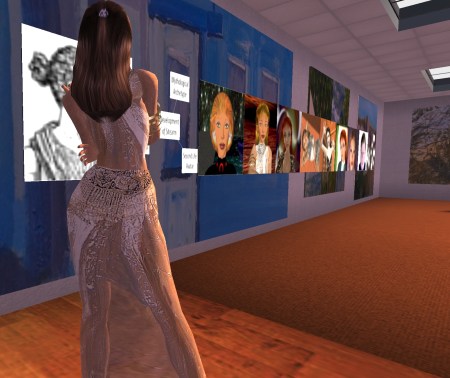
The joint show between DIT students and artists from Virtual Ability Island was a great success. There was so much work exhibited that it burst outside the gallery walls to the surrounding spaces. Turnout for the opening was also great with many friends from VAI coming along to see the work and party afterwards.

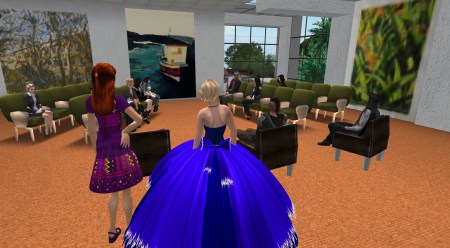
As part of their final assessment for the module the DIT student groups spoke about their collaborative artworks, introducing them to the assembled guests with confidence.

John and Glenn thanked you all for your enthusiastic engagement and hard work over the course of the semester. We also thanked Gentle Heron and everyone at Virtual Ability Island for their support.

Snapshot_012

Students presenting their work.

Snapshot_106

DIT individual student work is on show also. The exhibition continues throughout May.

Snapshot_110

Snapshot_107

Snapshot_104

Snapshot_103

Snapshot_102

33881505004_cd15b4d4c0_o

34561981132_f1da452590_o

34561980652_ce7a2e5e5d_o

The evening ended with a party and dancing.


h1

Digital Utopia!

May 16, 2017
show

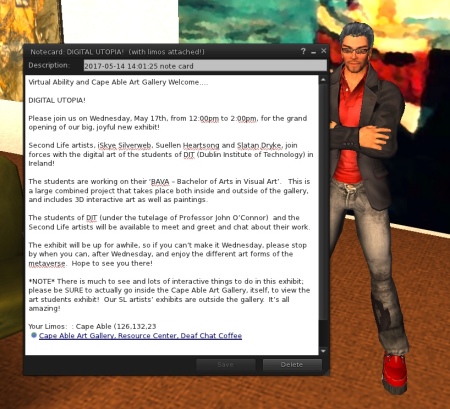
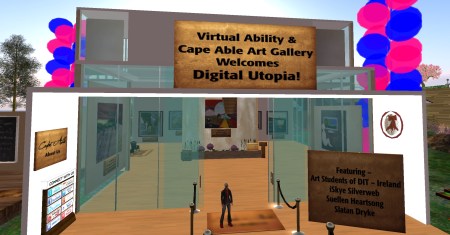
Join us in Second Life (at 8.oo pm Irish Time) for the opening of this semester’s presentation of projects.

Snapshot_001

Cape Able Gallery.

h1

Class 12: Virtual identities

May 3, 2017

Sitearm Madonna visited DIT in Second Life this week to talk about the origin and development of his online persona. An engineer in the US oil industry in RL and manager of Virtual Dublin in SL Sitearm is glamorous female avatar who happens to be male in RL.

Snapshot_004

The glamorous Sitearm Madonna discusses the evolution of his avatar.

A resident of SL almost since its inception in the early 2000s Site elected to inhabit the virtual world in the form of a female avatar from the start. Attracted to the classical Greek myth of Artemis, goddess of the hunt, wild animals, childbirth and virginity but finding the name already proliferating in SL he settled on the anagram. He muses on this decision wondering how it might have been influenced by his working single mother’s life experience, or a simple curiosity. He soon discovered that not only was there a greater choice of clothing available for female avatars but, male associates were prone to bestowing gifts of jewellery.

In the early days of SL communication was via text chat – voice chat did not became available until late 2009 – so there was little to give away the fact that a female avatar might be directed by an RL male. It was only as Site became more engaged with the virtual world in RL, attending conferences and developing a consultancy practice for companies trying to move into SL that his identity became an issue. This led to some colleagues variously being surprised, irritated, embarrassed or unaffected by the revelation.

Snapshot_013

Sitearm, left, introduces one of his alternative avatars.

However, men using female avatars and women using male avatars turns out not to be unusual in SL. Women sometimes refer to unwelcome attention from male avatars as the reason for their choice and, indeed, Site also spoke of this. Locks Aichi also spoke of her decision to use a male avatar saying that she grew up as a tomboy and felt comfortable that way in SL having tried female and male avatars. She does have a female avatar in traditional Nigerian costume which she reserves for special occasions.

We also remembered a past student, Box of Chocolates, who photographed herself in RL with a cardboard box over her head and face, sporting hand drawn features, which then influenced her avatar for the semester.

Virtual worlds such as SL, and social media in general, allow us to explore our identities in new ways. This can be an interesting and revealing experience. In Asian Genders in Tourism Rokhshad Tavakoli reflects on how virtual tourism could be used to overcome barriers to travel for Iranian women. But, one needs to be mindful of the impact this may have on others. There are numerous examples of how it can go terribly wrong from the Syrian lesbian blogger who was revealed to be a married man in 2011 to the outing of a white woman who posed as a black civil rights leader in 2015. They were both seen as behaving fraudulently despite their own insistence that they were presenting an inner integrity.

Somehow, the discussion segued into the subject of robots and cyborgs with special reference to Donna Haraway’s seminal feminist text: A Cyborg Manifesto (1984) which challenges traditional theories of the performativity of gender, proposing the confusion of gender roles against the essentializing of them. For Haraway the Cyborg represents the space to move beyond binary codes into more a fluid and dynamic understanding of identity, she writes;

Cyborgs might consider more seriously the partial, fluid, sometimes aspect of sex and sexual embodiment. Gender might not be global identity after all, even if it has profound historical breadth and depth. (P.108)

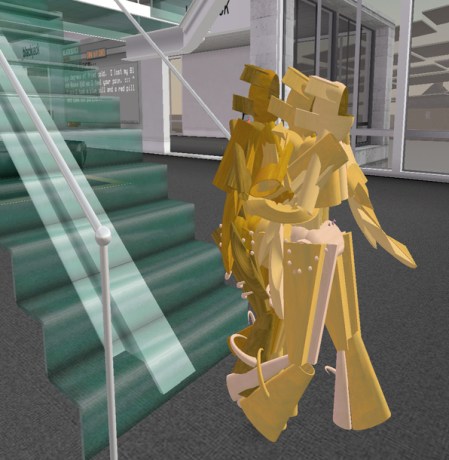
Within this conversation Site told us about the Museum of Robots in SL and promptly his avatar become a yellow robot, reminiscent of Duchamp’s Nude Descending a Staircase, No 2.

6a00d8341bf74053ef00e54f0dfe6f8833-800wi

Tasrill Sieyes, an SL Resident who made Duchamp’s legendary painting come alive.

This constant merging and morphing of identities throughout the presentation was resonant with practices in the field of Queer Pedagogy which seeks to use pedagogical techniques to disturb and trouble the way social norms are constructed and affirmed through traditional educational frameworks. In Site’s performance, the ‘Dragging’ of identity expressed a creative space between socially assigned norms ie ‘Male/Female’, Drag being the in-between (/). Such performative pedagogies also subvert the traditional role of mastery assigned to the teacher in education, allowing for more constructivist horizontal approaches reminiscent of Joseph Jacotot’s radical conception of Universal Education discussed in the first session.

As an extension of this discussion and as a way to both engage with the ‘making’ potential of SL and to interrogate and question the formation of identity in SL, Glenn suggested we build a robot for our next project. However, given that this is the last class of the module before the exhibitions and presentations on the 17th May, this ambitious undertaking will have to be postponed until a future point.

This last class has really been the wildest of them all and certainly opened up new questions and new possibilities within Second life. The students have been on a creative and somewhat disconcerting pedagogical journey through this project, one which has been challenging and bonding in equal measure. It has broadened our understanding of what constitutes a world in the contemporary sense and how we might act in worlds that are still too new to be fully comprehended, but which might at the very least give us a glimpse of what is to come. Class ended with Site offering a guided shopping tour in SL. This was received with much interest and we closed a most interesting discussion.