Merino (aka Çağla Solak) has produced this really useful and easy to follow series of short YouTube tutorial videos for building in Second Life. You can follow the instructions and practice building at Çağ University’s sandbox in the Second Life campus. Don’t forget to activate the Cag University group so you have permission to build.
How to Build in Second Life demonstrates the basics: creating a prim; using the ‘object’ tab to edit; applying textures; and linking objects.
Build a Basic Solar Panel in Second Life applies what was learned in the previous video.
the Basic Mushroom Lamp Modelling in Second Life tutorial explains how to make an object interactive by using a script.
The Second Life Marketplace Guide | How to Buy and Use Items tutorial explains how to find free items to use in your own building.
Using scripts to animate objects so that they react to being clicked is explained in How to Use a Script in Second Life.
Second Life Notecard Giver Tutorial exlpains how to have an object give out a notecard to anyone who clicks on it.
The class this Saturday began with Gentle Heron talking about the importance of accessibility when building in Second Life. The founder of Virtual Ability, she has a lifetime of experience in the area and her approach is based on the principle that ensuring accessibility is not simply to support the disabled but, it significantly improves results for everyone. Gentle also shared a link to the Second Life wiki on accessibility which has lots of useful information.
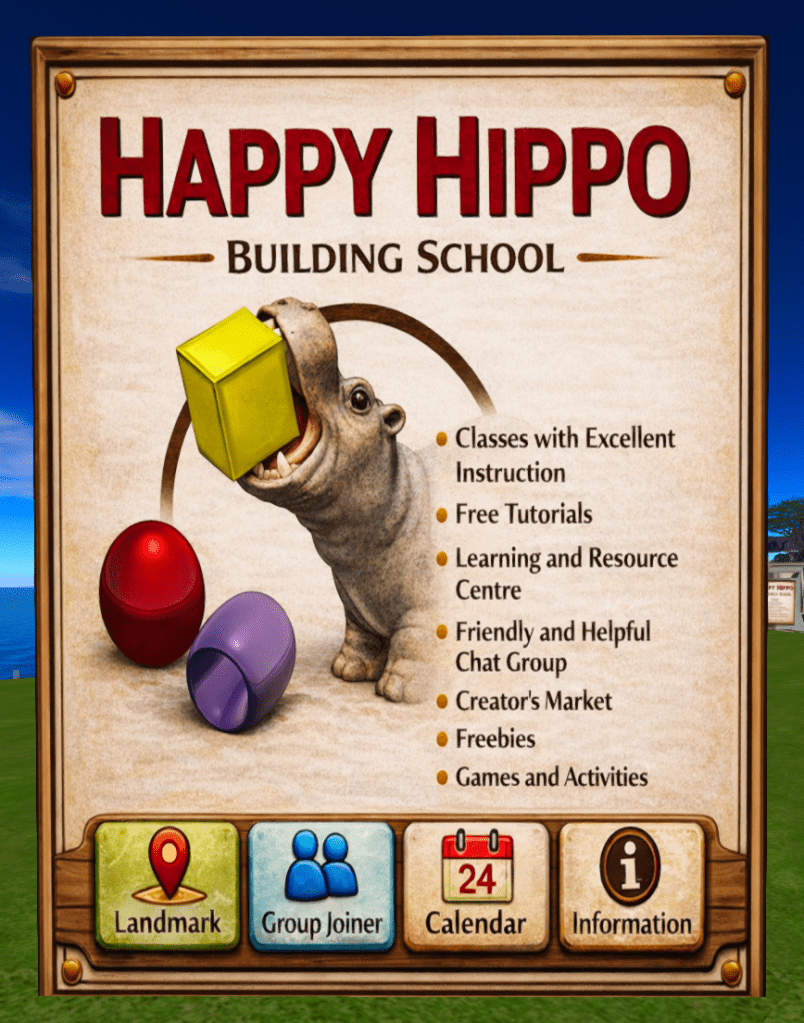
This was followed by a visit to the Happy Hippo Building School with Leslea Aldrin and JeZeBeLe Dagger. The school is a tremendous resource for anyone building in Second Life. It offers regular building classes at all levels and specialising in a range of topics from scripting to adding media. Many classes can be taken at your own convenience and are available all the time. The school is well worth visiting to see the huge range of support available. Here is the Landmark for the school in Second Life.
The VWEC Student Challenge presented a Absolute Beginners Building Class hosted by Tilly from Builders Brewery. The recording of this practical class can be followed by those who couldn’t attend, or by those who attended but would like to brush up on their newly acquired skills.
World leaders came together in 2015 and made a historic promise to secure the rights and well-being of everyone on a healthy, thriving planet when they adopted the 2030 Agenda for Sustainable Development and its 17 Sustainable Development Goals (SDGs).
Today, with the world suffering a range of crises from climate change to a shifting geopolitical situation these goals seem even more important to the future well-being of citizens across the globe.
You task is to select one of the UN Sustainable Development Goals and develop a presentation to explain what it means and how it might be achieved. Each team will choose from the relevant list below and design a virtual education experience explaining what the goal means and what needs to be done so that it can be fulfilled. The team will then build a simulation of this in Second Life. The build must be: • accessible, • authentic, • interactive, • and cite sources
When it is finished you will record a 5 minute video presenting your simulation to the judges.
The United Nations Sustainable Development Goals are a universal call to action in the face of global poverty and the impact of climate change on our planet. Seventeen goals were agreed by all member states in 2015 as part of the 2030 Agenda for sustainable Development. We have nine years left to achieve success and secure the future of humanity on Earth.
The United Nations call follows a Warning to Humanity issued by the Union of Concerned Scientists as long ago as 1992. They ‘feared that humanity was pushing Earth’s ecosystems beyond their capacities to support the web of life’. Five years ago the warning was updated as 15,000 scientists from around the world published World Scientists’ Warning to Humanity: A Second Notice.
Virtual reality (VR) has been in development since the last century but the coronavirus pandemic with its attendant public lockdowns and social distancing has resulted in a rapid growth in virtual engagement as reported in Forbes Magazine and in Newsweek recently. This, in turn, has led to significant development in the supporting technology.
Second Life was one of the first and remains one of the most successful platforms in the social and community development arena that also has significant educational and academic engagement. As an immersive environment with a functioning economy, creative building tools and a large active population it appears to be a self-sustaining world. According to the online magazine, Mic, residents have ‘full Second Life lives, filled with many of the same hobbies and activities one might enjoy in their first life’.
The platform is particularly relevant for online collaboration because it supports persistent chat, offline email, text chat, voice chat, group versus subgroup chat isolation, virtual to real world currency exchange (a precursor to bitcoin), inworld collaborative three dimensional build, three dimensional avatar self representation and interaction, and three dimensional environment immersion.
Second Life can be seen as a mirror to the real world, or an extension of the world. Does this virtual environment have a responsibility to also mirror the demand for sustainable development?
Assuming the answer is a resounding ‘Yes!’ the question becomes: how does Second Life measure up in terms of sustainability and responsible practices?
The Brief
Your task is to examine this question in the context of the UN Goals and report on the platform itself, the communities that it supports and the activities of the residents. Identify good practices and shortcomings; recommend possible improvements in operation; and present your conclusions. In researching this project draw on examples from your own culture, or the culture in which you are now residing. Compare this to what you observe in Second Life.
In short, your presentation should answer the question:
How does Second Life measure up in terms of sustainability and responsible practices ?
You will be assigned to a team to work on the project. Each team will be assigned one of the following three key topics: Economy, Society, or Environment and you will attempt to answer the question in the context of the sub topics listed for each theme below.
During the final class, at the end of the semester, each team will make a presentation in an entertaining, informative and lively manner, live in Second Life. The presentation should be no shorter than five minutes and no longer than ten minutes. You are encouraged to use visual, audio or any other aids to support the presentation during which each member of the team must take part.
Here are the three key topics, with the sub themes for each:
Economy
Society
Environment
All teams will also address the following sub topics:
Deliverables
Participation in the rehearsal of presentations.
Participation in the presentation of your Team Project.
Following the Team Project presentations write the sixth section of your essay reflecting on your contribution to the presentation, the reaction from the audience and the overall success (or otherwise) of your group work.
Assessment Criteria
It is important that you read and understand the Assessment Rubric (you will receive a copy from your lecturer in class) given for this assignment so that you understand the basis on which the assessment will be made. There are 6 assessment criteria in total. Each member of your group will receive the same mark for the first 2 criteria, For the other 4 criteria you will receive an individual mark.
Group Mark:
Communication with the audience: establishing a connection with the audience to deliver a coherent presentation.
Content: addressing the theme of the brief coherently.
Individual Mark:
Tools for Collaboration: selection of appropriate tools for group planning and effective use of the tools.
Teamwork: contribution to the team and demonstration of understanding of team dynamics.
6th section of your essay: ability to describe activity coherently, reflect on experience and present a critical evaluation of the process of developing the project, citing appropriate references.
Quality of Presentation: individual contribution to the presentation of the project.
This is the brief for this semester’s Team Project – ‘No One is too Small to Make a Difference’.
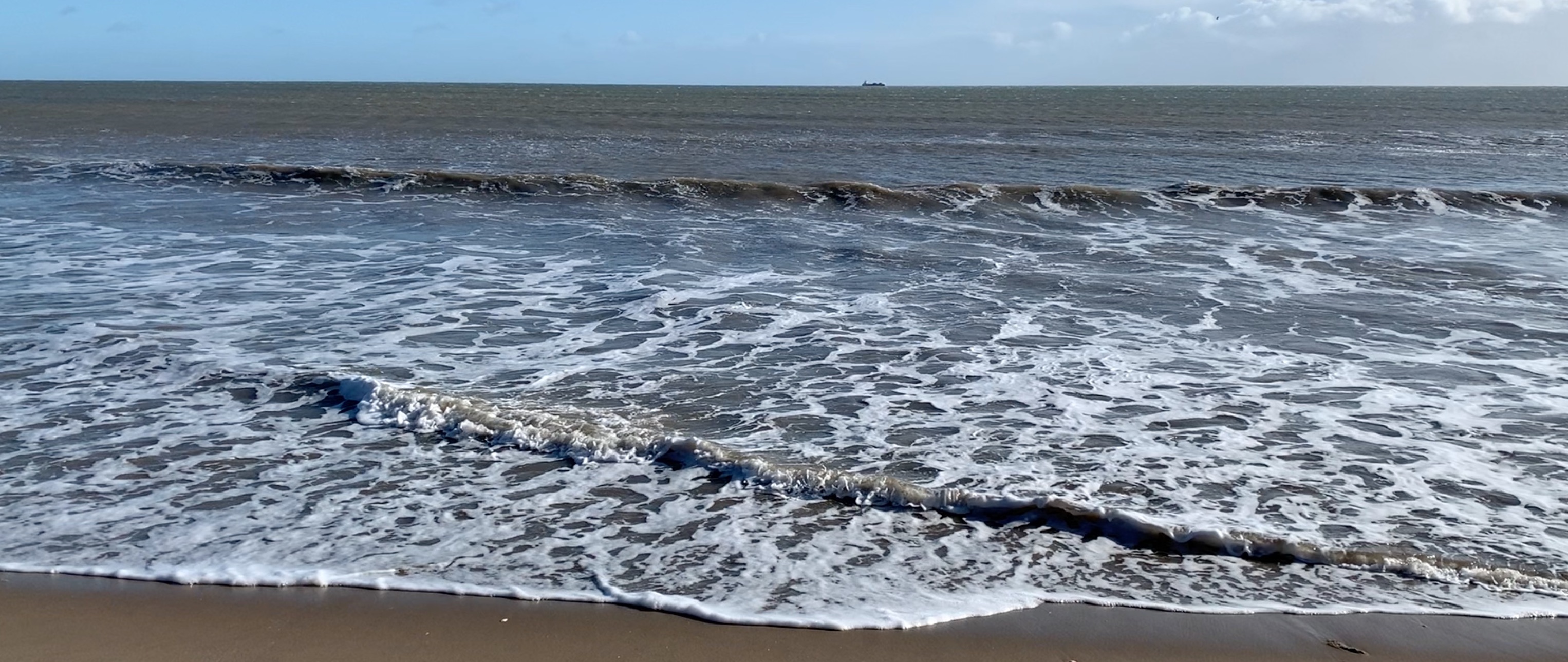
Photograph by John O’Connor.
The United Nations Sustainable Development Goals are a universal call to action in the face of global poverty and the impact of climate change on our planet. Seventeen goals were agreed by all member states in 2015 as part of the 2030 Agenda for sustainable Development. We have seven years left to achieve success and secure the future of humanity on Earth.
French philosopher Bernard Stiegler suggests that the excesses of the consumerist model are responsible for driving the world rapidly towards a dead end. Speaking in London at the Work Marathon event in 2018 he argued that a radically new approach to shaping our society is required. Rather than allowing capital and technology to dictate we need to bring epistemological, technological, artistic, judicial, social and economic questions together in order to shape the future.
This calls for a rethink of our way of life are growing more persistent as evidenced by activists such as Oğuz Ergen from Türkiye and Greta Thunberg from Sweden.
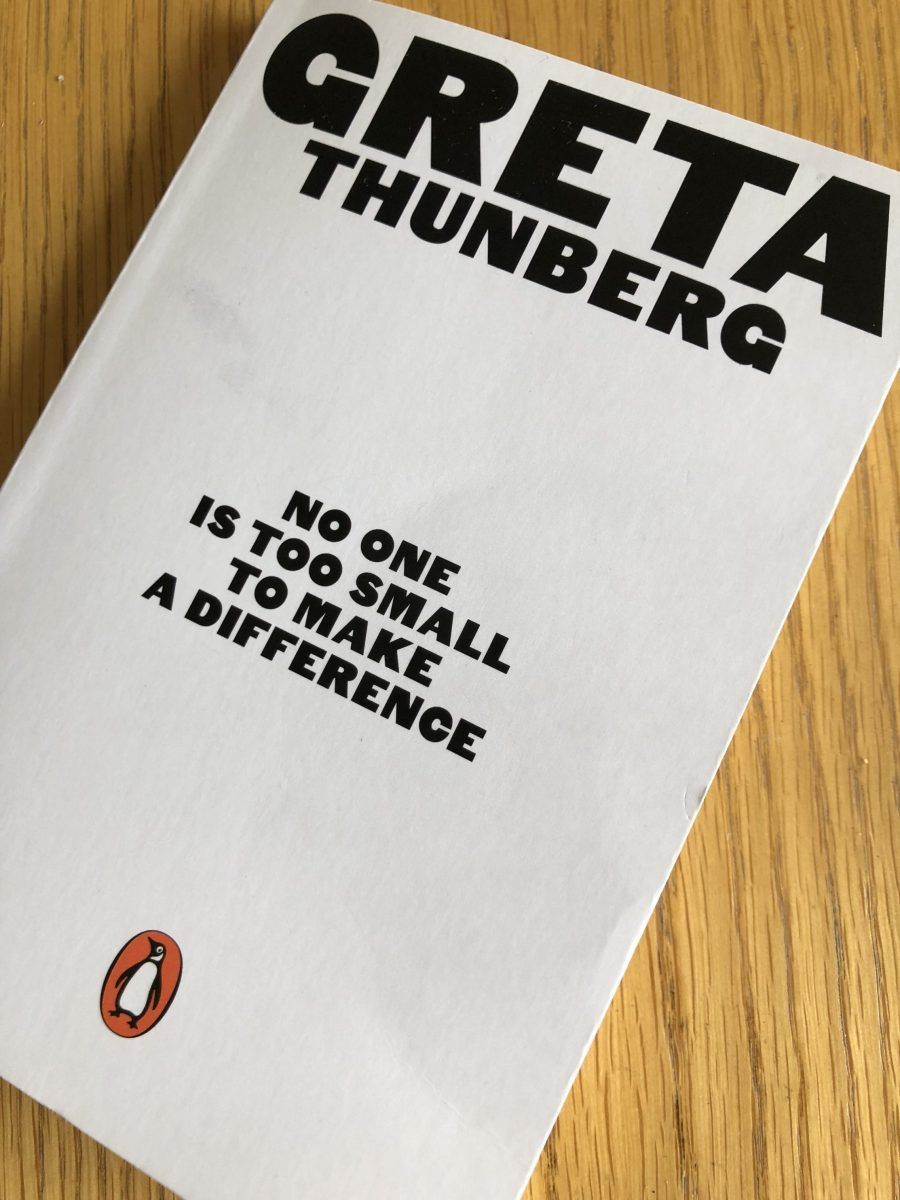
Thunberg, speaking at Davos in 2019 said ‘our house is on fire’ and implored world leaders to extinguish the fire before it gets out of control. Later that year she published her talks in a little book titled No One is Too Small to Make a Difference. If one small Swedish schoolgirl can make a difference in the world then it follows that we can all do so.
What difference can you make?
The Brief
Meet in your teams and discuss this text. Read the referenced texts and look at the videos to inform and expand your understanding. Find additional sources to deepen your knowledge and share these with your team members.
· Discuss your response to the issues.
· How does this make you feel?
· What might you be able to do about it?
Develop your ideas into a collective response and design an action plan in response to the crisis. Decide what you can do individually in your families, local communities or university. Agree on a joint approach and select a single action or a change that you think will lead to a specific outcome.
Develop a strategy to achieve your goal and an approach to communicating it to others in your community so they will join you in achieving greater success.
Submission
Build an installation in Second Life that explains your project to visitors and devise a guided tour that you will give to residents encouraging them to do something similar. Each team member should have a specific role in the tour.
Write a reflective review of the team project and how it progressed. Refer to team building theory and describe how it played out in your experience of the project. In particular, describe your own contribution to the project and to the team.
What kind of office do you think you might be working from in the future?
As you prepare to leave college with your degree the prospect of seeking a fulfilling career will become increasingly important. Much is being written now about the changing nature of work. As long ago as 2012 Forbes suggested that Job Hopping is the New Normal for Millennials. opens in new window But, the Guardian newspaper reported that the trade unions in Britain are concerned about the abuses of the gig economy suggesting it results in lower wages. An article in The Guardian, TUC wants clampdown on ‘poverty pay’ in gig economy jobs opens in new window, revealed that almost half of adults aged 25 or over were earning less than the minimum wage.
The World Economic Forum report on The Future of Jobs 2018 opens in new window provides a comprehensive analysis of trends on an industry-specific and country-specific basis. In the section on Strategic Drivers of New Business Models opens in new window it concludes that the unfolding of the Fourth Industrial Revolution is resulting in a variety of new and emerging jobs while the more traditional job roles are declining. But, there is some good news for you as the Economist reported in 2016 that people working in creative fields are less susceptible to automation in Automation and Anxiety. opens in new window
Taking a more holistic perspective raises deeper concerns for the future of not just work, but the entire ecosystem of society. French philosopher Bernard Stiegler suggests that the world is heading rapidly towards a dead end thanks to the consumerist model. Speaking in London opens in new window in 2018 he argued that a radically new approach to shaping our society is required. Rather than allowing capital and technology to dictate we need to bring epistemological, technological, artistic, judicial, social and economic questions together in order to shape the future.
In 1992 the Union of Concerned Scientists issued a Warning to Humanity suggesting that vast human misery would ensue if we did not change how we are impacting the planet. They ‘feared that humanity was pushing Earth’s ecosystems beyond their capacities to support the web of life.’ Last year the warning was updated when 15,000 scientists from around the world published World Scientists’ Warning to Humanity: A Second Notice opens in new window.
As if all that was not enough, we are now living through a global pandemic that seems likely to impact all our futures in ways we cannot predict. Working from home has already become a commonplace experience that is unlikely to change even when the pandemic eases. Online activity is becoming increasingly acceptable and people have adapted quickly out of necessity but more thought needs to be given to the principles of working between home and an office. Organisations like McKinsey & Company are already giving advice like that in the article Reimagining the office and work life after COVID-19 opens in new windowfrom June of this year.
This is a real challenge to you, individually and collectively, as you consider your emergence into society from college. For this project you are asked to consider how you might address the problems facing society while earning a living and living your lives. Do you accept the premise of the World Scientists? Can you see ways in which it is possible to work for a more sustainable engagement with our planet? Do you think the current situation might offer society an opportunity to re-think what we do and how we do it?
The Brief
You team is tasked with proposing how the workplace of the future might operate, taking into account the issues raised above, particularly sustainability. Consider issues such as the design of office/studio/workshop spaces, flexible working arrangements, presence, virtual and online engagement, new social norms for the workplace and so on. Clearly, you will need to address specific requirements for different disciplines and professions.
You will work on this project in your groups to make your presentation in an entertaining, informative and lively manner using whatever medium and format you wish as long as it can be stored for later review (e.g. a talk, short film, dramatic presentation, narration+visuals). Each team will present live in Second Life. The presentation should be no shorter than five minutes and no longer than ten minutes. You are encouraged to use visual, audio or any other aids to support the presentation during which each member of the team must take part.
Each participant must also describe the progress of the project in a weekly blog post with particular emphasis on your own contribution to the project. (What are you bringing to the group and how does it fit into the team’s work?) Discuss the details of the project and also the issues that arise in working collaboratively online. How easy is it meet up virtually and plan the project? What difficulties arise in development? How easy or difficult is communication? What particular problems arise and how do you deal with them? Focus on the experience rather than writing a ‘correct’ post or having an answer for every difficulty.
Important note: If you use images or sound be mindful of copyright, particularly as presentations will be posted to the module blog.
Presentations should be no less than 5 minutes and no more than 10 minutes in duration.
Your presentation can be made in the TU Dublin campus or any appropriate venue in Second Life selected by the group. Presentations will be delivered in the last class at the end of the semester.For full details on the Team Project specifications and the assessment criteria see the Assessment Unit.
Does the current pandemic provide an opportunity to re-evaluate how we spend our time?
As you prepare to leave college with your degree the prospect of seeking a fulfilling career will become increasingly important. Much is being written now about the changing nature of work. As long ago as 2012 Forbes suggested that Job Hopping is the New Normal for Millennials. opens in new window But, the Guardian newspaper reported that the trade unions in Britain are concerned about the abuses of the gig economy suggesting it results in lower wages. An article in The Guardian, TUC wants clampdown on ‘poverty pay’ in gig economy jobs opens in new window, revealed that almost half of adults aged 25 or over were earning less than the minimum wage.
The World Economic Forum report on The Future of Jobs 2018 opens in new window provides a comprehensive analysis of trends on an industry-specific and country-specific basis. In the section on Strategic Drivers of New Business Models opens in new window it concludes that the unfolding of the Fourth Industrial Revolution is resulting in a variety of new and emerging jobs while the more traditional job roles are declining. But, there is some good news for you as the Economist reported in 2016 that people working in creative fields are less susceptible to automation in Automation and Anxiety. opens in new window
Taking a more holistic perspective raises deeper concerns for the future of not just work, but the entire ecosystem of society. French philosopher Bernard Stiegler suggests that the world is heading rapidly towards a dead end thanks to the consumerist model. Speaking in London opens in new window in 2018 he argued that a radically new approach to shaping our society is required. Rather than allowing capital and technology to dictate we need to bring epistemological, technological, artistic, judicial, social and economic questions together in order to shape the future.
In 1992 the Union of Concerned Scientists issued a Warning to Humanity suggesting that vast human misery would ensue if we did not change how we are impacting the planet. They ‘feared that humanity was pushing Earth’s ecosystems beyond their capacities to support the web of life.’ Last year the warning was updated when 15,000 scientists from around the world published World Scientists’ Warning to Humanity: A Second Notice opens in new window.
As if all that was not enough, we are now living through a global pandemic that seems likely to impact all our futures in ways we cannot predict. Working from home has already become a commonplace experience that is unlikely to change even when the pandemic eases. Online activity is becoming increasingly acceptable and people have adapted quickly out of necessity but more thought needs to be given to the principles of working between home and an office. Organisations like McKinsey & Company are already giving advice like that in the article Reimagining the office and work life after COVID-19 opens in new window from June of this year.
This is a real challenge to you, individually and collectively, as you consider your emergence into society from college. For this project you are asked to consider how you might address the problems facing society while earning a living and living your lives. Do you accept the premise of the World Scientists? Can you see ways in which it is possible to work for a more sustainable engagement with our planet? Do you think the current situation might offer society an opportunity to re-think what we do and how we do it?
The Brief
Your team has been commissioned by a global firm in the communications sector to convince senior leaders that the time has come for change. The Board of the organisation recognises the challenges heralded by the pandemic and has acknowledged the imminent destruction of our planet if something is not done to address sustainability. It has decided that the company needs to lead the world to a new way of working. You have been briefed personally by the Chairman of the Board and the Chief Executive Officer (CEO) who have arranged a day-long online workshop in mid-January to which all senior executives have been instructed to attend. It is intended that the outcome will be a completely new direction for the organisation that is fully sustainable, flexible and indeed, will lead the way in rejuvenating the planet and our relationship with our home.
Your task is to kickstart the session with a dynamic, exciting and informative presentation. You must inspire a group of hard-nosed executives who have been ruthlessly successful in exploiting the planet’s resources (including their employees and customers) for the company’s benefit, without any consideration for the consequences, to review their behaviour and plan a new future.
You will work on this project in your groups to make your presentation in an entertaining, informative and lively manner using whatever medium and format you wish as long as it can be stored for later review (e.g. a talk, short film, dramatic presentation, narration+visuals). Each team will present live in Second Life. The presentation should be no shorter than five minutes and no longer than ten minutes. You are encouraged to use visual, audio or any other aids to support the presentation during which each member of the team must take part.
Each participant must also describe the progress of the project in a weekly blog post with particular emphasis on your own contribution to the project. (What are you bringing to the group and how does it fit into the team’s work?) Discuss the details of the project and also the issues that arise in working collaboratively online. How easy is it meet up virtually and plan the project? What difficulties arise in development? How easy or difficult is communication? What particular problems arise and how do you deal with them? Focus on the experience rather than writing a ‘correct’ post or having an answer for every difficulty.
Important note: If you use images or sound be mindful of copyright, particularly as presentations will be posted to the module blog.
Presentations should be no less than 5 minutes and no more than 10 minutes in duration.
Your presentation can be made in the TU Dublin campus or any appropriate venue in Second Life selected by the group. Presentations will be delivered in the last class at the end of the semester.
For full details on the Team Project specifications and the assessment criteria see the Assessment Unit.





 Virtual Environments: Is one life enough?