Posts Tagged ‘Group Project’

h1

Class 3: Exploring SL

February 18, 2016

This week saw better attendance than last week and all participants shared links to their blogs. John will review them and post comments (where possible, tumblr and blogger don’t seem to allow this). There was a discussion about the best way to communicate which led to the setting up of a Facebook group for the class. This will be the main method of communication outside of SL.

We got reports from everyone about their experiences exploring Second Life. The reaction was mixed with the exercise throwing up some of the difficulties interacting with the virtual world and its residents. We will talk about interacting with other avatars next week, when everyone will have had an opportunity to try it out!

Not everyone had read the assigned text so John reminded the class of the importance of doing so. If not, we will break off to read it during class and then run on late. It is necessary to have read the text so that an informed discussion can be had. We did go on to talk about how virtual teams might work. Everyone joined in and gave examples from their own experience. The general view is that it is more difficult to build and maintain teams that do not meet in real life. John suggested that participants keep an eye on this aspect of their experience over the semester and review their opinions at the end to see if they have changed in any way.

Because of attendance a slight rearrangement of groups will be needed. John will post the updated group members to the Facebook group.

THINGS TO DO BEFORE THE NEXT CLASS:

  1. Explore: SL and find at least two different strangers to talk to. Find out what you can about their second life; what they do in SL; why they spend time here; what interests they have; and so on. Remember that in SL there is no need to be shy – it is not unusual to approach other residents and start a conversation.
  2. Write the third post: on your blog describing your encounters.
  3. Read: The truth doesn’t seem to matter very much in UCD revenge porn saga an opinion piece in The Irish Times that reveals the fear and uncertainty surrounding online engagement.
h1

Class 2: Getting to know SL

February 11, 2016

There seems to be an issue with attendance in the class. Only three out of the nine participants enrolled have attended so far – and not the same three each time. That means that four participants have not yet appeared in class. Last week one person sent apologies in advance but none of the other absent class members has done so since. Therefore it is unclear whether some people have opted out of the module with letting John know or were absent for another reason.This is unsatisfactory for all concerned because we are now two weeks into the syllabus but not everyone has gone through the introduction to the module.

Small classes, by their nature, are more intense and demanding on students than larger ones because there is nowhere to hide: everyone must contribute if meaningful discussion is to occur. This means that students can gain more due to greater individual participation. Unfortunately, it also means that even one absence from class meetings is very obvious and impacts on the possibility of sharing a range of different views. It also means it is not viable to host guest speakers or visit other locations as a class.

empty class_001

Finally, lack of attendance makes student group project work difficult. (This will not impact on assessment because participants are assessed individually.) It has a real impact on the depth of learning – experiential learning about the dynamics of group work is not possible of one is not actually a member of a group! The learning can only only be academic if you are in a group of one.

Those who attended class this week met Prof Dudley Dreamscape from University of Akron who joined the class and offered his support to participants. Each participant introduced themselves in the form of an ‘elevator pitch’, a less than thirty second statement of their interests. Other than that the class was a repetition of last week’s introduction. Interestingly, some of the participants already have blogging experience. The advice for this class is not to use an existing blog but to start a new one to record your experiences and reflect on what you learn throughout the module.

John also identified the student groups for this semester which will be notified to participants by email.

All participants are asked to read the post for Class 1 and complete the tasks listed under ‘Activity for next week’s class’ before we meet next week. In addition, you need to complete the tasks listed below before next week. That will involve visiting Second Life during the week, with your team mate.

THINGS TO DO BEFORE THE NEXT CLASS:

  1. Explore: Get to know your team partner and explore SL together. You are to visit at least 3 locations that are new to you. Find them in search, or ask other residents for recommendations or select them at random.
  2. Write the second post: on your blog reviewing the locations you visited. Describe the places and include photos, if you can. Explain what you liked and disliked about the location and talk about any interactions you had.
  3. Read: 5 steps to build a productive and tight knit remote team

h1

Class 1: First meeting

February 4, 2016

Well done to those who made it to Second Life for the first class! You all managed very well indeed. For those who are still having difficulty logging into SL please talk to your colleagues and see if they can offer advice and help.

The landmark to Dublin is no longer working so after contacting John we all teleported directly to the media centre for an introduction to the course. The regular class meeting time will be Thursday at 8.00 pm and finishing between 9.00 and 9.30 pm. We will meet at the Media Lab and all participants saved the location so you will be able to return there whenever you log into SL. For anyone who missed it here is the link again DIT in SL

We also added each other to our ‘friends’ list. This enables you to see when participants login to SL and you can send an instant message (IM) to each other when you are in different locations – very handy if someone gets lost in SL. John also added you to the DIT Module group.

John explained that class will be interactive and discursive. Each week we will look at a different topic, introduced by a set text that you are asked to read before the class so as to inform the debate. It is important that all participate fully and engage to get the full benefit from attending. You will also need to visit SL between class times to complete activities that will be set to encourage exploration. Specific activities will be set for the first few classes to get you started.

You were all asked to create a new blog for the duration of the course. You will be expected to write a weekly post describing your experience of the class and the discussions and activities in which you engage. If you keep this habit and post weekly you will avoid the burden of having to write a complete paper at the end of the module. John also explained that you will be paired off next week to work on a project which will be presented at the final class of the semester. You are encouraged to read through the pages listed in the right hand column of this website to get full details of the project, see examples of previous student blogs and get an idea of what to expect in the rest of the course.

ACTIVITIES FOR NEXT CLASS:

  1. Set up your blog: using bloggerwordpresstumblr or any other blog site. Complete the ‘About Me’ page (read some of those pages on other blogs first) and remember it is different from the first post on your blog. Write from the perspective of your avatar: the persona you will be using to explore in this module. 
  2. Write the first post: to your blog about your expectations for this module – what you hope to get out of it, what you think you might contribute, etc. Address the relevance of  module objectives from your perspective, ie, justify why you think they are important to you.
  3. Look at: John O’Connor’s blog and Dreamscape Diary bearing in mind what you learned today compare your own blog writing to this.
  4. Visit the following: Dolce Merda, Brain PickingsIllustration Friday, Chris BroganStyle Pantry Think about how you would identify these blog authors…what impression do you get of the person behind the blog?
h1

Class 8: Projects

November 19, 2015

Students presented progress on their projects in this week’s class. Each group is well engaged in their work, having visited potential buildings around SL and selected one to work with. Students have made an effort to contact the owners of buildings with varying success. We discussed ways of finding out who to contact and how to go about establishing communication. Sometimes this is not as easy as it sounds – even if the avatar is standing in front of you as we discovered last week.

John introduced the class to ‘notecards’ and demonstrated how to make a new notecard and share it with somebody, even when they are offline. This can be a useful way of explaining your interests and reason for making contact.

A few comments on your blogs: most of you are not keeping up with the prescribed posts. You should all have written at least seven posts by now (as listed in the Activities for Next Class section of each class summary). Your posts should be more than a simple description of your activity in SL. You need to reflect on what you are seeing around you; what you feel about the experience; and what you are learning. Look at Rory and Paige’s blogs for good examples. After class 8 your blogs will be assessed again so make sure to get them up to date.

ACTIVITIES FOR NEXT CLASS:

  1. Write the eighth post: to your blog describing progress on your project.
h1

Group project: Building in SL

October 30, 2015

The project is to explore SL to find an interesting building. By ‘interesting’ we mean:

  1. the design (interior or exterior);
  2. the purpose (what use the building has been designed for);
  3. the actual use of the building (it may be that it ends up having a different use than the original purpose);
  4. the type of people who visit, own or use the building; etc etc.

For the project each pair of students will visit at least five possible buildings before selecting one to work with. The building must be open to the public (or, in the case of a private dwelling, permission should be sought from the owner) and freely accessible. The rationale for selection is to be developed and a presentation made to support your choice. The presentation should describe the building drawing attention to the key aspects that make it interesting. It should also describe the building in context:

  1. how it fits into the immediate environment;
  2. its fitness for purpose;
  3. the use to which it is being put;
  4. the origin of the building;
  5. how and why it was built;
  6. whether or not it is considered a success by its owner, builder, users, neighbours etc.

The presentation should also give the audience a flavour of the building.

The presentation can be made in or near the building or in any other appropriate venue selected by the group/pair. It should last between 5 and 10 minutes. Presentation date is normal class time on Thursday 10th December.

Each participant should also describe the progress of the project in a weekly blog post. Discuss the details of the project and also the issues that arise in working collaboratively online. How easy is it meet up virtually and plan the project? What difficulties arise in development? How easy or difficult is communication? What particular problems arise and how do you deal with them?

See page 6 Module assessment for assessment criteria applying to this project.

Important note: If you use images or sound be mindful of copyright, particularly as presentations will be posted to the module blog.

Central station, Amsterdam

Central station, Amsterdam

Mocha cathedral

Mocha cathedral

Falling Water

Falling Water

h1

New course begins October 1st

September 17, 2015

Snapshot6_004We are pleased to announce that registration for the Autumn/Fall 2015 course is now open. The module will begin Thursday, October 1st, 8:00 p.m. Irish Time, and will be taught online in Second Life.

The ‘Is One Life Enough’ professional social media course is a university-level online course taught weekly for 10 sessions held at Dublin Institute of Technology Campus in Second Life and accredited by Dublin Institute of Technology in Ireland. The audience for this course is undergraduates, professionals, and educators seeking university-level training and credit in the use of online tools, such as Second Life, WordPress, Twitter and LinkedIn. Attending class as avatars participants will maintain online journals between sessions. Students will learn to establish and strengthen their online professional presence. You will learn also to work collaboratively, online, to complete team projects selected by the students and presented at module’s end to a collective university and Second Life audience.

Dublin Institute of Technology Students will receive 5 ECTS Credits as part of their current tuition – contact the office of Dean John O’Connor or your School for details.
Second Life Students receive DIT Accredited Professional Continuing Education Credit for a part-time tuition fee (99 Euro or equivalent in L$/US$) – contact Dublin In SL Registrar Sitearm Madonna
University of Akron Students may receive UOA College Credit as part of their current tuition – contact the office of Dr. Dudley B. Turner.

Inquiries: James Neville (‘Sitearm Madonna’ in SL) sitearm@gmail.com

Module History

In 2009, the ‘Is One Life Enough’ module was founded for Dublin Institute of Technology DIT students by (then) Head of School, John O’Connor (‘Acuppa Tae’ in SL), and eLearning Development Officer, Claudia Igbrude (‘Locks Aichi’ in SL).

In 2010, IOLE received the ‘Jennifer Burke Innovation in Teaching and Learning Award’ from the Irish Learning Technology Association and Dublin City University. Also in 2010, module eligibility was expanded to the greater Second Life Community via collaboration with Dublin Virtually Live Owner, John Mahon (‘Ham Rambler’ in SL).

In 2012, IOLE received the ‘Further and Higher Education Innovation Award’ from Learning Without Frontiers (London, UK). Also in 2012, Dr. Dudley Turner (Dudley Dreamscape in SL) graduated from the Autumn 2012 module as a Second Life Student.

In 2014, module eligibility was further expanded to University of Akron students via collaboration with Dr. Turner.

Organization History

Dublin Institute of Technology is the largest provider of third level education in Ireland with degree awarding authority and is on track to be Ireland’s first nationally accredited technological university.

Dublin in Second Life is a recreation of Dublin City online, celebrating the music, art, education, culture, and enterprise of Ireland and is a premier member of the broad Second Life Community, recognized by both Residents and Linden Lab Top Management.

University of Akron is one of America’s strongest public universities, focused on innovation, entrepreneurship and economic growth.

Vitae

John O’Connor is a Director of Dublin Institute of Technology (DIT) in Dublin, Ireland, and Dean of the College of Arts and Tourism. His work includes sitting on the Senior Leadership Team of DIT, teaching the award winning module, ‘Virtual Environments: Is one life enough?’ and promoting Dublin as a creative city and thriving economic hub. His academic interests include: access to education for isolated communities; the use of technology to support learning; typography; and development of the professional design sector in Ireland.

Dr. Dudley B. Turner is Former Interim Dean, College of Creative & Professional Arts, University of Akron (UOA) in Akron, Ohio, USA. He teaches communication, persuasion, and professional speaking. Dr. Turner is a champion of the use of virtual world communication technologies such as Second Life. He is the 2014 winner of the prestigious Ohio’s Innovative Teacher Award from the Ohio Communication Association.

h1

Class 9: Consumers to Produsers

March 28, 2015

This week is Spring Break for Akron students so the class was in the DIT seminar room in Dublin for a change of scene. For the first half we discussed progress on the group project and re-emphasised the importance of reflecting on what is not working in the collaboration in addition to what is working. It is important that participants are writing about this in their blogs from now to the end of the semester.

The second part of the class consisted of a discussion based around Prof Axel Bruns’ lecture that students had read over the week. At the beginning many professed confusion about what Bruns was proposing but as the discussion progressed it became clear that most understood it better than they realised. It may be that as emerging ‘produsers’ themselves the concept is so familiar that it is almost invisible to them.

The concept of wikipedia not being about the creation of finished products but the ongoing revision of information – constantly amended and updated by people who may have originally come to it as consumers but have become content creators – was clearly understood. The development of the distribution system for news from the formality of traditional newspapers that are controlled by editors and publishers to the openness of blogs, Facebook and such systems that have eliminated the gatekeeper was considered – with particular consideration of the pros and cons. The issue of reliability was surfaced, leading to a reminder of the importance of reputation – and brand. As users become the producers of content: people who care enough to participate – as opposed to those who merely want to consume – personal brand becomes increasingly important.

DIT students are reminded that their blogs were due for the second assessment (after week 8) but this has been postponed to this week giving you a chance to catch up if necessary. The importance of proofreading posts before publishing was emphasised.

ACTIVITIES FOR NEXT WEEK:

  1. Read: about the girl who resigned her position as uk police youth commissioner due to previous tweets (accessed 02/13/15).
  2. Read: about another example of a person losing her job over a tweet (accessed 02/13/15).
  3. Read: why Dr Phil removed a tweet from his TV show (accessed 02/13/15).
  4. Write the ninth post: to your blog reflecting on the benefits and difficulties of collaborating online across time zones.
h1

Class 7: Communication?

March 15, 2015

Class this week proved to be a lesson in communication – or lack of it! Summer time began in the US the previous Sunday but doesn’t begin in Ireland until the end the month resulting in a three week period where the usual time difference between us is increased. We knew about this but, the difficulties associated with adjusting schedules and communicating across continents defeated us this semester. For DIT the 9.30 pm finish time is quite late and moving it on to 10.30 pm is not possible. For Akron students the class takes place in the afternoon and most students have other classes directly after it so changing their schedule is not feasible. In addition, it is reading week for a number of DIT students and they were not expecting class this week. In the end, about six students attended a rather small class gathering – demonstrating in a practical way how difficult online collaboration and communication can be across time zones.

We used the opportunity to discuss project progress with those in attendance and, unsurprisingly, similar difficulties were revealed by the students in relation to their communication within groups. One particular issue that may be a cause of concern to some is the selection of the cause or charity for the project. John and Locks advised students not to become overly concerned about this, reminding that the project is a vehicle for participants to experience working collaboratively online and discover not only what works well but also what doesn’t. It is the process of working together that students are expected to explore and the detail of the project itself is of lesser importance. Group members might also do well to review Sitearm Madonna’s talk, in the second class, about the roles of group members

This conversation continued as the student blogs were discussed. The importance of reflecting critically on the process of working with colleagues in an online environment across different time zones was emphasised. Please read what was posted to the blog around this time last year which outlines what students need to consider in their own blog writing.

ACTIVITIES FOR NEXT CLASS:

  • Lecture: watch ‘From Prosumer to Produser: Understanding User-Led Content Creation‘ by Prof Axel Bruns (Creative Industries Faculty at Queensland Institute of Technology) explains his theory of user-led collaborative content creation.
  • Write the seventh post: to your blog describing the process in which your group engage to select the subject for your project. Include a critical review of how successful (or otherwise) you think the process was and what you would change if you were approaching this task again.
h1

Class 6: Review of projects

March 6, 2015

At the start of class we had some more elevator pitches followed by a discussion on the visit last week to Virtual Ability Island. Most students were impressed by what they saw and the visit gave you a sense of how important virtual worlds can be to those who are housebound for one reason or another.

Then the students divided into their groups and found quiet parts of Akron Island in which to work on their projects while John, Dudley and Locks met with each group to discuss progress. We seem to have missed one or two groups so please let us know next week and we can meet you then.

Most groups appear to be making good progress and have decided on the general direction of the project. Each groups seems to have met synchronously and asynchronously and have agreed their communication methodology. While many are finding Facebook useful because they check it regularly already some have opted for email, google documents or Second Life as the key space for collaboration.

ACTIVITIES FOR NEXT CLASS:

  1. Read this: interesting blog post about understanding Marshall McLuhan’s ‘medium is the message’ (accessed on 12/02/15).
  2. Read: some of Reinventing Ourselves: Contemporary Concepts of Identity in Virtual Worlds, Eds Anna Peachy and Mark Childs, published by Springer 2011 (accessed on 12/02/15).
  3. Write the sixth post: to your blog describing your contribution to the development of the group project.
h1

Class 5: Virtual Ability Island

February 27, 2015

We had a brief discussion of how to establish community in the virtual realm. There are many approaches, and we listed a few ways to begin: Facebook, blog (as you are doing), Twitter (with appropriate hashtags) and follow others, and LinkedIn. But it takes time and effort, as we are learning in this module.

Then we wanted to make sure we had time to learn about Virtual Ability Island (VAI), so we took a field trip. Students can return to VAI and explore some of the other areas by using the landmarks on the notecard: ‘Landmarks for Virtual Ability,’ and if you did not get one, contact Dudley Dreamscape for one.

Gentle Heron and her friends greeted us. Gentle gave us a brief overview of the history and activities of VAI in both voice and text. They communicate in varied modes so that everyone, even those who are not able to see or hear or read or comprehend English can participate in ‘real time.’

VAI_001

Welcome to Virtual Ability Island.

An overview of VAI from Gentle Heron:

(1) Who is the Virtual Ability community?

We are a cross-disability peer support community of nearly 1,000 members from 6 continents. That means our members who have disabilities may have a physical disability, a mental or emotional or developmental disability, or a sensory disability (deafness or blindness). About ¼ of our members do not (yet!) have disabilities. They may be a parent, spouse, child, or friend of a person with a disability; caregiver; researcher; medical professional; or an educator.

Our community has been in Second Life for over 7 years, and we won the first Linden Prize for a project that has “a tangible impact on the real world.”

We are supported by an RL nonprofit, Virtual Ability, Inc. Our community assists people with all kinds of disabilities to enter and thrive in virtual worlds like Second Life. As a community, we offer our members a variety of educational and entertainment activities daily, but also encourage members to explore all the incredible things to do and places to explore within Second Life.

(2) Why are we considered a community?

Some definitions of ‘community’ include a geographic proximity, and obviously since we are on every continent except Antarctica, we don’t embody that aspect. Nor do we have cultural similarity. In fact, we embrace diversity! The population of persons with disabilities is the largest minority, and the most varied.

However other aspects of community we do certainly exhibit:

  • Both close and informal relationships
  • Mutual support among members
  • Common values and beliefs (in our case about emphasis on Ability, not DISability)
  • Organized interactions and activities
  • A strong sense of belonging to the community

On Healthinfo Island, we are focusing not on disabilities and impairments, but rather on health and wellness. You will find landmarks to exhibits, displays, a pavilion listing research opportunities, and the Path of Support. The Path of Support lists information about the more than 120 peer support communities we have identified so far in Second Life for disabling conditions and chronic health issues.

Our community has 2 residential islands, with private properties around the edges, but public land in the central area. On Cape Able, there is an art gallery on the public land; on Cape Serenity, there is a library. In both the art gallery and the library, we offer only works that are created by persons with disabilities. That goes along with our emphasis on the abilities of people with disabilities.

You can learn more about the VAI community at their website: www.virtualability.org

Then we had a lively Q&A session.

The Q&A session covered a lot. Only a few are summarized below. Answers were provided by Gentle Heron and some of the members of the VAI community: Ruby Vandyke, Winter Wardhani, Stepin, ÎsaЪeĻ, Lukey Woodget, James Heartsong, Suellen Heartsong , levi Ewing, oɹɐubǝ dןɐuǝɹ, and Vandala.

QUESTION: How did the community begin?

  • A: We wanted to participate in a community but were too disabled to do so, and we came to a virtual world so we could socialize.

QUESTION: how do you get people from RL into this community in SL? How do you get the word out?

  • A: I found this community by seeing one of their Events listed in the Events search
  • We often invite people in other online types of communities, like chat rooms for people with specific disabilities.
  • I found an article in MS Magazine, mentioning support in SL. I came here, was lost for a bit, but then was guided here by a kind person who knew of VAI.
VAI_002

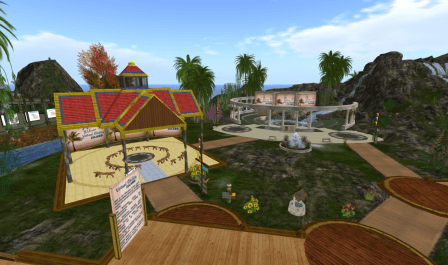
Overview of the island.

QUESTION: Are people more accepting in SL than RL?

  • A: yes, I find that they are
  • not always people are accepting as in real life that is also the case:)
  • that kind of depends on the disability that is being responded to. Some people are very rude to people with disabilities that make them type slowly or if they type in ASL grammar (which makes them sound nonintelligent).
  • I find that SL is sort of a ‘great equalizer’. Disabilities are not as obvious here, so we feel more confident in our interactions with other.

QUESTION: what benefits have you and the members found from joining this group

  • A: personally for myself I have open up more about my disability with Virtual Ability which actually they have helped me deal with it as well much more in real life
  • We have done several research projects on benefits to people with disabilities of being in a virtual world. It offers several! including improved socialization and self esteem.
  • understanding your not on your own and understanding about the outlook and thinking of other disabled people

QUESTION: Does the improved self-esteem translate to RL?

  • A: yes, being at SL has made me more confident in RL, such as doing public speaking, being able to strike up a conversation with people

One last benefit to SL. I get to meet folks from around the world, without ever leaving my desk. 🙂

  • world wide friends
  • I got to meet so many people from so many place that I wouldn’t have otherwise
  • me too, being retired helps..but would never be able to physically travel to other countries

We thank the VAI folks for participating and to Suellen for voicing.

NEXT WEEK:

Groups will work together and the instructors will visit each group to get an up date on your progress and provide some help.