Posts Tagged ‘class meeting’

h1

Class 9: Site visits

November 26, 2015

We spent this class on site visits to the buildings chosen by each group. This gave us an opportunity to observe if voice is available and discuss how the presentations might best be made. Where voice is unavailable text would need to be prepared in advance: for example, prepared text could be pasted into local chat or notecards could be prepared for circulation.

We also noted the footfall at each site. It might be disturbing if there are too many people in the vicinity so we suggested you give this some consideration – visit the site at the same time as class is usually held to ensure you know if it will be busy and to find a suitable location for the presentation.

ACTIVITIES FOR NEXT CLASS:

  1. Write the ninth post: to your blog describing progress on your project.
h1

Class 8: Projects

November 19, 2015

Students presented progress on their projects in this week’s class. Each group is well engaged in their work, having visited potential buildings around SL and selected one to work with. Students have made an effort to contact the owners of buildings with varying success. We discussed ways of finding out who to contact and how to go about establishing communication. Sometimes this is not as easy as it sounds – even if the avatar is standing in front of you as we discovered last week.

John introduced the class to ‘notecards’ and demonstrated how to make a new notecard and share it with somebody, even when they are offline. This can be a useful way of explaining your interests and reason for making contact.

A few comments on your blogs: most of you are not keeping up with the prescribed posts. You should all have written at least seven posts by now (as listed in the Activities for Next Class section of each class summary). Your posts should be more than a simple description of your activity in SL. You need to reflect on what you are seeing around you; what you feel about the experience; and what you are learning. Look at Rory and Paige’s blogs for good examples. After class 8 your blogs will be assessed again so make sure to get them up to date.

ACTIVITIES FOR NEXT CLASS:

  1. Write the eighth post: to your blog describing progress on your project.
h1

Class 6: Content creation

November 5, 2015

empty class_001

For some reason attendance at class this week was very poor. This made it difficult to have a really meaningful discussion. However, Rory made up for it by sharing his experience of co-creating a successful automotive blog over the last five years. He shared the story behind the development as a few friends went from posting photos about their common interest to becoming a recognised source of expertise with several hundred followers. We discussed how this led to more focussed sense of responsibility towards the community of followers and greater sensitivity around the audience. Issues of copyright and plagiarism emerged also. The value of having a recognisable approach to the subject is one way of counteracting this – Rory suggested that the source of distinctive images remains recognisable even if cropped or altered.

John reminded the class that everyone should have at least the following five posts made to their blogs by now:

  1. Expectations for the module.
  2. Review of three locations visited in SL.
  3. Description of encounters with two residents of SL.
  4. Three adjectives describing yourself and a 30 second elevator pitch.
  5. How to convert your personal presence online to an identity for professional networking.

From this week on you should write at least one post a week describing progress on your project: how you are communicating with your partner, the tools you find useful, how easy/difficult you are finding online collaboration, what works for you and what doesn’t, etc.

ACTIVITIES FOR NEXT CLASS:

  1. Read: some of Reinventing Ourselves: Contemporary Concepts of Identity in Virtual Worlds, Eds Anna Peachy and Mark Childs, published by Springer 2011.
  2. Prepare: a report on your progress with the project for next week’s class.
  3. Write the sixth post: to your blog describing progress on your project.
  4. If you have some time visit The Garden Maze at Falconmoon and see if you can find your way to the middle!
h1

Class 3: Exploring Second Life

October 15, 2015

To facilitate a class trip In Real Life (IRL) the time for this weeks class was brought back to 4.00 pm. Some people had a little difficulty finding their way up to the Media Centre because the ‘Home’ landmark brings you to the ground floor – you need to teleport up to the Media Centre from there.

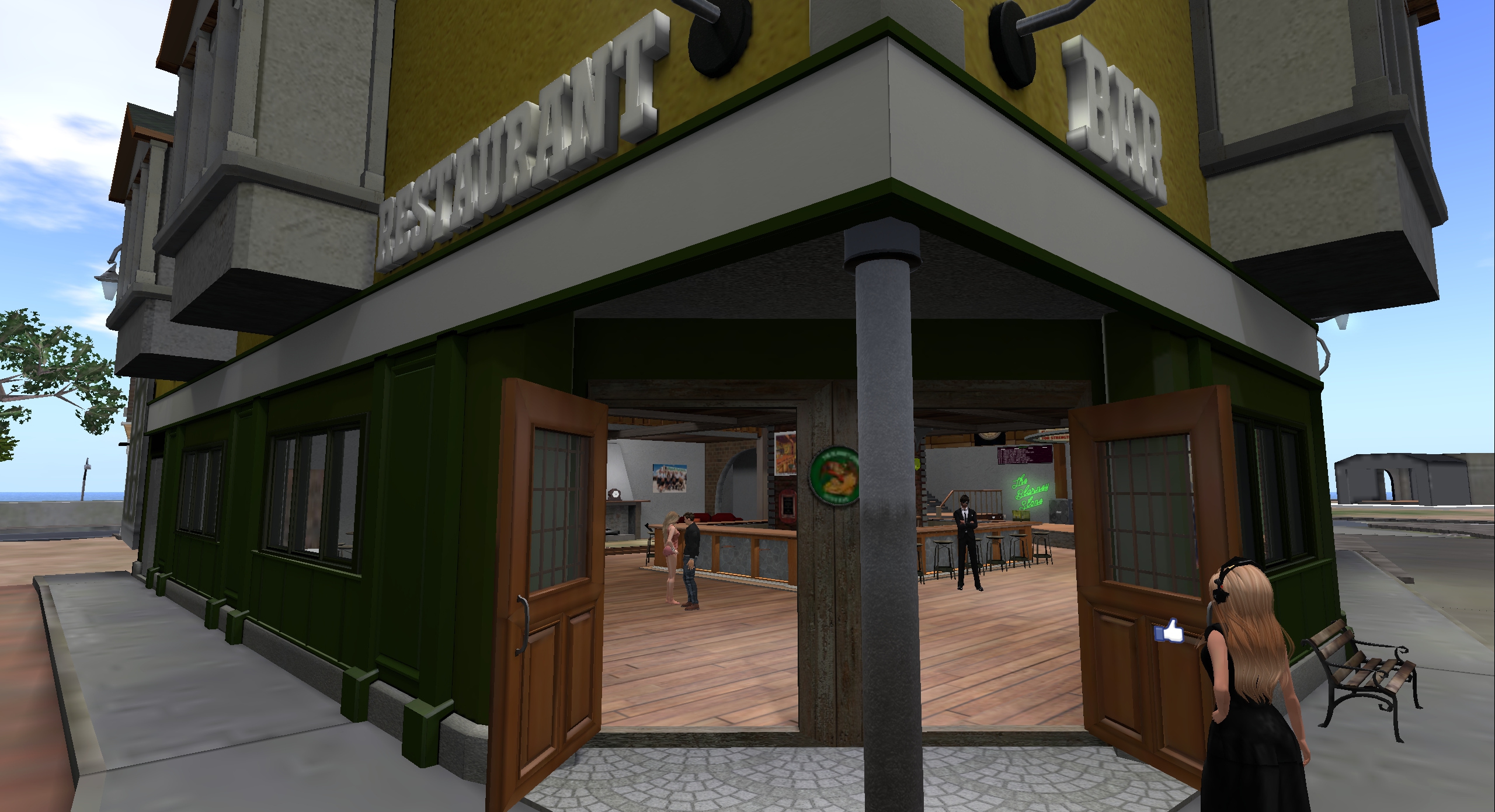
We spoke about the experience of finding interesting places to visit in SL and many of you had difficulty finding places or accessing landmarks. Some of this may have been a result of slow connection speed. So, we visited a few different locations to give you a sense of the variety of SL. First, we went to Lauk’s Nest, one of the oldest locations in SL, and a lovely nature reserve with some interesting buildings and tree houses. We got used to controlling our avatars when flying and trying not to get lost. After a chat about the economy of SL we visited a shop to see how a commercial enterprise works. Finally, we visited the Blarney Stone pub in Dublin Virtually Live to meet some of the punters and experience a virtual leisure outlet. The final destination was the only one that did not allow voice. We had all activated the module group so we were able to use private group chat to keep in contact.

Lark's Nest wildlife park in Second Life

Lauk’s Nest wildlife park in Second Life

Blarney Stone pub in Dublin Virtually Live

Blarney Stone pub in Dublin Virtually Live

Returning to the Media Centre there was a brief chat about the importance of keeping your blogs up to date – writing at least one post a week. it is also important that the activities set for the next class are completed. All of you had read at least one of the texts on personal branding but as we ran out of time it was agreed to postpone discussion until next week – giving time for those of you who haven’t yet read the text to do so now!

We spoke a little about the etiquette around approaching strangers in SL. John explained that it is perfectly acceptable to approach strangers and talk to them. In this way SL is very different form RL. Generally, avatars are perfectly happy to chat. This may be done via voice or public chat, depending on the avatar’s preference and/or the availability of voice in the location. If you feel uncomfortable or threatened for any reason simple teleport away to another location or log off. Do not hesitate to do so if you meet any aggressive or unpleasant behaviour. SL allows you the freedom and safety to explore in a way you might not in RL.

ACTIVITIES FOR NEXT CLASS:

  1. Go: out into SL and make contact with at least two people who you haven’t met before.
  2. Write the third post: on your blog describing your encounters.
  3. Explore: the website Humans of New York (accessed on 16/10/15) and see how the author has used social media to make an impact – an example being his use of instagram, facebook, twitter alongside the blog. Take note of how he has identified and positioned himself.
h1

Class 2: Getting to know Second Life

October 8, 2015

Participants in the module this semester are engaging very well with Second Life and were able to make their way to the Media Centre without difficulty. We started the class with a quick review to ensure that everyone is comfortable in the environment. John got links to all your blogs which will be posted to the module blog this week. Well done on getting the blogs set up and making the first post. Don’t forget to complete the ‘About’ section by giving a little bit of information about yourself (if you prefer to keep personal details private and don’t want to reveal anything about yourself invent a life for your avatar!)

John paired up the participants who were in class and spoke a little about the group project. Normally the class is made up of students from different programmes but because you are all Interior and Furniture Design students this semester we decided to base the project on your discipline. You will explore SL to find an interesting building and make a presentation describing it, discuss how successful it is at fulfilling its purpose, introduce the designer, builder or owner if you can find them, and explain why you find the building interesting. A more detailed brief will be posted shortly.

We also began to explore some of the options for getting around SL by having our avatars fly around the Media Centre. It takes a little bit of time and practice to control your avatar so John advised spending some time in SL before the next class, practising. The activities to be completed for next week will encourage you in this regard. Each of you was given L$300 (roughly about US$1) to explore the consumer economy in SL.

Everyone joined the DIT Module group which allows you to set the Media Centre as your ‘Home’. That means you can set SL to login directly to the Media Centre. It also allows us to participate in private Instant Messaging (IM) among the group. John reminded everyone that SL is a ‘real’ place in the sense that anybody can join. Therefore – just as In Real Life (IRL) it is important to be careful about where you travel and to whom you speak – give some consideration to your online exploration, whether in SL or anywhere else. If you find your self in an uncomfortable situation in SL do not hesitate to QUIT immediately.

ACTIVITIES FOR NEXT CLASS:

  1. Explore: Get to know your class partner and explore SL together. You are to visit at least 3 new locations. Find them in search, or by flying or walking around, ask other residents for recommendations or select them at random.
  2. Write the second post : on your blog reviewing the locations you visited. Explain how and why you chose them and what was particularly interesting about them.
  3. Read: The Lazy Person’s Guide to Personal Branding by Yohana Desta at Mashable or Personal Branding Basics by Chris Brogan, expert in online community, social media, and related technologies or The first Step to Building Your Personal Brand from Forbes to prepare for the discussion in next week’s class.
  4. Other interesting reading about SL and virtual worlds:
    in Virtual Worlds Magazine, Virtual Anthropology and the Prometheus myth
    An article about Rod Humble, former CEO of Linden Labs, owner of Second Life Shared created spaces
    Your Second Life is Ready – Popular Science’s take on SL in 2006.
h1

New course begins October 1st

September 17, 2015

Snapshot6_004We are pleased to announce that registration for the Autumn/Fall 2015 course is now open. The module will begin Thursday, October 1st, 8:00 p.m. Irish Time, and will be taught online in Second Life.

The ‘Is One Life Enough’ professional social media course is a university-level online course taught weekly for 10 sessions held at Dublin Institute of Technology Campus in Second Life and accredited by Dublin Institute of Technology in Ireland. The audience for this course is undergraduates, professionals, and educators seeking university-level training and credit in the use of online tools, such as Second Life, WordPress, Twitter and LinkedIn. Attending class as avatars participants will maintain online journals between sessions. Students will learn to establish and strengthen their online professional presence. You will learn also to work collaboratively, online, to complete team projects selected by the students and presented at module’s end to a collective university and Second Life audience.

Dublin Institute of Technology Students will receive 5 ECTS Credits as part of their current tuition – contact the office of Dean John O’Connor or your School for details.
Second Life Students receive DIT Accredited Professional Continuing Education Credit for a part-time tuition fee (99 Euro or equivalent in L$/US$) – contact Dublin In SL Registrar Sitearm Madonna
University of Akron Students may receive UOA College Credit as part of their current tuition – contact the office of Dr. Dudley B. Turner.

Inquiries: James Neville (‘Sitearm Madonna’ in SL) sitearm@gmail.com

Module History

In 2009, the ‘Is One Life Enough’ module was founded for Dublin Institute of Technology DIT students by (then) Head of School, John O’Connor (‘Acuppa Tae’ in SL), and eLearning Development Officer, Claudia Igbrude (‘Locks Aichi’ in SL).

In 2010, IOLE received the ‘Jennifer Burke Innovation in Teaching and Learning Award’ from the Irish Learning Technology Association and Dublin City University. Also in 2010, module eligibility was expanded to the greater Second Life Community via collaboration with Dublin Virtually Live Owner, John Mahon (‘Ham Rambler’ in SL).

In 2012, IOLE received the ‘Further and Higher Education Innovation Award’ from Learning Without Frontiers (London, UK). Also in 2012, Dr. Dudley Turner (Dudley Dreamscape in SL) graduated from the Autumn 2012 module as a Second Life Student.

In 2014, module eligibility was further expanded to University of Akron students via collaboration with Dr. Turner.

Organization History

Dublin Institute of Technology is the largest provider of third level education in Ireland with degree awarding authority and is on track to be Ireland’s first nationally accredited technological university.

Dublin in Second Life is a recreation of Dublin City online, celebrating the music, art, education, culture, and enterprise of Ireland and is a premier member of the broad Second Life Community, recognized by both Residents and Linden Lab Top Management.

University of Akron is one of America’s strongest public universities, focused on innovation, entrepreneurship and economic growth.

Vitae

John O’Connor is a Director of Dublin Institute of Technology (DIT) in Dublin, Ireland, and Dean of the College of Arts and Tourism. His work includes sitting on the Senior Leadership Team of DIT, teaching the award winning module, ‘Virtual Environments: Is one life enough?’ and promoting Dublin as a creative city and thriving economic hub. His academic interests include: access to education for isolated communities; the use of technology to support learning; typography; and development of the professional design sector in Ireland.

Dr. Dudley B. Turner is Former Interim Dean, College of Creative & Professional Arts, University of Akron (UOA) in Akron, Ohio, USA. He teaches communication, persuasion, and professional speaking. Dr. Turner is a champion of the use of virtual world communication technologies such as Second Life. He is the 2014 winner of the prestigious Ohio’s Innovative Teacher Award from the Ohio Communication Association.

h1

Class 9: Consumers to Produsers

March 28, 2015

This week is Spring Break for Akron students so the class was in the DIT seminar room in Dublin for a change of scene. For the first half we discussed progress on the group project and re-emphasised the importance of reflecting on what is not working in the collaboration in addition to what is working. It is important that participants are writing about this in their blogs from now to the end of the semester.

The second part of the class consisted of a discussion based around Prof Axel Bruns’ lecture that students had read over the week. At the beginning many professed confusion about what Bruns was proposing but as the discussion progressed it became clear that most understood it better than they realised. It may be that as emerging ‘produsers’ themselves the concept is so familiar that it is almost invisible to them.

The concept of wikipedia not being about the creation of finished products but the ongoing revision of information – constantly amended and updated by people who may have originally come to it as consumers but have become content creators – was clearly understood. The development of the distribution system for news from the formality of traditional newspapers that are controlled by editors and publishers to the openness of blogs, Facebook and such systems that have eliminated the gatekeeper was considered – with particular consideration of the pros and cons. The issue of reliability was surfaced, leading to a reminder of the importance of reputation – and brand. As users become the producers of content: people who care enough to participate – as opposed to those who merely want to consume – personal brand becomes increasingly important.

DIT students are reminded that their blogs were due for the second assessment (after week 8) but this has been postponed to this week giving you a chance to catch up if necessary. The importance of proofreading posts before publishing was emphasised.

ACTIVITIES FOR NEXT WEEK:

  1. Read: about the girl who resigned her position as uk police youth commissioner due to previous tweets (accessed 02/13/15).
  2. Read: about another example of a person losing her job over a tweet (accessed 02/13/15).
  3. Read: why Dr Phil removed a tweet from his TV show (accessed 02/13/15).
  4. Write the ninth post: to your blog reflecting on the benefits and difficulties of collaborating online across time zones.
h1

Class 8: Is the medium the message?

March 22, 2015

Last week students were asked to watch a lecture by Prof Axel Bruns but the link was faulty – while the slides accompanying the talk were visible the lecture itself was missing. So, the correct link will  be posted this week and we will discuss the idea of ‘Prosumer to Produser: Understanding User-Led Content’ in another class.

This week in class we discussed Marshall McLuhan’s proposal that the ‘medium is the message’. Use of the smart phone emerged as the dominant theme, particularly the way in which it appears to have replaced face-to-face encounters for many people today.

marshall-mcluhan-quote-the-medium-is-the-message-this-is-merely-to.

ACTIVITIES FOR NEXT CLASS:

  • Watch and listen: to the lecture ‘From Prosumer to Produser: Understanding User-Led Content Creation‘ by Prof Axel Bruns (Creative Industries Faculty at Queensland Institute of Technology) explains his theory of user-led collaborative content creation.
  • Write the eighth post to your blog explaining how Marshall McLuhan’s theories inform the thinking behind this class.
h1

Class 7: Communication?

March 15, 2015

Class this week proved to be a lesson in communication – or lack of it! Summer time began in the US the previous Sunday but doesn’t begin in Ireland until the end the month resulting in a three week period where the usual time difference between us is increased. We knew about this but, the difficulties associated with adjusting schedules and communicating across continents defeated us this semester. For DIT the 9.30 pm finish time is quite late and moving it on to 10.30 pm is not possible. For Akron students the class takes place in the afternoon and most students have other classes directly after it so changing their schedule is not feasible. In addition, it is reading week for a number of DIT students and they were not expecting class this week. In the end, about six students attended a rather small class gathering – demonstrating in a practical way how difficult online collaboration and communication can be across time zones.

We used the opportunity to discuss project progress with those in attendance and, unsurprisingly, similar difficulties were revealed by the students in relation to their communication within groups. One particular issue that may be a cause of concern to some is the selection of the cause or charity for the project. John and Locks advised students not to become overly concerned about this, reminding that the project is a vehicle for participants to experience working collaboratively online and discover not only what works well but also what doesn’t. It is the process of working together that students are expected to explore and the detail of the project itself is of lesser importance. Group members might also do well to review Sitearm Madonna’s talk, in the second class, about the roles of group members

This conversation continued as the student blogs were discussed. The importance of reflecting critically on the process of working with colleagues in an online environment across different time zones was emphasised. Please read what was posted to the blog around this time last year which outlines what students need to consider in their own blog writing.

ACTIVITIES FOR NEXT CLASS:

  • Lecture: watch ‘From Prosumer to Produser: Understanding User-Led Content Creation‘ by Prof Axel Bruns (Creative Industries Faculty at Queensland Institute of Technology) explains his theory of user-led collaborative content creation.
  • Write the seventh post: to your blog describing the process in which your group engage to select the subject for your project. Include a critical review of how successful (or otherwise) you think the process was and what you would change if you were approaching this task again.
h1

Class 6: Review of projects

March 6, 2015

At the start of class we had some more elevator pitches followed by a discussion on the visit last week to Virtual Ability Island. Most students were impressed by what they saw and the visit gave you a sense of how important virtual worlds can be to those who are housebound for one reason or another.

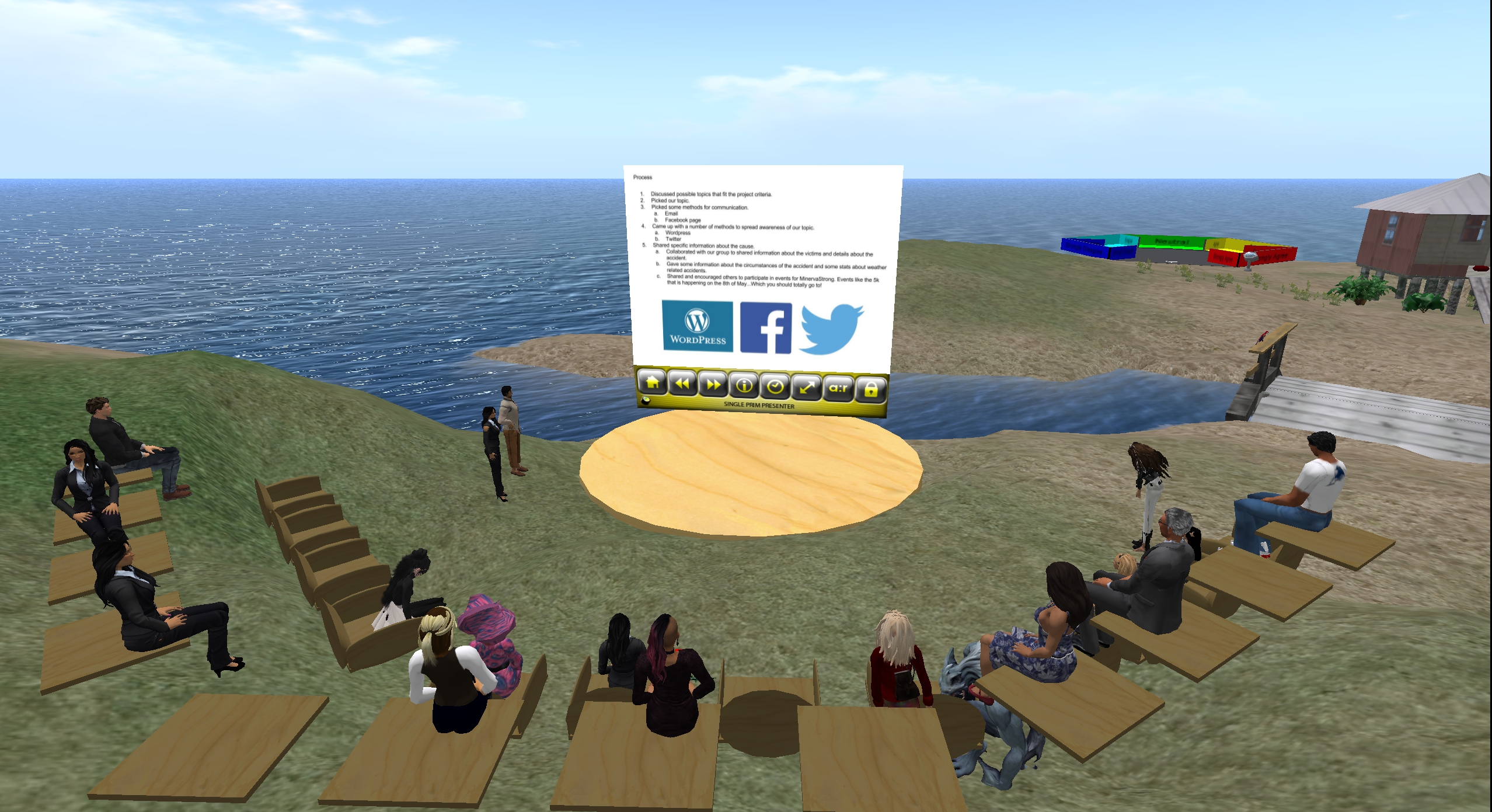
Then the students divided into their groups and found quiet parts of Akron Island in which to work on their projects while John, Dudley and Locks met with each group to discuss progress. We seem to have missed one or two groups so please let us know next week and we can meet you then.

Most groups appear to be making good progress and have decided on the general direction of the project. Each groups seems to have met synchronously and asynchronously and have agreed their communication methodology. While many are finding Facebook useful because they check it regularly already some have opted for email, google documents or Second Life as the key space for collaboration.

ACTIVITIES FOR NEXT CLASS:

  1. Read this: interesting blog post about understanding Marshall McLuhan’s ‘medium is the message’ (accessed on 12/02/15).
  2. Read: some of Reinventing Ourselves: Contemporary Concepts of Identity in Virtual Worlds, Eds Anna Peachy and Mark Childs, published by Springer 2011 (accessed on 12/02/15).
  3. Write the sixth post: to your blog describing your contribution to the development of the group project.