h1

Class 5: Virtual Ability Island

February 27, 2015

We had a brief discussion of how to establish community in the virtual realm. There are many approaches, and we listed a few ways to begin: Facebook, blog (as you are doing), Twitter (with appropriate hashtags) and follow others, and LinkedIn. But it takes time and effort, as we are learning in this module.

Then we wanted to make sure we had time to learn about Virtual Ability Island (VAI), so we took a field trip. Students can return to VAI and explore some of the other areas by using the landmarks on the notecard: ‘Landmarks for Virtual Ability,’ and if you did not get one, contact Dudley Dreamscape for one.

Gentle Heron and her friends greeted us. Gentle gave us a brief overview of the history and activities of VAI in both voice and text. They communicate in varied modes so that everyone, even those who are not able to see or hear or read or comprehend English can participate in ‘real time.’
VAI_001

Welcome to Virtual Ability Island.

An overview of VAI from Gentle Heron:

(1) Who is the Virtual Ability community?

We are a cross-disability peer support community of nearly 1,000 members from 6 continents. That means our members who have disabilities may have a physical disability, a mental or emotional or developmental disability, or a sensory disability (deafness or blindness). About ¼ of our members do not (yet!) have disabilities. They may be a parent, spouse, child, or friend of a person with a disability; caregiver; researcher; medical professional; or an educator.

Our community has been in Second Life for over 7 years, and we won the first Linden Prize for a project that has “a tangible impact on the real world.”

We are supported by an RL nonprofit, Virtual Ability, Inc. Our community assists people with all kinds of disabilities to enter and thrive in virtual worlds like Second Life. As a community, we offer our members a variety of educational and entertainment activities daily, but also encourage members to explore all the incredible things to do and places to explore within Second Life.

(2) Why are we considered a community?

Some definitions of ‘community’ include a geographic proximity, and obviously since we are on every continent except Antarctica, we don’t embody that aspect. Nor do we have cultural similarity. In fact, we embrace diversity! The population of persons with disabilities is the largest minority, and the most varied.

However other aspects of community we do certainly exhibit:

  • Both close and informal relationships
  • Mutual support among members
  • Common values and beliefs (in our case about emphasis on Ability, not DISability)
  • Organized interactions and activities
  • A strong sense of belonging to the community

On Healthinfo Island, we are focusing not on disabilities and impairments, but rather on health and wellness. You will find landmarks to exhibits, displays, a pavilion listing research opportunities, and the Path of Support. The Path of Support lists information about the more than 120 peer support communities we have identified so far in Second Life for disabling conditions and chronic health issues.

Our community has 2 residential islands, with private properties around the edges, but public land in the central area. On Cape Able, there is an art gallery on the public land; on Cape Serenity, there is a library. In both the art gallery and the library, we offer only works that are created by persons with disabilities. That goes along with our emphasis on the abilities of people with disabilities.

You can learn more about the VAI community at their website: www.virtualability.org

Then we had a lively Q&A session.

The Q&A session covered a lot. Only a few are summarized below. Answers were provided by Gentle Heron and some of the members of the VAI community: Ruby Vandyke, Winter Wardhani, Stepin, ÎsaЪeĻ, Lukey Woodget, James Heartsong, Suellen Heartsong , levi Ewing, oɹɐubǝ dןɐuǝɹ, and Vandala.

QUESTION: How did the community begin?

  • A: We wanted to participate in a community but were too disabled to do so, and we came to a virtual world so we could socialize.

QUESTION: how do you get people from RL into this community in SL? How do you get the word out?

  • A: I found this community by seeing one of their Events listed in the Events search
  • We often invite people in other online types of communities, like chat rooms for people with specific disabilities.
  • I found an article in MS Magazine, mentioning support in SL. I came here, was lost for a bit, but then was guided here by a kind person who knew of VAI.
VAI_002

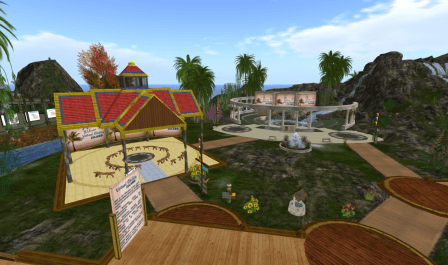
Overview of the island.

QUESTION: Are people more accepting in SL than RL?

  • A: yes, I find that they are
  • not always people are accepting as in real life that is also the case:)
  • that kind of depends on the disability that is being responded to. Some people are very rude to people with disabilities that make them type slowly or if they type in ASL grammar (which makes them sound nonintelligent).
  • I find that SL is sort of a ‘great equalizer’. Disabilities are not as obvious here, so we feel more confident in our interactions with other.

QUESTION: what benefits have you and the members found from joining this group

  • A: personally for myself I have open up more about my disability with Virtual Ability which actually they have helped me deal with it as well much more in real life
  • We have done several research projects on benefits to people with disabilities of being in a virtual world. It offers several! including improved socialization and self esteem.
  • understanding your not on your own and understanding about the outlook and thinking of other disabled people

QUESTION: Does the improved self-esteem translate to RL?

  • A: yes, being at SL has made me more confident in RL, such as doing public speaking, being able to strike up a conversation with people

One last benefit to SL. I get to meet folks from around the world, without ever leaving my desk. 🙂

  • world wide friends
  • I got to meet so many people from so many place that I wouldn’t have otherwise
  • me too, being retired helps..but would never be able to physically travel to other countries

We thank the VAI folks for participating and to Suellen for voicing.

NEXT WEEK:

Groups will work together and the instructors will visit each group to get an up date on your progress and provide some help.

h1

Class 4: Content creation, part one

February 20, 2015

Class this week opened with some more participants delivering their elevator pitches. Following that we had a discussion, informed by the reading material set last week, about the creation of ‘content’. Students participated confidently and coherently via text and voice.

.
Content is anything online, a person’s print on the virtual web. Content does not have to be interactive, but Daniel argued that by being online in video or text form implies it is already interactive by default.
There are different types of content, but does it have any value? Some content only has meaning to the person who posted it, eg, random posts on twitter. But then meaningless to who? Or is it more a case of having value to a few people only Sometimes, commentary may only have relevance to certain people. Sometimes people use social media to hide behind and post spiteful and malicious material. They behave differently from how they may behave in the real world because there is no accountability. Internet trolls being an example.

.
The point was made that interaction on the internet is different from face to face. This is not necessarily negative.
Going back to look at your own blog, do you have a different take on what content is now? The answer was yes, creating blog posts is creating content as it is contributing something new to the internet. The Humans of New York blog is a good example of how a creator uses multiple media-images plus text to tell stories of humans. As we create content for people, we hope to make connection, often emotional connections, and it is through these connections that we project our personae into the online world.

.
According to Olwyn ‘many businesses or corporations using social media have had a negative review/blog/comment written about them therefore creating negative content around their brand. It is possible to hire people to write so many positive comments it rids the page in question of negative content. It shows how important your virtual footprint is.’
Have a think about how you are going to create content for your project and while doing so, create a credible personae for yourself to complete your assignment.

.

Snapshot_007

Elfay Pinkdot

Guest speaker Elfay Pinkdot was introduced to the class to talk about communities and making connections. She brought us on a field trip to Bugs and Us, a butterfly sanctuary. Once settled in the peaceful environment Elfay talked to class about online communities she has been involved in. Her SL radio programme Coffee and Pajamas is an SL group around jazz. She wanted to share her love of jazz with other SL residents. She had previously used Jazz and her love of music to teach geography, as a social lubricant, as a way in, and that was not different when trying to form the community in SL. The show was widely listened to and quickly formed into a tight community, impacting people in more ways than Elfay realises. When you start to create content or connect online, especially around something that means a lot to you, you cannot always envisage how rich a resource it can be. In Elfay’s case, her SL life has led her to meet with people from around the world – including the lecturers in this module.

.
The internet can seem like a really dauntless place but what #IOLE enables you do, is take control of how you choose to use and engage with the medium of the internet, and control the message(s) you choose to put out. Elfay does not consider SL or online life different from real life… she sets boundaries just like real life. She encourages that you take responsibility as you make your mark.

Snapshot_003
As was pointed out in the class, there is a lot more potential for people to think they can get away with things that are not permissible in real life. There is a huge challenge in how the law keeps up with change in the online space and the various envionmnents and changing methods of interaction. All of this is the reason why you need to give a full and measured consideration to how much of yourself you want to share online.
Kaiya, one of the owners of Bugs and Us, added by saying ‘I have been in SL a long time, and I bring my RL morals into SL, I prefer honesty and loyalty. There are many here in SL that bring drama, and lose their sense of self. Don’t make yourself vulnerable as there are many wolves in SL that prey on others.’
Also, taking a lead from Sitearm Madonna, don’t be shy about playing with your identity in SL. And you are welcome to reach out to Elfay as you prepare for your final presentation and work on your project.
Don’t be vulnerable, let people earn your trust, don’t underestimate the online medium.

.

At the end of the class the lecturers told the participants about the research work they were doing around the class. We asked that you complete an anonymous survey by clicking here.

Finally, DIT students are reminded that your blogs are undergoing the first of three assessments this week so make sure you are up to date!

ACTIVITIES FOR NEXT CLASS:

  1. Read: this thoughtful blog post Content Licensing in Virtual Worlds about the legal issues around protecting ‘things’ you create in SL and online in general. Read the comments also.
  2. Read: The Laws of Virtual Worlds. From the California Law Review 2003 this is an excellent, if highly specialised, review of the legal position of avatars in virtual worlds.
  3. Write the fifth post: to your blog about the value of copyright in a world where everything can be easily copied
h1

Group Project: Going Global

February 12, 2015

Coined in the 1960s by Canadian intellectual Marshall McLuhan the term ‘global village‘ is becoming a reality in today’s society. This is seen in how news spreads, the connections people make, working patterns and day to day life – shopping, socialising, communicating etc. The world of online digital communication in the form of the web, social media, virtual worlds and so on is becoming an integral part of the professional experience. No longer restricted by physical geography professional collaboration crosses cultural boundaries and time zones. The ability to work effectively in this environment is essential for those joining the 21st Century workforce. Familiarity with the legal frameworks, social conventions and etiquette that frame this online environment is a prerequisite to success.

For the project each student group will explore this theme by identifying a cause or charity anywhere in the world, and taking it global. Use the social media platforms of your choice to raise the profile of your cause or charity beyond the local boundaries. Groups will present their projects on either 30th April class or 7th May class. The presentation will be in the form of a Pecha Kucha and will highlight your work, your group dynamic, and the impact; and describe the challenges encountered as you worked with the cause or charity. 20 images x 20 secs each.

For tips, examples and resources, see Catherine Cronin’s blog.

In summary: working in your group, design a campaign to manage your digital footprint; and at the same time work with your group to raise the profile of a cause or charity beyond local or geographical boundaries using social media and online platforms. At the end of the campaign, design a PK presentation to showcase all you did and your experience. Emphasis is on the experience rather than the result. But results will be noticed too.

Important note: If you use images or sound be mindful of copyright, particularly as presentations will be posted to the module blog.

36694

If you haven’t already done so, read this book.

h1

Class 3: Personal branding

February 12, 2015

The class met in the amphitheatre in Dublin to be briefed on the group project. Details of the project are given in the next post.

As the briefing came to an end an unwelcome visitor arrived and caused some disruption by walking aimlessly around so we went back to Akron Island for a discussion on personal branding based on the reading material from the previous week. Most participants said they had based their appearance in SL on their Real Life (RL) selves. The opportunity to reflect a different aspect of their personalities was considered in the context of the guest speaker from last week. Claudia argued that managing one’s identity online is now becoming a necessity as to have no presence is a statement in itself.

The bio (or ‘about me’) piece you write is a very important element in establishing your ‘promise’, your possible value to a potential follower. It is a signal to those who may decide whether or not to follow you. But, your identity will really be formed by the content you add and that should reinforce your promise. Just as the corporate brand builds recognition by repetition and consistent delivery on its promise your personal brand will be shaped by your reliability also.

B9q_O_8CQAIDHCm.jpg-large

ACTIVITIES FOR NEXT CLASS:

  1. Go: outside your established community/group (eg, this class group) in SL and make contact with at least two people relevant to your interests (artist, gallery owner, musician, shop manager, business owner, educator, builder, etc).
  2. Write the third post: on your blog describing your encounters.
  3. Decide: among your group what tools you will use for planning your project (how you will stay in touch and share information, etc.).
  4. Write the fourth post: on your blog explaining your choice of communication tools and reflect on how the group arrived at the decision.
  5. Read: Your Employee is an Online Celebrity. Now What Do You Do? from the Wall Street Journal. The article discusses employees developing their personal brand and implications for their employer (accessed on 12/02/15).
  6. Explore: the website Humans of New York (accessed on 12/02/15) and see how the author has used social media to make an impact – an example being his use of instagram, facebook, twitter alongside the blog. Take note of how he has identified and positioned himself.
  7. Read: about the Heron Sanctuary which we will be visiting next week (accessed on 12/02/15).
h1

Class 2: Online collaboration

February 6, 2015

020515 - class with Site

Class started with a selection of students delivering their elevator pitches. Really good work and well presented from everyone. The class has an interesting mix of students from healthcare, creative and cultural backgrounds.

Sitearm Madonna kicked off his Team-building talk by asking who had worked in a successful team. Most people had some experience. He shared his online slide presentation using a narrative to set the scene, and then referring to the slides to highlight how teams are built: Form–Storm–Norm–Perform. He noted that the Storm stage is probably the most uncomfortable but, it passes!

When your team gets to the Norm stage, it is imperative, that you have ground rules in place, for example: agree to entertain all ideas without criticism; remember nothing is too wild; everyone has something to contribute. He also suggested that teams may need to move between brainstorming and deciding quite a few times before settling on a final direction.

Review slide 5 to see how he identified the effective team roles. Using the narrative with which he began he highlighted how this played out when four team members had to work together. Sometimes, you will find that one person may take on more than one role, or there may be more than one person with a single role.

A notecard with the Student Groups was circulated so that you can start to get to know each other. (For those who missed class the notecard will be added to the class group #iole15 so make sure you have joined and activated the group next time you visit Second Life.) We have nine teams with four members each, and have tried to make each group as diverse as possible. You will need to work collaboratively online and we encourage you to support one other. Working in groups online is much the same as in real life, so spend time together and get past the Form and Storm stages in good time.

The brief for the Group Project work will be presented in next week’s class.

Sitearm Madonna is online, as are all of the guest speakers you will meet throughout the course. Find him @sitearm and his blog.

ACTIVITIES FOR NEXT CLASS:

  1. Explore: Get to know your group members and explore SL with your group. You are to visit at least 3 locations that are new to you. Find them in search, or ask other residents for recommendations or select them at random. Also find a blog that interests you and review it with respect to subject area, engagement, profile of blogger, etc. Can be a hobby, any interest… 
  2. Discuss: with your group how you would like to operate, what ground rules might be helpful, and who might take on different roles. Think about what skills you have now have collectively.
  3. Write the second post : on your blog reviewing the locations you visited. Explain how and why you chose them and what relevance they might have for your group.
  4. Read: The Lazy Person’s Guide to Personal Branding by Yohana Desta at Mashable or Personal Branding Basics by Chris Brogan, expert in online community, social media, and related technologies or The first Step to Building Your Personal Brand from Forbes.
  5. Other interesting reading about SL and virtual worlds:
    in Virtual Worlds Magazine, Virtual Anthropology and the Prometheus myth
    An article about Rod Humble, former CEO of Linden Labs, owner of Second Life Shared created spaces
    Your Second Life is Ready – Popular Science’s take on SL in 2006.
h1

Class 1: Akron meets Dublin

January 30, 2015

CLASS SUMMARY: Akron students started familiarising themselves with Second Life in early January and Dublin students joined them this week on Akron Island, virtual home of the University of Akron. This semester sees a larger group than previously with about 30 participants in total. Dudley and John spoke about the module in general and gave some details of what to expect over the next weeks.

  1. The format of the class is interactive discussion, based on reading material provided prior to the class. You need to have read the material posted in advance (or else next class will be longer to allow for catch-up).
  2. You will need to spend time in SL outside the normal class time to complete tasks and activities.
  3. Check this blog regularly for updates on the module. Information will also be posted to Twittter using the hashtag #iole15. When you post to Twitter don’t forget to include this hashtag.
  4. After each class you will be given a topic to write about in your blog. It is important to keep your blog up to date as this will ensure you don’t have an excessive amount of work to do at the end of the module. The blogs will be graded using the rubrics found here.
  5. Academic writing standards must be adhered to always.
  6. Every week, visit a new location in SL and refer to it in your blogpost.

Academic writing Part of the methodology for this module is to use writing as a mechanism for learning and as a goal in itself. We hope that by the end of this module you are confident in writing as well as being familiar with conventions around accountable writing. The following points were addressed:

  • Forms of writing to use include: Narrative, Descriptive, Reflective, Critical.
  • Sourcing reliable information is essential: where to find it, deciding what is okay to use (judging sources)
  • Correct referencing is essential. Use the Chicago or APA style preferably (see link below) MLA if needed.
  • Writing to topic – don’t go off the point. Use headings as anchors.

References

DIT’s Study & IT Skills Survival Guide for Academic Writing
Purdue Online Writing Lab page on Academic Writing

Here is a guide to the Chicago referencing style
And here is a guide to the APA style
And this helps with MLA if you use it.

ACTIVITIES FOR NEXT CLASS:

  1. Set up your blog: using bloggerwordpress, tumblr or any other blog site. Complete the ‘About Me’ page (read some of those pages on other blogs first) and remember it is different from the first post on your blog. Write from the perspective of your avatar: the persona you will be using to explore in this module.  Post a link to your blog in your SL and twitter profiles. 
  2. Write the first post: to your blog about your expectations for this module – what you hope to get out of it, what you think you might contribute, etc. Address the relevance of  module objectives from your perspective, ie, justify why you think they are important to you, all the while applying the conventions of academic writing given in the class.
  3. Look at: John O’Connor’s blog and Dreamscape Diary bearing in mind what you learned today compare your own blog writing to this.
  4. Visit the following: Dolce Merda Brain Pickings Illustration Friday Chris Brogan Style Pantry Think about how you would identify these blog authors…what impression do you get of the person behind the blog?
  5. Set up: your twitter account in your avatar’s name. When posting to twitter don’t forget to use the hashtag #iole15.
  6. Do: Based on your ‘About Me’ blog page prepare a 30-second ‘elevator pitch’ about yourself and the identity you want to portray online for the next class. Think about yourself (your avatar). Who are you? What is your online identity? (who you are and what you are about). NOTE: Dudley will provide a notecard in SL with some help for the elevator pitch if you IM him and ask for it.
h1

New module begins 29th January 2015

September 6, 2014

We are pleased to announce that registration for the Spring 2015 course is now open. The module will begin Thursday, January 29th, 8:00 p.m. Irish Time, and will be taught online in Second Life.

The ‘Is One Life Enough’ professional social media course is a university-level online course taught weekly for 10 sessions held at Dublin Institute of Technology Campus in Second Life and accredited by Dublin Institute of Technology in Ireland. The audience for this course is undergraduates, professionals, and educators seeking university-level training and credit in the use of online tools, such as Second Life, WordPress, Twitter and LinkedIn. Attend class as avatars participants will maintain online journals between sessions. Students will learn to establish and strengthen their online professional presence. You will learn also to work collaboratively, online, to complete team projects selected by the students and presented at module’s end to a collective university and Second Life audience.

Dublin Institute of Technology Students will receive 5 ECTS Credits as part of their current tuition – contact the office of Dean John O’Connor or your School for details.
Second Life Students receive DIT Accredited Professional Continuing Education Credit for a part-time tuition fee (99 Euro or equivalent in L$/US$) – contact Dublin In SL Registrar Sitearm Madonna
University of Akron Students may receive UOA College Credit as part of their current tuition – contact the office of Dr. Dudley B. Turner.

Inquiries: James Neville (‘Sitearm Madonna’ in SL) sitearm@gmail.com

Module History

In 2009, the ‘Is One Life Enough’ module was founded for Dublin Institute of Technology DIT students by (then) Head of School, John O’Connor (‘Acuppa Tae’ in SL), and eLearning Development Officer, Claudia Igbrude (‘Locks Aichi’ in SL).

In 2010, IOLE received the ‘Jennifer Burke Innovation in Teaching and Learning Award’ from the Irish Learning Technology Association and Dublin City University. Also in 2010, module eligibility was expanded to the greater Second Life Community via collaboration with Dublin Virtually Live Owner, John Mahon (‘Ham Rambler’ in SL).

In 2012, IOLE received the ‘Further and Higher Education Innovation Award’ from Learning Without Frontiers (London, UK). Also in 2012, Dr. Dudley Turner (ìDudley Dreamscapeî in SL) graduated from the Autumn 2012 module as a Second Life Student.

In 2014, module eligibility was further expanded to University of Akron students via collaboration with Dr. Turner.

Organization History

Dublin Institute of Technology is the largest provider of third level education in Ireland with degree awarding power and is on track to be Ireland’s first nationally accredited technological university.

Dublin in Second Life is a recreation of Dublin City online, celebrating the music, art, education, culture, and enterprise of Ireland and is a premier member of the broad Second Life Community, recognized by both Residents and Linden Lab Top Management.

University of Akron is one of America’s strongest public universities, focused on innovation, entrepreneurship and economic growth.

Vitae

John O’Connor is a Director of Dublin Institute of Technology (DIT) in Dublin, Ireland, and Dean of the College of Arts and Tourism. His work includes sitting on the Senior Leadership Team of DIT, teaching the award winning module, ‘Virtual Environments: Is one life enough?’ and promoting Dublin as a creative city and thriving economic hub. His academic interests include: access to education for isolated communities; the use of technology to support learning; typography; and development of the professional design sector in Ireland.

Dr. Dudley B. Turner is Former Interim Dean, College of Creative & Professional Arts, University of Akron (UOA) in Akron, Ohio, USA. He teaches communication, persuasion, and professional speaking. Dr. Turner is a champion of the use of virtual world communication technologies such as Second Life. He is the 2014 winner of the prestigious Ohio’s Innovative Teacher Award from the Ohio Communication Association.

h1

Class 12: Reality

May 2, 2014

The three student groups gave their presentations in this class and it was evident that all had given great thought to the content and serious effort to the production.

Tutor Locks Aichi.

Tutor Locks Aichi.

Student group

After the final project was presented all students gathered to answer questions from the judging panel and hear their comments.

The students were divided into three groups with each one comprising Akron and DIT participants.

The students were divided into three groups with each one comprising Akron and DIT participants.

The third group presented first.

The third group presented first…

Group 2

…followed by the second group…

Group 1

…with the first group completing the agenda.


h1

Classes 10 and 11: Project work

April 24, 2014

CLASS SUMMARY:

The final two classes were given over to project work. In class 10 we had feedback from each group on how they were approaching their projects and collaborative online engagement.

For class 11 each group went to a different part of Akron Island to work on their projects and the lecturers visited each group to get feedback and offer advice.

h1

Class 9: Project work

April 11, 2014

SL class discussion_001CLASS SUMMARY:

The class commenced with a discussion arising from the reading material given last week. The effects of careless or thoughtless tweets posted by individuals who would have been expected to know better (for the most part) were reviewed. The ease of posting a tweet without thinking of the result and the subsequent impact on your career, family and friends was considered – along with the unwitting exposure of privately held views that may be unacceptable in society. The conversation also ranged into the area of privacy and how the appearance of openness may be simply an appearance – with consequent behavioural changes. In other words, people still require privacy – they simply guard it in different ways. The conventions around the use of social media continue to develop in line with these challenges. Social networks that prioritise privacy are now becoming popular and may well find that they can charge a premium for this value.

The second part of the class consisted of an update on progress in the group projects. All teams reported on the theme, communication between team members and development status. Good work on all fronts.