h1

Class 4: Walking away

March 1, 2017
snapshot_004

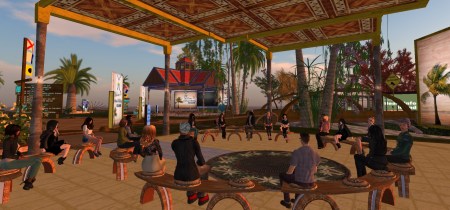
Looking in on the discussion from the outside.

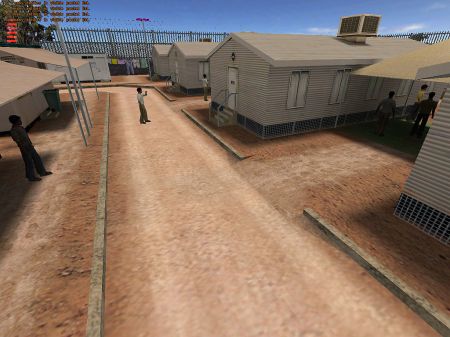
Last night was the fourth Digital Skies session with the group and it was the second theory-based session after we looked at Stephen Duncombe’s intro to Sir Thomas Moore’s Utopia in the first one. This week we updated the concept of Utopia by reading Ursula Le Guin’s text: The Ones Who Walk Away From Omelas (1973). A deeply provocative rendering of a Utopian society that is conditioned by a darker reality, the picture painted by LeGuin in the text falls between Utopia and Dystopia. By implying that a perfect society will always be structured by some kind of exclusion or exploitation, Le Guin draws a parallel between the fantasy of Omelas and the social economic order that has dominated since the industrial revolution. It seemed that for most of the participants in the group the story was an analogy of contemporary democracy and the ethical challenges of living in a globalised economy. Whilst much of the discussion focused on the moral dilemma faced by those citizens in Omelas there was also an ambivalence towards their final response, the act of ‘walking away’. In many ways we could argue that this is a negative response to the situation, an abandonment, however by refusing to be a part of the situation, to leave it and go towards the unknown, we could say it also is a utopian act. It may not be Utopia in the macro sense of the word, as in the creation of a new society, but rather in those micro acts of freedom that happen in everyday life and that have the potential for greater change. Anyone interested in following this train of thought could look into the work of Avery Gordon who is developing the Hawthorne Archive which sets out to ‘record the living and intellectual history of the arrival and existence of a group of runaways, secessionists and in-differents who form autonomous zones and settlements and have receded from living as obedient (and also resistant or resisting) subjects’. Further within this discussion, an important point was raised about how one might even begin to imagine resisting in an overwhelmingly oppressive situation, such as the Nazi Regime, and a reference was made to the White Rose student movement, as an example of non-violent resistance, which led to a discussion on a more contemporary (and virtual) act of resistance in the online critical game Escape from Woomera.

Escape_from_Woomera_3.jpg

Escape From Woomera. 2004

As can be deduced from this summary, the session got a little dark as the group entered into a deeper discussion on the politics of the utopian imagination. We will lighten this discussion a bit in the next session by looking at a lecture by Richard Noble on ‘The Politics of Utopia’. All being well, we will be joined in this session by German Artist Susanne Bosch who will talk about her residency at the Utopia Festival in Austria in 2015.

Finally, each student was asked to send in some landscape photos of their travels in second life, these will be used on Sherkin Island to develop a series of visual investigations around the question: what is nature? We might try to show some of these works in second life in the next theory session.

It was really great to get over most of the technical issues the group have been having and to focus on the content of the course. Last night was a very impressive discussion to have on a Wednesday evening with a bunch of weird looking avatars (No Offence!!).

Next week will be led by John and below are the requirements for this session:

THINGS TO DO BEFORE THE NEXT CLASS:

  1. View: Fake It – to control your digital identity. In a 2013 TEDx Oxford presentation Danish journalist Pernille Tranberg, who wrote the book Fake It – Your Guide to Digital Self-defense with the German journalist Steffan Heuer, explains what happens with your data, what it can cost you now and in years to come.
  2. View: The Power of Privacy. In this 2016 film by The Guardian, Aleks Krotoski travels the world to undergo challenges that explore our digital life in the 21st century. Watch her be stalked and hacked, fight to get leaked documents back, dive into open data and live in a futuristic home that monitors her every move.
  3. Read: Who’s watching me on the internet? Technology Correspondent for the BBC, Rory Cellan-Jones writes about our digital footprint and explains data trails in iWonder 2016.
  4. Write the fourth post: to your blog reflecting on the discussion of The Ones Who Walk Away From Omelas. Ursula K Le Guin. 1973.
h1

Class 3: Teamwork and collaboration

February 22, 2017
snapshot_001

Open discussion about places students visited in SL since the last class.

Locks Aichi, formerly of the DIT Learning Teaching and Technology Centre and who has been teaching the module since it started, joined the class this week. She will be around to provide support and guidance from now on.

We began class by explaining the thinking behind our SL avatars names. Some people have chosen to model their avies (as they are known in SL) on their RL selves and consequently the name reflects this choice. Others have developed new ‘en ligne’ personalities that may reflect previous engagements or suggest future exploration, with correspondingly thoughtful names. John explained that when he started in SL in 2006 residents had to choose a surname from a existing list, which gave him Tae. Forenames could be freely invented so Accupa was impossible to resist. However, when SL changed its policy to allow any name to be allocated to an avie he reverted to John O’Connor. Maintaining two identities was too time consuming! So, if anyone is unhappy with their initial choice it can be changed but make sure to let everyone know.

The discussion moved onto a report on the locations everyone had been visiting since the last class. You have been very adventurous exploring pubs, museums, shopping malls, clubs and even some venues of dubious repute. Many have tried dancing, with varying degrees of success; chatting with other residents; flying; teleporting; and generally trying to get a feel for the environment. You are noticing the nuances of etiquette in this particular virtual space and, despite the occasional embarrassing moment, settling in very well.

The opportunity to observe your own responses to being in this strange new environment, one where you feel awkward and clumsy as you try to control your avie, and struggle to understand the conventions around acceptable behaviour, are not lost on you – everyone is reflecting on this. But, John reminded the class not to become too caught up in SL as an end in itself – the module merely uses SL to explore online behaviour in its broadest context, particularly for how teamwork and collaboration can be facilitated and supported. Keep that in mind while you inhabit the space.

We had hoped to look at Teamwork and Collaboration in more detail but time ran out. We did, however, present the teams you will break into for the main project, and in which you should continue your online exploration. Get used to working together online.

Group 1: shadidame; freddymcfreddy; ChipVanCorner.
Group 2: AlxMway; Burnsygirl; whatyamacallit.
Group 3: Saoise; jackmittons; amarcordcat.
Group 4: Deeuwan; Fayebubba; Inchydoney.
Group 5: Yashurdoshur; Agendasm; Yogitea.

John also said he would give each avatar L$300 for pocket money – instantly transforming from lecturer to Dad! Don’t get excited and spend it all at in the first shop – you will need some of it to upload images into SL for your project (at a cost of L$10 per image). By the way, your pocket money is the equivalent of about US$1. Your ‘bank balance’ appears in the menu bar at the right hand side.

THINGS TO DO BEFORE THE NEXT CLASS:

  1. Meet: at least two residents of SL and try to engage them in conversation.
  2. Write the third post: to your blog describing your encounters.
  3. Read: (if you haven’t done so already) the very short story The Ones Who Walk Away From Omelas. Ursula K Le Guin. 1973.
  4. Prepare: one question about the text to propose to the group at the next class.
h1

Class 2: Art and Utopia

February 15, 2017
snapshot_007

Exploring the changing light from the balcony of the DIT campus in SL.

This week we met three times! On Tuesday Glenn did a technical support session to resolve access to SL, activating voice for everyone and generally getting used to residing in SL. John followed this up on Wednesday to ensure everyone had joined the module group. We looked at changing the orientation of the sun for capturing dramatic photos and tried out flying. We also agreed to use the Sherkin Class 2016 private group for communication outside class time.

Only a few participants had checked the post from last week’s class so much of the activities were not completed. Please read them carefully and get them done for next week. It is particularly important that you start your individual blogs immediately so you can reflect on the issues that arise in class. If you wish to retain a sense of anonymity set up the blog with your avatar’s identity: there is no obligation to reveal your true self online!

We also spoke a little about how conventions in SL differ from Real Life (RL). For instance, it is perfectly acceptable to approach complete strangers in SL and initiate a conversation in a way that would be unthinkable in RL. More often than not, other residents are happy to engage. Sometimes they may ignore you or, indeed, may have stepped away for their pc – known as ‘away from keyboard’ or AFK – leaving their avatar abandoned and unable to respond! It is not possible to tell whether or not an avatar is inhabited merely by looking at it. Similarly, we don’t receive the subliminal confirmation that somebody has heard and understood what we have said because the RL facial gestures and expressions are missing. So, remember to provide deliberate cues during class discussion to confirm you are still in attendance and understand what is being spoken of. Type a comment in ‘Nearby Chat’ or even just a simple ‘y’ to indicate agreement. Better yet, type a question. Typos and poor spelling are perfectly acceptable in SL, as are txt words and acronyms – it is poor etiquette to correct another’s spelling or grammar! Familiarity with all this will develop as you  spend more time in SL.

Screen Shot 2017-02-17 at 16.53.17.png

Class 2. Continued…

Good start to the second session this week. We have most of the technical issues worked out at this stage, everyone is on the Facebook page and it seems that almost everyone has a voice and can hear when others speak. The room was arranged into a more informal setting to allow for the second part of the module, which will be based around the close reading of key texts on Utopia and Art. This week Glenn gave a broad introduction and overview of Thomas More’s Utopia text. The group was asked to read the introduction to Stephen Duncomb’s text: Open Utopia. This introduction is quite lengthy and quite dense, however, it provides two important ways of thinking about More’s Utopia. Firstly it addresses the idea of Utopia in the present and after a century of failed and violent attempts that led to Fascism and Communism. As a result of these attempts, the concept of Utopia has become a difficult somewhat closed or static concept. However, referring to Francis Fukuyama’s thesis on the ‘end of history’, Duncombe also suggests that while we may be at the end of large-scale social projects, the status quo is very far from perfect for most of the populace. It is within this context that the concept of Utopia is being considered anew, as a way to begin to look forward to the future in a way that has been somewhat barred since the fall of the Berlin wall in 1989. At a more technical level, Duncombe makes some interesting arguments about the relationship between criticism and utopia, suggesting that criticism is utopias antithesis. This argument is made in a more general sense and then in a way that is much more particular to More’s Utopia, and it was quite illuminating to read Duncombe’s interpretation of the book as a critique of the function of criticism. This critique leads Duncombe to assert the role of the artist in mediating the present-ness of criticism and the future orientation of Utopian projection. This articulation of the artist as the proposer of alternative modes of social formation will be picked up in the next session. The rest of the session looked at other examples of utopian literary exposition such as François Rabelais (1483– 1553) Abbey of Thelema from his novel Gargantua.  Finally, we looked at a couple of concrete experiments such as  André Godin’s  Familistère complex in 1859 and the Worgl Experiment in Austria in 1932.

THINGS TO DO BEFORE THE NEXT CLASS:

  1. Explore: SL with some colleagues from the class. Visit at least 3 different locations that are new to you. Find them in search or ask other residents for recommendations, or simply select places at random.
  2. Write the second post: to your blog reviewing the locations you visited. Describe the places and include photos, if you can. Explain what you liked and disliked about the locations and describe any interaction you might have had – relate this to the concept of a Utopian place.
  3. Read: the very short story The Ones Who Walk Away From Omelas. Ursula K Le Guin. 1973.
  4. Pose one question about the text to the group.
  5. Read: 5 steps to build a productive and tight knit remote team
  6. Read: 10 Rules of Professional Etiquette for the Digital Workplace
  7. Supplementary reading about SL and virtual worlds:
    in Virtual Worlds Magazine, Virtual Anthropology and the Prometheus myth.
    Interview with Rod Humble, former CEO of Linden Labs, owners of Second Life, Forget Playing Games. Meet the Man Who Wants to Empower You to Make Games.
h1

Class 1: First meeting

February 8, 2017

Well done to everyone who made it to the first class meeting in Second Life (SL). It always takes a little time for everyone to get settled in and find out how things work in this virtual world. Activating your voice is usually the most tricky part (but some avatars can find it takes a while to learn how to sit down!). John suggested that everyone meet in SL before the next class to iron out any technical difficulties and Glenn agreed to meet participants there on Tuesday evening.

As we got settled some basic housekeeping was done. Everyone added each other to our ‘friends’ list which enables us to see when participants log in and to send instant messages (IM) to each other, even when you are in different locations. This can be useful if you cannot find the DIT campus or get lost somewhere in SL. Everyone should also have been added to the DIT Module group. It is important to activate this before joining the class: think of it as your student card. It will give you access to the DIT campus and allow group conversations.

This class will be interactive and discursive. Each week we will look at a different topic, introduced by a set text that you are asked to read before the class so as to inform the debate. It is important that everyone participates fully and engages to get full benefit from attending. You will also need to visit SL between class times to complete activities that will be set to encourage exploration. Specific activities will be set for the first few classes to get you started.

You were all asked to create a new blog for the duration of the course. You will be expected to write a weekly post describing your experience of the class and the discussions and activities in which you engage. If you keep this habit and post weekly you will avoid the burden of having to write a complete paper at the end of the module. John also explained that you will divided into groups next week to work on a project which will be presented at the final class of the semester. You are encouraged to read through the pages listed in the right hand column of this website to get full details of the project, see examples of previous student blogs and get an idea of what to expect in the rest of the course.

We discussed what communication platform we should use to support the class. It should be one that most people use already so you are not having to introduce something new. It also means that as you are using it regularly messages about the class are less likely to be missed. Previous groups set up private Facebook groups and used twitter and LinkedIN. Other options include WhatsApp or Tinder. Think about it and we will decide next week.

THINGS TO DO BEFORE THE NEXT CLASS:

  1. Set up your blog: using bloggerwordpresstumblr or any other blog site. Complete the ‘About Me’ page (read some of those pages on other blogs first) and remember it is different from the first post on your blog. Write from the perspective of your avatar: the persona you will be using to explore in this module. Email a link to your blog to John.
  2. Write the first post: to your blog about your expectations for this module – what you hope to get out of it, what you think you might contribute, etc. Address the relevance of  module objectives from your perspective, ie, justify why you think they are important to you.
  3. Look at: John O’Connor’s blog and Dreamscape Diary bearing in mind what you learned today compare your own blog writing to this.
  4. Visit the following: Dolce Merda, Brain PickingsIllustration Friday, Chris Brogan. Think about how you would identify these blog authors…what impression do you get of the person behind the blog?
  5. Read: some of Utopia. Thomas More. 1516. which will be the topic for discussion in next week’s class.
h1

Spring semester 2017

February 8, 2017
10659ia4e178ac8c5bed9d

Digital Skies starts on Wednesday 8th February at 8.30 pm.

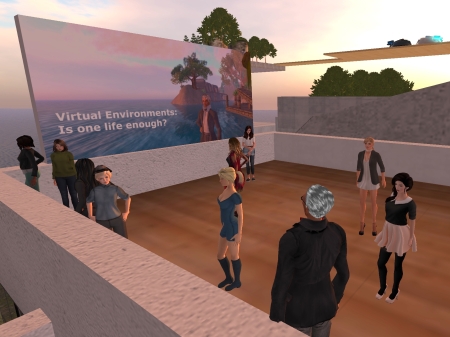
Welcome to the module ‘Virtual Environments: Is one life enough?’ being offered exclusively to students on the BA in Visual Art (BAVA) from Sherkin Island this semester.

Titled DIGITAL SKIES: Art & Utopian thought in the 21st Century this semester’s offering is inspired by the 500th Anniversary of Thomas More’s book Utopia last year and, to mark this event, the Dean of the College of Arts and Tourism John O’Connor and BAVA Programme Chair Dr Glenn Loughran have teamed up to develop the first Digital Painting module on Sherkin Island. 

Expanding upon the module’s usual consideration of online collaboration and an investigation into our digital personae, students will engage philosophically with the idea of Utopia, its historical significance and how it relates to the digital world today. Within this module, students will develop practical skills in the development of a suite of digital paintings that will be exhibited in Second Life and on Sherkin Island in May 2016.

The first class meeting will be on Wednesday 8th February at 8:30 pm. We meet online every week at DIT in Second Life. If you are new to Second Life, known as SL, then start by reading Getting into Second Life to find out how to access the class. You should then visit SL and find the DIT campus, learn how to get around the virtual world and familiarise yourself with the environment and how to control your avatar. This will take a few hours so give yourself plenty of time before class starts.

Please read pages 1 to 9 in the column to the right also. If you would like to find out more about what to expect during the semester read the posts in this blog: all classes since 2009 have been summarised.

Email John O’Connor or Glenn Loughran if you have any difficulties.

h1

Class 12: Group projects

December 15, 2016

The final class presentations were made by all six groups of students and were impressive. Everything proceeded as planned without any technical issues arising and it was clear that each team had prepared and rehearsed sufficiently. Special guests Sitearm Madonna and Gentle Heron remarked favourably on the quality of the presentations and complimented the work. Two of the groups also provided YouTube videos for the record.

snapshot_004

The first group got the class off to a good start.

snapshot_012

The class sat in rapt attention for each presentation.

snapshot_017

Each group made use of supporting visual material.

John concluded the class by thanking the participants for their attendance, attention, engagement and lively participation throughout the module.


h1

Class 11: Hashtags

December 8, 2016

We had short class meeting this week because everyone is engaged with end of semester assessments. There was a discussion around the use of social media in major events such as disaster relief and the Arab Spring. John and Locks were surprised to hear that none of the participants was aware of the Arab Spring so the example went down like a lead balloon! Locks provided a link to Wael Ghonim’s Ted Talk Let’s Design Social Media that Drives Real Change where he talks about touching off the Arab Spring in Egypt by setting up a Facebook page.

Everyone was familiar with the use of hashtags and one of you shared a link to We Declare a #HASHTAG War! which demonstrates the proliferation of hashtags in all forms of social media.

THINGS TO DO BEFORE THE NEXT CLASS:

Complete group project for presentation at next week’s class.

h1

Class 10: Building

December 1, 2016

This week John is in Florence at the ELIA Biennial Conference so he logged into SL from his hotel room. It seems the wifi signal was good enough to support voice, apart from some reported background hissing, so the class was able to proceed as usual.

John reminded everyone that the student feedback form Q6A should be completed online by everyone (many of you have already done so) and it is completely anonymous so you may be brutally honest!

The class tried their hands at building simple shapes in SL during class. Starting with basic cubes which we positioned on the balcony wall we stretched them into flat panels and then placed images on them. This will serve as a basic slide presentation screen for delivering your group projects in two weeks. Create your images in Photoshop (512 x 512 pixels) and save in jpg format. Upload the jpgs to SL from the menubar Build>Upload>Image. This will cost L$10 (contact John if you have spent all of your allowance!).

Video is not very reliable in SL so John recommended posting to YoTube and providing a link if you want to use moving images.

There will be six groups presenting on Thursday 15th December and no matter how well prepared we all are technical issues inevitably arise which leads to delays. So please aim to remain in class until 9.30 pm to give everybody enough time to present comfortably.

John closed with a reference to this week’s reading list. It addresses the use of social media in disaster relief and business and the power of hashtags. We will discuss the implications next week.

snapshot_001

Poilination created an elegant archway into the classroom from the balcony.

THINGS TO DO BEFORE THE NEXT CLASS:

  1. Read: Technology’s Impact on Disaster Relief which talks about the use of Twitter, Google and other apps for coordination between relief teams.
  2. Look at: The History and Power of Hashtags in Social Media Marketing an infographic.
  3. Read: Five brilliant ways to use hashtags in social media marketing.
h1

Class 9: Project review

November 24, 2016
snapshot_002

Pints and cocktails in class…?

We started class this week by agreeing to reschedule the project presentations to Thursday 15th December – only three weeks away. John also suggested that seven minutes would be the ideal length.

The class meeting then considered progress on the major project to date. All six groups have started researching the online presence of their colleagues to discover a range of profiles – some of you have considerable presence while others appear to have remained off the grid. This has been a deliberate choice in some cases. It will be interesting to see if any unexpected or surprising data emerges (but, remember to respect individual privacy and anonymise findings where appropriate).

For the next stage of development in the project ensure you consult the Reading and watching list in the brief and reference the content in your presentation. You should also try to find your own references and include them. This reading should inform and support your perspective.

John demonstrated how to construct a simple view screen for presenting your project. You will need to have the module group activated to allow you to build an object in the DIT space. It will be returned to your inventory after you log out so look for it in your ‘Lost and Found’ folder next time you log in.

THINGS TO DO BEFORE THE NEXT CLASS:

  1. Read: the project brief again… carefully… pay particular attention to the outcomes. Make sure you understand exactly what you are being asked to do.
  2. Read: the assessment criteria again. This will help clarify what you need to produce.
  3. Write the tenth post: to your blog describing your role in the team and how you have contributed to the project so far.
h1

Class 8: Content creation

November 17, 2016

John started this week by discussing the student blogs. He recommended that you have a look at each others blogs for reference. Compare them with your own blog for insights into how you could improve. You have until 8.00 pm next Thursday to bring your blog up to date before the week 8 assessment. One or two of you need to complete your bios in the ‘About’ section. In response to a question John did not recommend revising old posts but rather, put any effort into your future writing – this will give a better opportunity for improving your mark as it will demonstrate improvement and that you are learning. If any of you would like direct feedback on your progress speak to John after the class and we can discuss then or make any appropriate arrangement.

From now on your blog posts should report and reflect on the group project. Discuss how your team is functioning, how roles are filled, meetings are organised and conducted, decisions are made, work schedule agreed etc. Look at your own contribution in a critical light and describe what you discover about working in an online team: what makes it difficult and what supports it. Remember, you don’t need to use SL – any online tool or application that works for your team is good.

snapshot_003

Does this qualify as a diverse range of class participants…?

We went on to discuss the project in a little more detail after that. Some of you have been meeting in your teams while others are just getting started. Some of you have begun researching your own and your team mates digital footprints using Google searches. This is a good way into the project and should be a feature of each team’s approach. However, be sensitive to each other’s right to privacy and don’t go so far as to cause discomfort to your colleagues. This is a class project not a private investigation! Back away if it starts to become personally uncomfortable for anyone. The final presentation should describe your methodology (how you researched the project), a summary of what the team discovered about the members online presence, a reflection on your reaction (were you surprised by anything discovered?) and a possible scenario where the information could be exploited by others.

On a daily basis most of us are generating ‘content’ online and broadcasting it to the world. Whether anyone is interested in it, or even aware of it, is a different matter. Before the internet facilitated such easy access to broadcasting there were gatekeepers in the form of newspaper and book editors, financial controllers etc. This provided some form of quality control. Now, much of what is published on the web is worthless making the issue of ‘value’ more important.

THINGS TO DO BEFORE THE NEXT CLASS:

  1. Look up: the infographic Things that can and can’t be copyrighted.
  2. Read: this thoughtful blog post Content and licensing in virtual worlds about the legal issues around protecting ‘things’ you create in SL and online in general. Read the comments also.
  3. Write the ninth post: to your blog reflecting on the progress being made on the group project.