Author Archive

h1

Class 1: Akron meets Dublin

January 30, 2015

CLASS SUMMARY: Akron students started familiarising themselves with Second Life in early January and Dublin students joined them this week on Akron Island, virtual home of the University of Akron. This semester sees a larger group than previously with about 30 participants in total. Dudley and John spoke about the module in general and gave some details of what to expect over the next weeks.

  1. The format of the class is interactive discussion, based on reading material provided prior to the class. You need to have read the material posted in advance (or else next class will be longer to allow for catch-up).
  2. You will need to spend time in SL outside the normal class time to complete tasks and activities.
  3. Check this blog regularly for updates on the module. Information will also be posted to Twittter using the hashtag #iole15. When you post to Twitter don’t forget to include this hashtag.
  4. After each class you will be given a topic to write about in your blog. It is important to keep your blog up to date as this will ensure you don’t have an excessive amount of work to do at the end of the module. The blogs will be graded using the rubrics found here.
  5. Academic writing standards must be adhered to always.
  6. Every week, visit a new location in SL and refer to it in your blogpost.

Academic writing Part of the methodology for this module is to use writing as a mechanism for learning and as a goal in itself. We hope that by the end of this module you are confident in writing as well as being familiar with conventions around accountable writing. The following points were addressed:

  • Forms of writing to use include: Narrative, Descriptive, Reflective, Critical.
  • Sourcing reliable information is essential: where to find it, deciding what is okay to use (judging sources)
  • Correct referencing is essential. Use the Chicago or APA style preferably (see link below) MLA if needed.
  • Writing to topic – don’t go off the point. Use headings as anchors.

References

DIT’s Study & IT Skills Survival Guide for Academic Writing
Purdue Online Writing Lab page on Academic Writing

Here is a guide to the Chicago referencing style
And here is a guide to the APA style
And this helps with MLA if you use it.

ACTIVITIES FOR NEXT CLASS:

  1. Set up your blog: using bloggerwordpress, tumblr or any other blog site. Complete the ‘About Me’ page (read some of those pages on other blogs first) and remember it is different from the first post on your blog. Write from the perspective of your avatar: the persona you will be using to explore in this module.  Post a link to your blog in your SL and twitter profiles. 
  2. Write the first post: to your blog about your expectations for this module – what you hope to get out of it, what you think you might contribute, etc. Address the relevance of  module objectives from your perspective, ie, justify why you think they are important to you, all the while applying the conventions of academic writing given in the class.
  3. Look at: John O’Connor’s blog and Dreamscape Diary bearing in mind what you learned today compare your own blog writing to this.
  4. Visit the following: Dolce Merda Brain Pickings Illustration Friday Chris Brogan Style Pantry Think about how you would identify these blog authors…what impression do you get of the person behind the blog?
  5. Set up: your twitter account in your avatar’s name. When posting to twitter don’t forget to use the hashtag #iole15.
  6. Do: Based on your ‘About Me’ blog page prepare a 30-second ‘elevator pitch’ about yourself and the identity you want to portray online for the next class. Think about yourself (your avatar). Who are you? What is your online identity? (who you are and what you are about). NOTE: Dudley will provide a notecard in SL with some help for the elevator pitch if you IM him and ask for it.
h1

New module begins 29th January 2015

September 6, 2014

We are pleased to announce that registration for the Spring 2015 course is now open. The module will begin Thursday, January 29th, 8:00 p.m. Irish Time, and will be taught online in Second Life.

The ‘Is One Life Enough’ professional social media course is a university-level online course taught weekly for 10 sessions held at Dublin Institute of Technology Campus in Second Life and accredited by Dublin Institute of Technology in Ireland. The audience for this course is undergraduates, professionals, and educators seeking university-level training and credit in the use of online tools, such as Second Life, WordPress, Twitter and LinkedIn. Attend class as avatars participants will maintain online journals between sessions. Students will learn to establish and strengthen their online professional presence. You will learn also to work collaboratively, online, to complete team projects selected by the students and presented at module’s end to a collective university and Second Life audience.

Dublin Institute of Technology Students will receive 5 ECTS Credits as part of their current tuition – contact the office of Dean John O’Connor or your School for details.
Second Life Students receive DIT Accredited Professional Continuing Education Credit for a part-time tuition fee (99 Euro or equivalent in L$/US$) – contact Dublin In SL Registrar Sitearm Madonna
University of Akron Students may receive UOA College Credit as part of their current tuition – contact the office of Dr. Dudley B. Turner.

Inquiries: James Neville (‘Sitearm Madonna’ in SL) sitearm@gmail.com

Module History

In 2009, the ‘Is One Life Enough’ module was founded for Dublin Institute of Technology DIT students by (then) Head of School, John O’Connor (‘Acuppa Tae’ in SL), and eLearning Development Officer, Claudia Igbrude (‘Locks Aichi’ in SL).

In 2010, IOLE received the ‘Jennifer Burke Innovation in Teaching and Learning Award’ from the Irish Learning Technology Association and Dublin City University. Also in 2010, module eligibility was expanded to the greater Second Life Community via collaboration with Dublin Virtually Live Owner, John Mahon (‘Ham Rambler’ in SL).

In 2012, IOLE received the ‘Further and Higher Education Innovation Award’ from Learning Without Frontiers (London, UK). Also in 2012, Dr. Dudley Turner (ìDudley Dreamscapeî in SL) graduated from the Autumn 2012 module as a Second Life Student.

In 2014, module eligibility was further expanded to University of Akron students via collaboration with Dr. Turner.

Organization History

Dublin Institute of Technology is the largest provider of third level education in Ireland with degree awarding power and is on track to be Ireland’s first nationally accredited technological university.

Dublin in Second Life is a recreation of Dublin City online, celebrating the music, art, education, culture, and enterprise of Ireland and is a premier member of the broad Second Life Community, recognized by both Residents and Linden Lab Top Management.

University of Akron is one of America’s strongest public universities, focused on innovation, entrepreneurship and economic growth.

Vitae

John O’Connor is a Director of Dublin Institute of Technology (DIT) in Dublin, Ireland, and Dean of the College of Arts and Tourism. His work includes sitting on the Senior Leadership Team of DIT, teaching the award winning module, ‘Virtual Environments: Is one life enough?’ and promoting Dublin as a creative city and thriving economic hub. His academic interests include: access to education for isolated communities; the use of technology to support learning; typography; and development of the professional design sector in Ireland.

Dr. Dudley B. Turner is Former Interim Dean, College of Creative & Professional Arts, University of Akron (UOA) in Akron, Ohio, USA. He teaches communication, persuasion, and professional speaking. Dr. Turner is a champion of the use of virtual world communication technologies such as Second Life. He is the 2014 winner of the prestigious Ohio’s Innovative Teacher Award from the Ohio Communication Association.

h1

Class 12: Reality

May 2, 2014

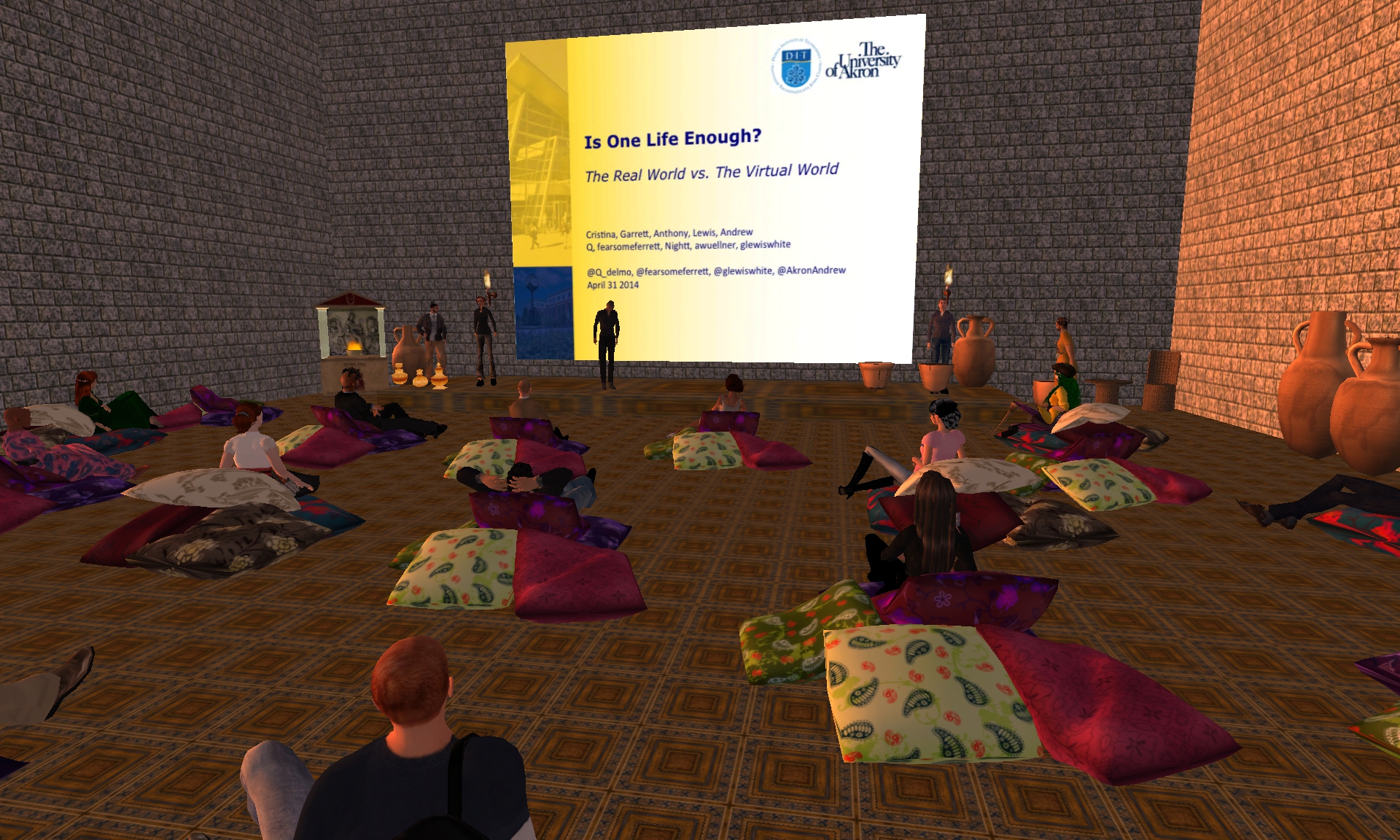
The three student groups gave their presentations in this class and it was evident that all had given great thought to the content and serious effort to the production.

Tutor Locks Aichi.

Tutor Locks Aichi.

Student group

After the final project was presented all students gathered to answer questions from the judging panel and hear their comments.

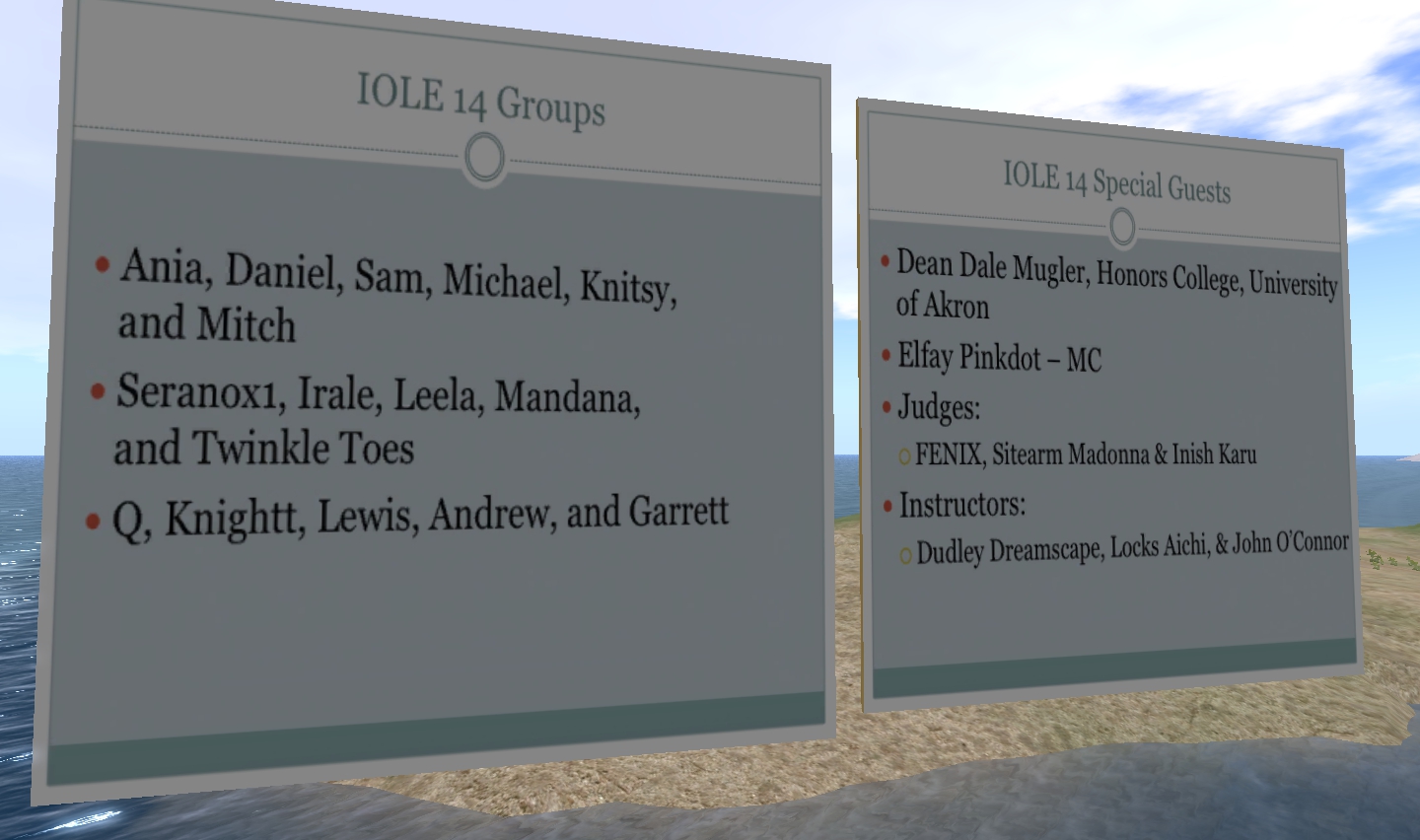
The students were divided into three groups with each one comprising Akron and DIT participants.

The students were divided into three groups with each one comprising Akron and DIT participants.

The third group presented first.

The third group presented first…

Group 2

…followed by the second group…

Group 1

…with the first group completing the agenda.


h1

Classes 10 and 11: Project work

April 24, 2014

CLASS SUMMARY:

The final two classes were given over to project work. In class 10 we had feedback from each group on how they were approaching their projects and collaborative online engagement.

For class 11 each group went to a different part of Akron Island to work on their projects and the lecturers visited each group to get feedback and offer advice.

h1

Class 9: Project work

April 11, 2014

SL class discussion_001CLASS SUMMARY:

The class commenced with a discussion arising from the reading material given last week. The effects of careless or thoughtless tweets posted by individuals who would have been expected to know better (for the most part) were reviewed. The ease of posting a tweet without thinking of the result and the subsequent impact on your career, family and friends was considered – along with the unwitting exposure of privately held views that may be unacceptable in society. The conversation also ranged into the area of privacy and how the appearance of openness may be simply an appearance – with consequent behavioural changes. In other words, people still require privacy – they simply guard it in different ways. The conventions around the use of social media continue to develop in line with these challenges. Social networks that prioritise privacy are now becoming popular and may well find that they can charge a premium for this value.

The second part of the class consisted of an update on progress in the group projects. All teams reported on the theme, communication between team members and development status. Good work on all fronts.


h1

Class 8: Presenting yourself online

April 4, 2014

CLASS SUMMARY:

Snapshot_003

Sitearm Madonna (left, with John O’Connor and Dudley Dreamscape) joined the class again this week to share knowledge and experience of presenting online. The accompanying slide show Presentation Tips for Virtual Collaboration Projects is worth reviewing again.

A question-and-answer session segued to a broader discussion on the use of social networks arising from the reading material set the week before last. The lively session was conducted through voice and text chat and ranged from the different social mores of twitter, Facebook, LinkedIn and other platforms to the power relationship between the boss/workers students/teachers.

ACTIVITIES FOR NEXT CLASS:

  1. Post an entry to your blog describing progress on your group project. Be sure to write about your own particular contribution, how you are finding online communication, what is working well and what is not.
  2. Read Justine Sacco, PR executive fired over racist tweet, ‘ashamed’
  3. Read Police chief insists teens say ‘appalling things’ on Twitter
  4. Read Dr Phil deletes controversial tweet
h1

Class 7: Informal discussion

March 28, 2014

CLASS SUMMARY:

This week is Spring Break for students of the University of Akron so attendance at class was optional. Although only three participants were in a position to attend there was representation from each of the Project Groups. We talked about the progress each group was making and answered some general questions.

One important piece of advice was for participants to ensure their presentation was directed to those who will be attending in Second Life. In other words, while it was appropriate to introduce a range of media into the presentation it should be remembered that this is a live virtual performance. So, it would not be a good idea for a group to simply prepare a video for showing on the day.

It was agreed that Akron Island is the most appropriate location for the presentations as participants can build there and Dudley Dreamscape indicated that tools such as media players can be made available.

h1

Class 5: Content creation

March 14, 2014

Ham Rambler 1_001CLASS SUMMARY:

Ham Rambler (above) and Sitearm Madonna spoke on the development of content in the online environment. Sitearm covered the following points:

  • Content Creation – what constitutes content, how is it generated?
  • Value – does your content have any value?
  • Sharing your content – making it available, generating an income.
  • Use and protection of online content – copyright and Intellectual Property (IP) issues.
  • Consider your content for the end project.

Ham talked about the use of corporate trademarks in Second Life and the reaction of global brands to seeing themselves appear in the virtual world. The various methodologies for protecting content including copyright, trademark registration and patents were discussed. A question about the copyright of book titles focussed on what might not be protected (see You Thought We Wouldn’t Notice…) The development of digital and online content has led to a new approach to sharing under the Creative Commons system.  Finally, we referred to Bruns’ Consumer – Prosumer – Produser proposition brought about by the web (see last weeks list of activities).

Sitearm Madonna’s slides are available here:
Content creation examples and tips
Creating content inside and outside of Second Life (with an emphasis on team working)
Tips and tools for online virtual collaboration and team working

Some other interesting links from Sitearm:
Soundtracks from the Is One Life Enough Song Contest
YouTube video of the Second Life Build A Robot Contest Winners

ACTIVITIES FOR NEXT CLASS:

1. Read: Content licensing in Virtual Worlds (accessed on 03/14/14) a thoughtful blog post about the legal issues around protecting ‘things’ you create in Second Life. Read the comments also.

2. Read The Laws of Virtual Worlds (accessed on 03/14/14) from the California Law Review 2003 this is an excellent, if highly specialised, review of the legal position of avatars in virtual worlds.

h1

Class 4: Online communities and relationships

March 7, 2014

Snapshot_002

CLASS SUMMARY:

There were presentations from three guest lecturers in three different locations for this class meeting. The photograph taken at an art installation shows, from left, John O’Connor, Elfay Pinkdot, Inish Karu and Ham Rambler (in his Paddy’s Day leprechaun guise). The session begun with Ham, Mayor of Virtual Dublin, telling the story of how he came to develop the space in Second Life. It started out as an Irish Bar, The Blarney Stone, that built a regular clientele for live music, story telling and general socialising and gradually grew into a replica of the centre of Dublin City. From the elegant arena where Ham delivered his talk the class moved to the Dublin Conference Centre originally built for Dublin Tourism and containing a virtual build of the former church that now hosts the Tourist Information Office. There Inish Karu, a graduate of the module, spoke about her involvement in role play in Second Life and how this led to the development of a community of role playing pirates and many long term friendships.

Finally, Elfay Pinkdot brought the class to an art installation to share her experiences producing and presenting one of the longest running radio programmes in Second Life, Coffee and Pajamas Jazz programme.

ACTIVITIES FOR NEXT CLASS:

  1. Post: a blog entry discussing the importance of regulation, convention and etiquette in online communities.
  2. Watch: ‘From Prosumer to Produser: Understanding User-Led Content Creation‘ (accessed 03/07/14) by Prof Axel Bruns (Creative Industries Faculty at Queensland Institute of Technology) who explains his theory of user-led collaborative content creation.
  3. Read: User Generated Content and Virtual Worlds‘ (accessed 03/07/14) a paper on the legal background to creating content in an online context.
h1

Class 3: Personal branding

February 28, 2014

CLASS SUMMARY:

The reading for this class included an article in Forbes and Chris Brogan’s blog post on personal branding. We discussed the difference between corporate and personal branding and looked more closely at the latter. The importance of distinguishing between the professional and personal when it comes to our online presence was identified and this led to some consideration of the different expectations supported by different platforms. So, for example, LinkedIn is a specifically for professional promotion whereas Facebook is primarily personal, and twitter can be seen in either category.

The bio (or ‘about me’) piece you write is a very important element in establishing your ‘promise’, your possible value to a potential follower. It is a signal to those who may decide whether or not to follow you. But, your identity will really be formed by the content you add and that should reinforce your promise. Just as the corporate brand builds recognition by repetition and consistent delivery on its promise your personal brand will be shaped by your reliability also.

ACTIVITIES FOR NEXT CLASS:

  1. Go: outside your established community/group (eg, this class group) in SL and make contact with at least two people relevant to your interests (artist, gallery owner, musician, shop manager, business owner, educator, builder, etc). Write about the experience in a post to your blog.
  2. Decide: among your group what tools you will use for planning your project (how you will stay in touch and share information, etc.).
  3. Write: the third post on your blog explaining your choice of communication tools and reflect on how the group arrived at the decision.
  4. Read: this article from the Wall Street Journal that looks at what might happen when employees mix their ‘personal’ and ‘professional’ online identities. Your Employee is an Online Celebrity. Now What Do You Do? (accessed on 02/28/14)