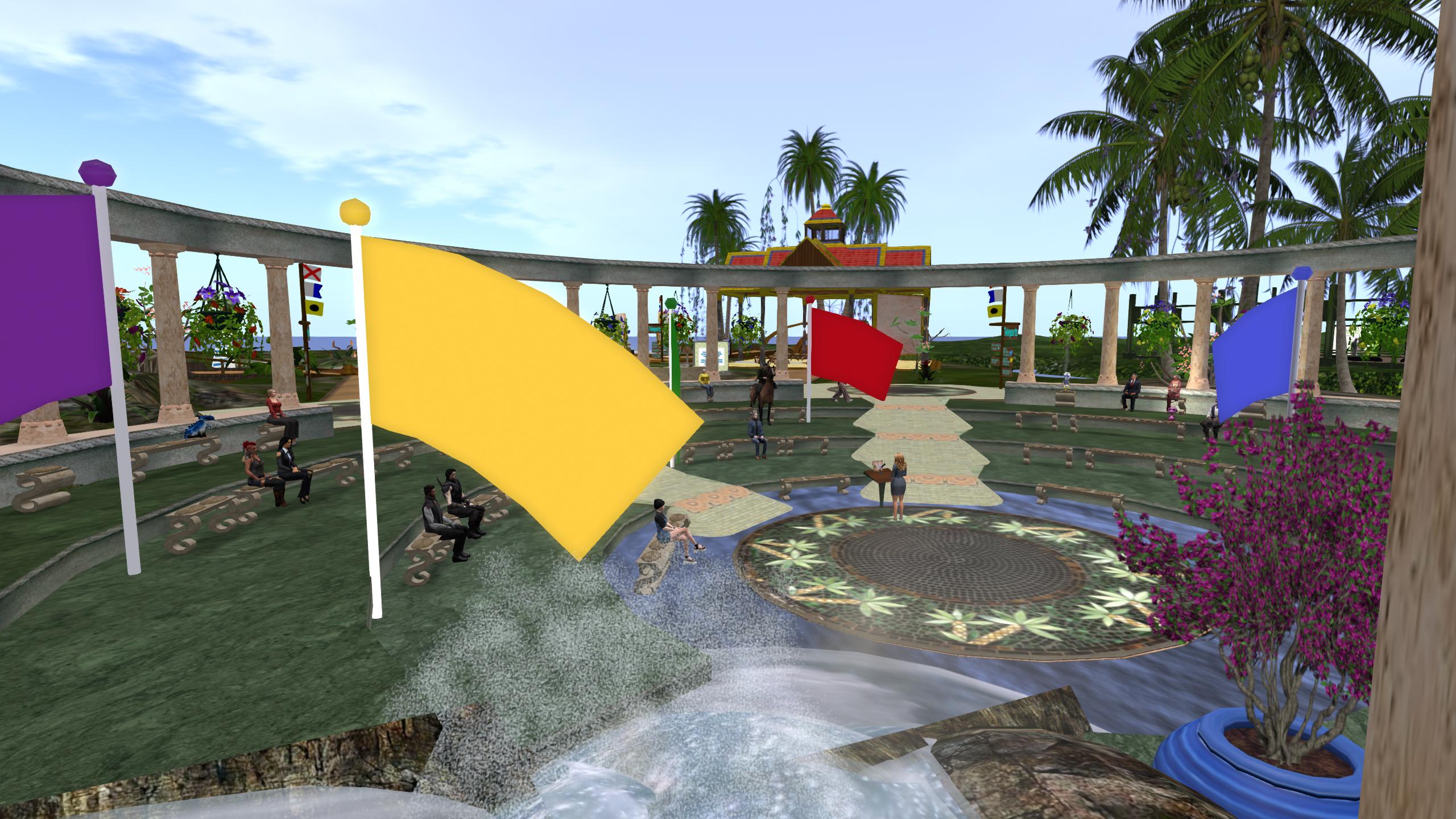
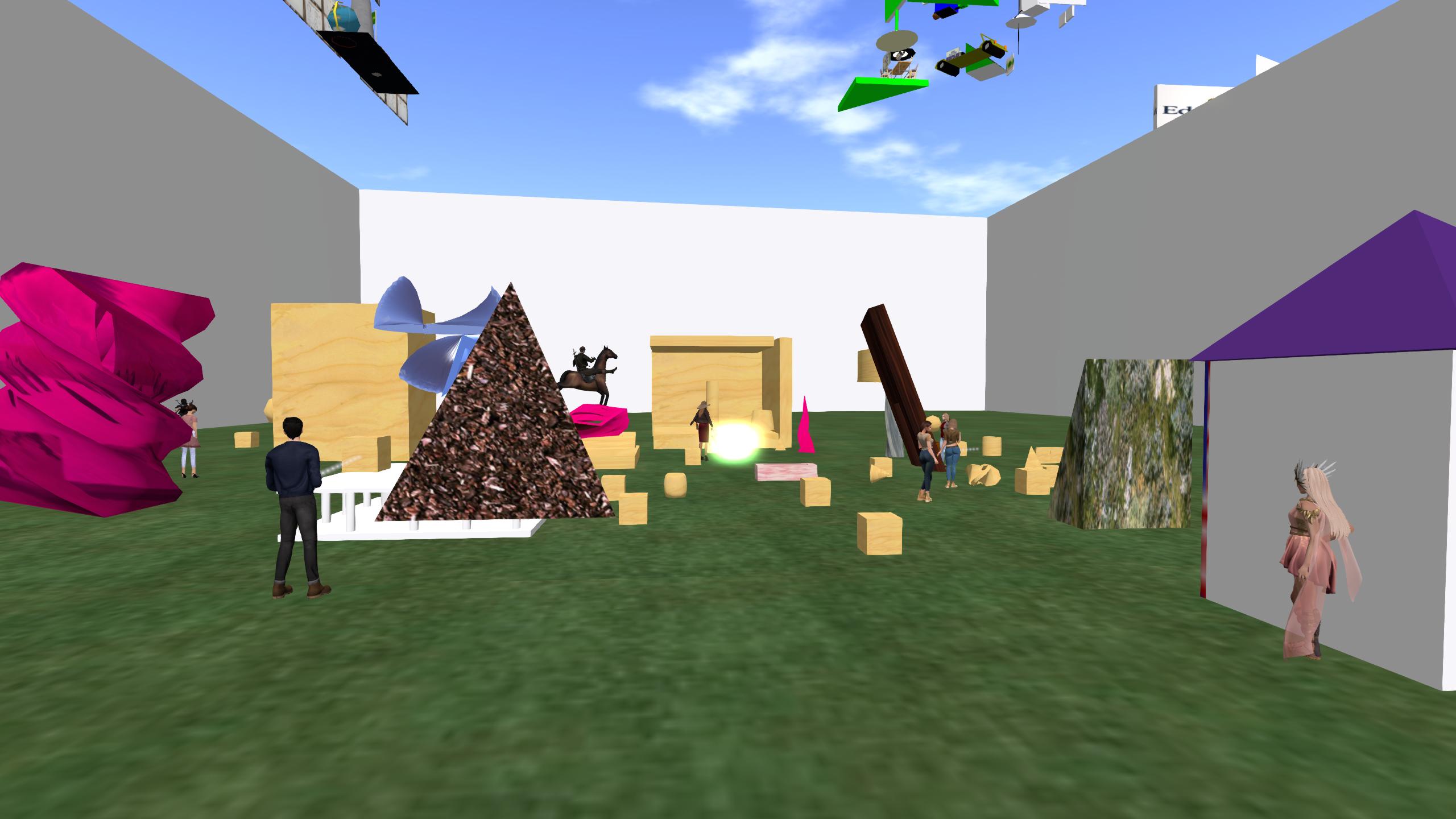
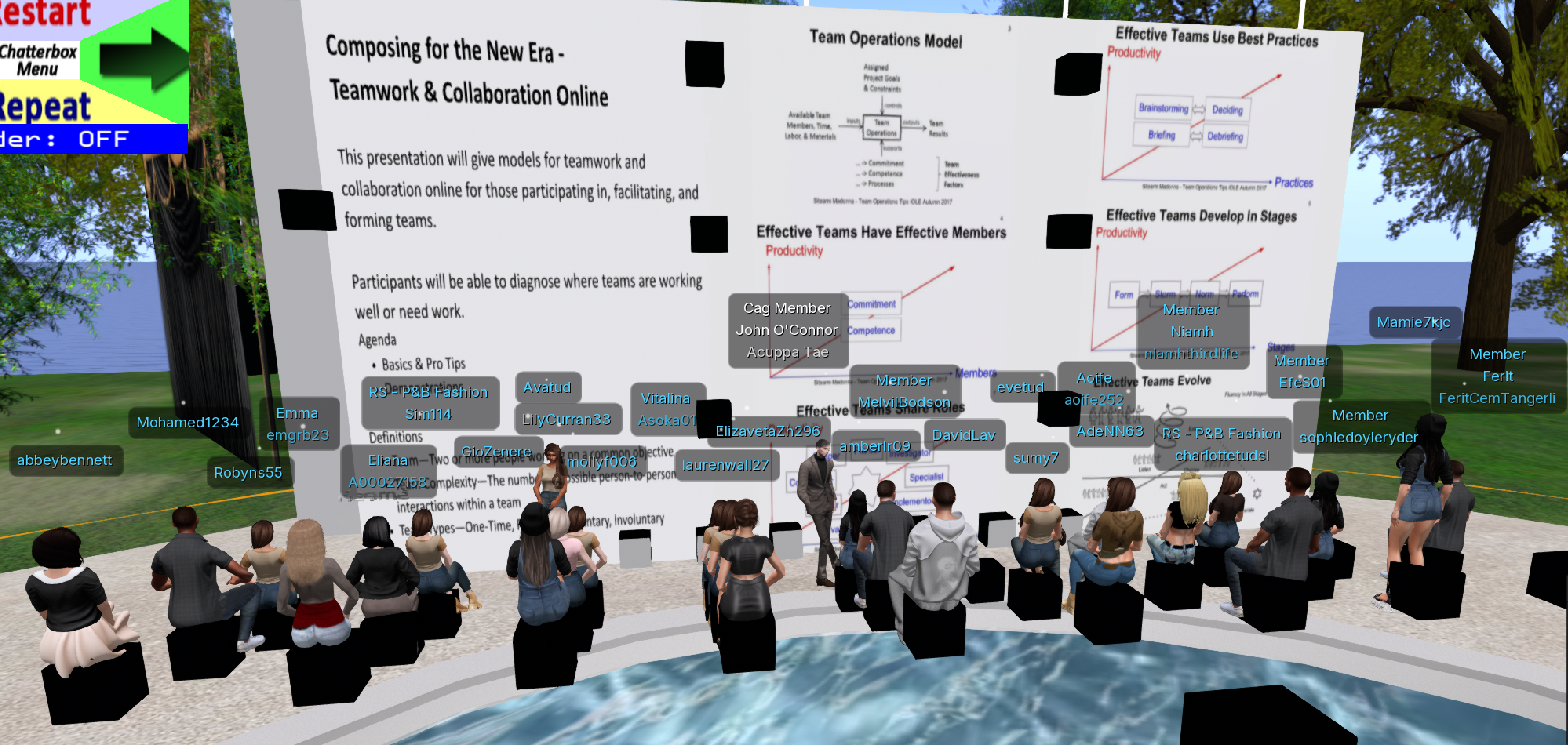
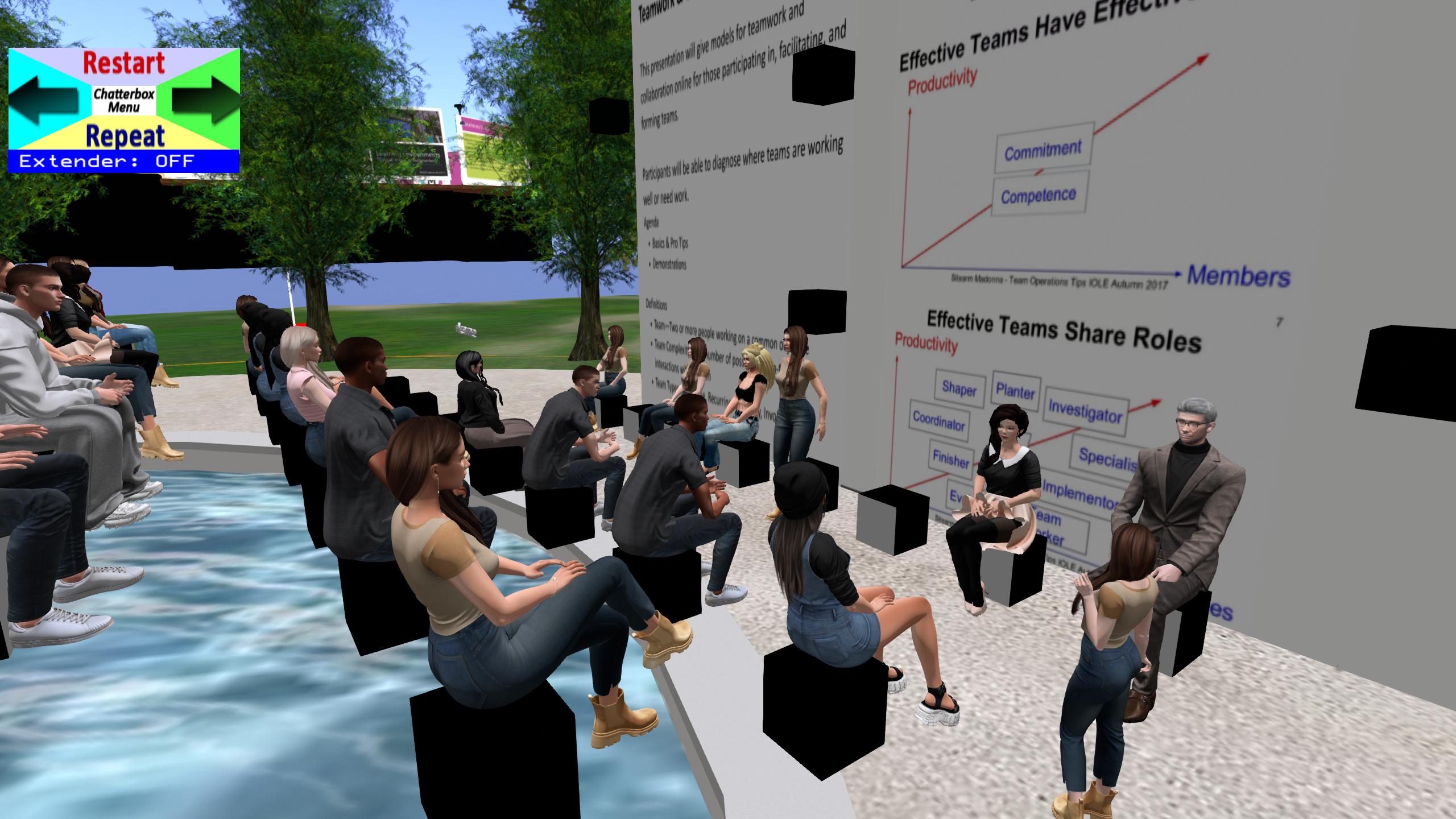
We assembled at the outdoor auditorium in Çağ after the break. John spoke about the impact of technology on society, drawing on the ideas of mid-to-late twentieth-century media theoretician Marshall McLuhan. Although this presentation had not been scheduled it provided an opportunity for a useful discussion in the context of the Team Project. There was a good response from the students who engaged with the ideas enthusiastically.
John reminded the class that the field trip next week is another high point of the semester – so don’t miss it !
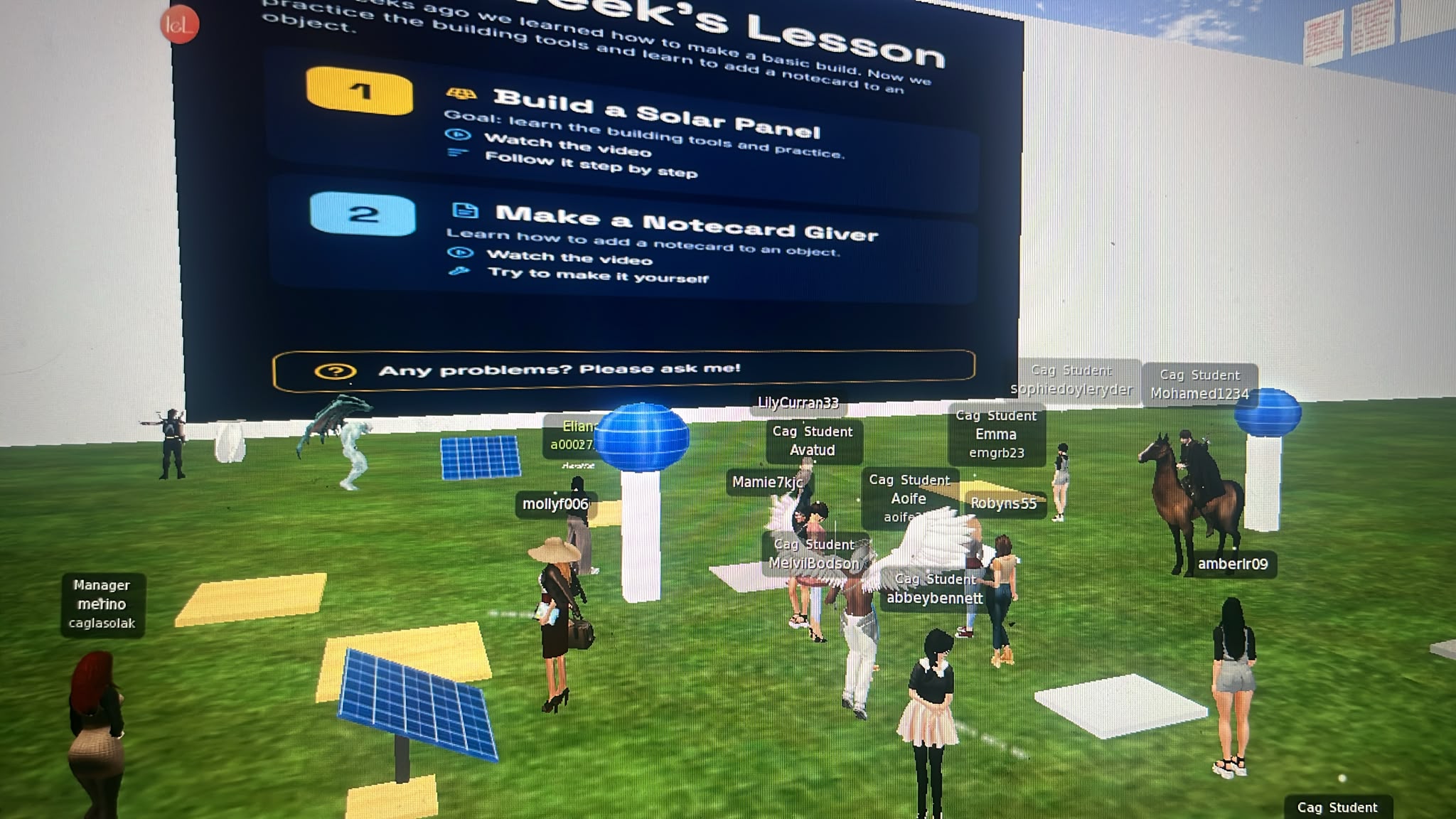
Merino’s workshop for advanced building in Second Life took place for the first half of the class this week. Now that the building areas for the Team Projects have been allocated everyone is beginning to master their building skills. Every semester there are participants who already have experience of building in virtual environments or using tools for 3D modelling. Others don’t have such skills so the allocation of roles within the teams becomes a very real proposition. Nevertheless, most people develop some mastery at building, an increasingly useful skill, even if you only ever use it for prompting AI.
Halfway through class there was a region reset so we went back to the TU Dublin campus for a chat. One of the interesting questions that emerged was about the use of AI on the module. John and Merino told the students that it is encouraged throughout this module. AI can be useful for helping with 3D modelling and building, particularly for writing scripts. You can also use it to discuss your projects and tease out ways of approaching your builds. There is no requirement to report on this use. The one area that AI should be avoided is in writing the reflective text on the conclusion of the module. Because this is an opportunity to reflect on your own learning over the semester it would be a pointless exercise to use AI. You deprive yourself of this important time to look back at the experience and synthesise your understanding. AI is such a new tool, subject to ongoing rapid development, that society in general, and education in particular, is still coming to terms with its impact. There has not been time to develop appropriate guidelines so we need to approach it with care, attention and a dose of scepticism. But, as it seems to be here to stay, it is important that we all learn to engage with it and see how we can use it to enhance our work without becoming a slave to its undoubted charms.
John reminded the teams that there is a budget available for each student Team to buy items on the SL Marketplace, or in-world. Requests should come from the team lead or communications coordinator to John, either by email or in the WhatsApp group. Include a rough budget, an indication of how many Linden Dollars are needed.
We took a ten minute break after the building and John asked the class to return for a talk on technology and society, From Hammer to Pixel.
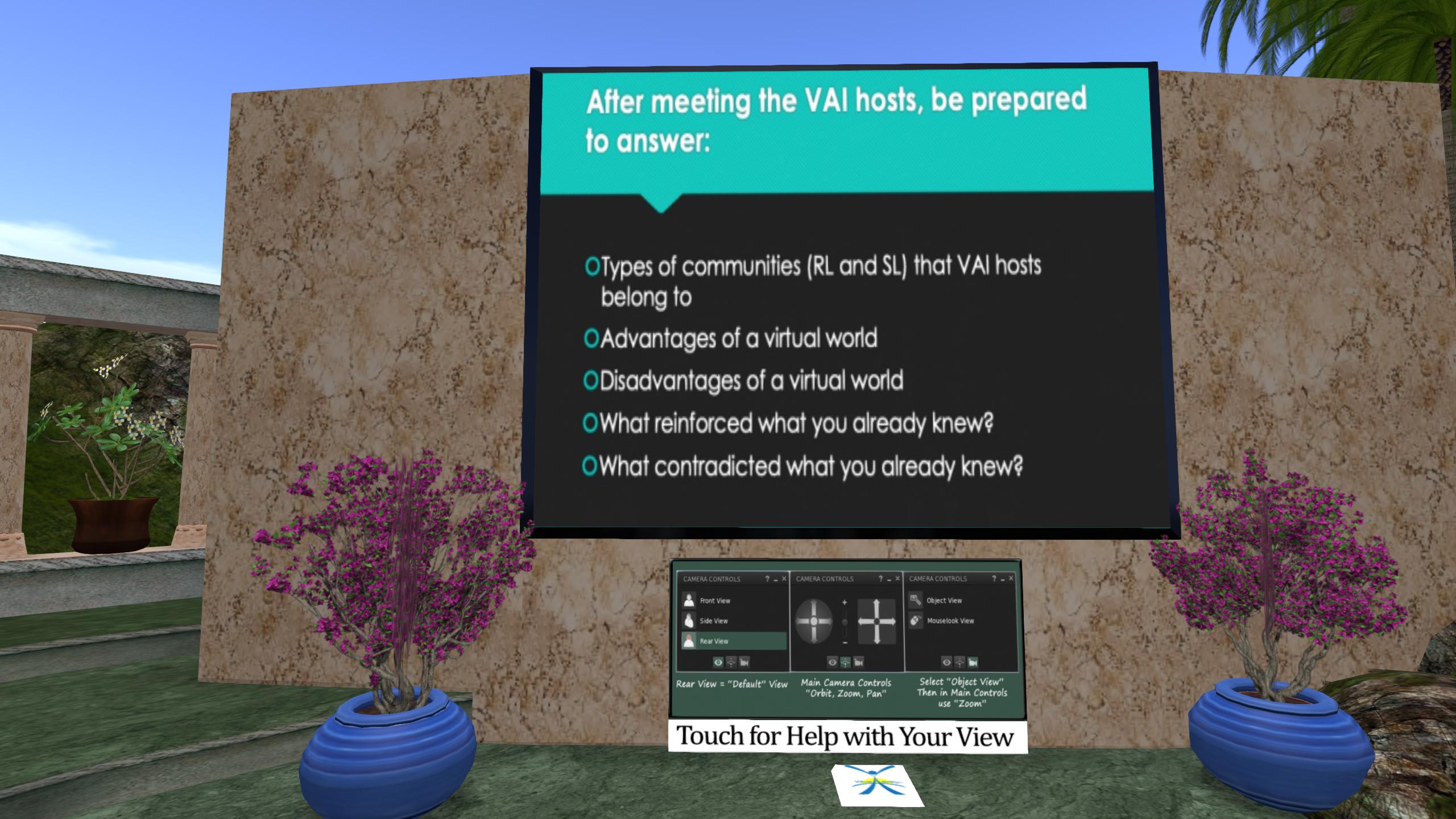
Unfortunately, one of the most interesting field trips of the semester was poorly attended due to a scheduling oversight. It is Reading Week at TU Dublin so many students were off-campus and forgot that classes in Second Life continue. Those who did make it to Virtual Ability Island received a warm welcome from the founder, Gentle Heron. After telling the story of the community and how it began, each team went to a different location with VAI hosts. The conversations within these smaller groups were fascinating and we realised just how valuable a virtual world can be to those who may have little other opportunity for engagement. The community is not merely a side interest or a game: it is a fundamental part of life for the members. Without it they may not have any social interaction.
The generosity of the Virtual Ability community in sharing their stories is wonderful. We heard about people who formed deep friendships, and indeed partnerships, who may never meet in the natural world. There are also those who, having met at Virtual Ability travelled long distances to meet physically. But, the overriding takeaway is that Second Life allows the community members to take part in activities that are not possible for them in the natural world: dancing, running, horse riding, playing golf, meeting friends, talking, learning new skills and much more.
The community also hosts many important information areas, cultural, and social spaces. Cape Able Gallery is a showcase for artists and Health Island provides support for both physical and mental wellbeing. It also organises and hosts two acclaimed international conferences annually. Virtual world communities really can be a substitute for the natural world communities when there is no other option.
The students were particularly interested to hear from so many people with disabilities from different backgrounds. One noted the joy they found in the freedom to appear however they wished through the form of their avatars, relating it to the notion of avatars being a reflection of our natural world selves explored in the class about identity. Another spoke of how there are people from so many different locations around the natural world that have become friends in this virtual one.
The students also enjoyed the fresh perspective on Second Life – while just a place to attend class for them – it can be a community and even provide a career for others. They became very aware of the accessibility afforded by the digital environment and Gentle’s explanation about ensuing that all abilities are considered here: text accompanies voice, images are supported with descriptions, colour is used sensitively to support those with poor vision and so on.
As the visit concluded the students thanked the community, saying how insightful the discussion was and how much they learned from the visit. They were particularly grateful to the volunteers for sharing their stories.
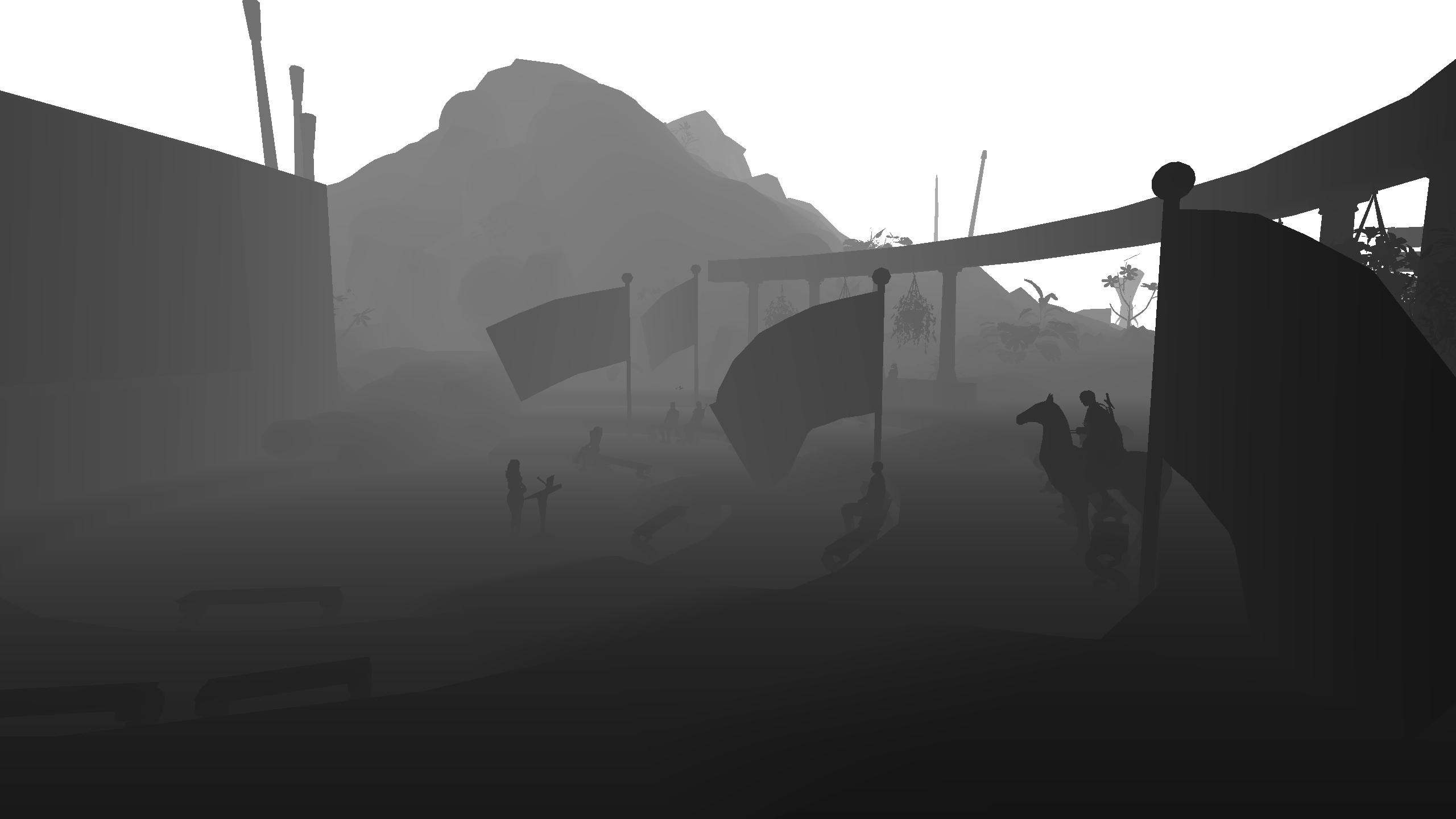
John’s SL camera malfunctioned towards the end of class and produced this atmospheric black and white image, something that would have been difficult to achieve if you were trying!
.
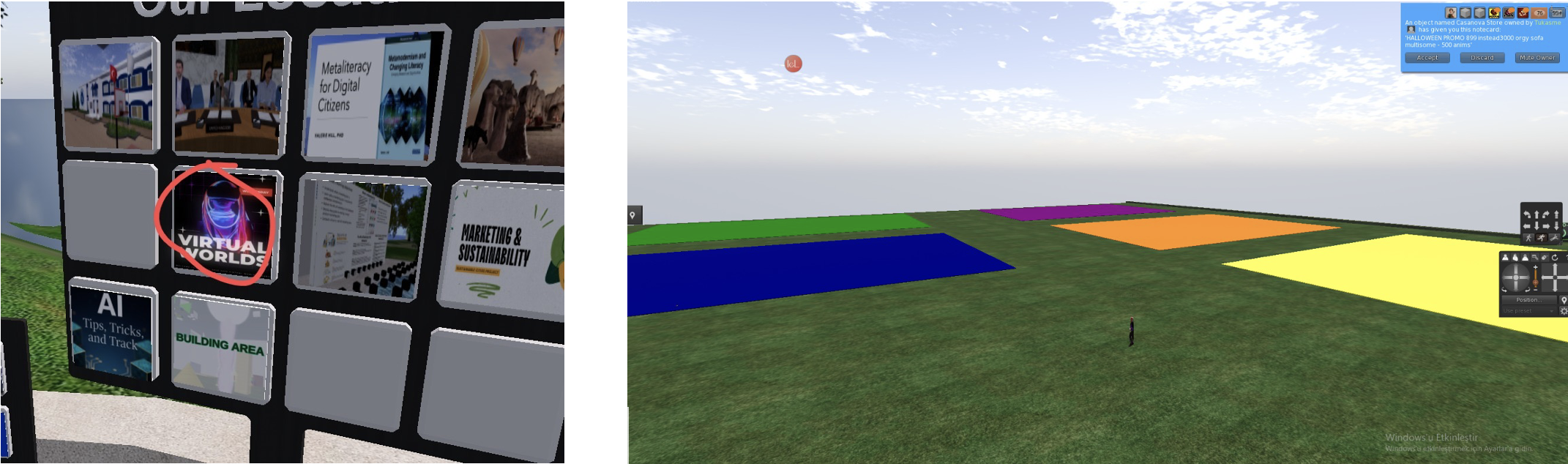
After class Merino allocated spaces on the Çağ campus (in a skybox) for each team to build their presentation. They can be accessed from the teleporter at the campus meeting circle (see the image on the left below). Do remember that you must have the Cag Student group activated to have permission to build here.
Merino led the class this week for an introduction to building techniques in Second Life. Her series of useful YouTube videos formed the basis of the activity and once everyone had activated their Çağ student group they had permission to build in the skybox above the campus. Some students have previous experience building with 3D modelling software and were even able to import items to SL. Each student was able to create something new, however, and seemed to enjoy the experience.
After that we had a quick update from each team about their progress on the project. John noted that there is significant activity on the WhatsApp groups. Although it is not always an easy matter to meet, due to time constraints and time zone difference, discussions take place and decisions get made. Progress is about where it would be expected at this stage in the semester.
Next week we will have a field trip to Virtual Ability Island and John asked that everyone try to log in early at the Çağ meeting point so we can all go together in good time. Please see the page for Online Communities and Relationships in preparation for the class.
As Sitearm Madonna was not available this week John / Tae gave the presentation Identity with Intent.
The talk was followed by a practical session where all participants experimented with changing their avatars and their clothing. This demonstrated some of the points made during the talk and help everyone get a sense of how our avatars and our clothing can affect how we feel about ourselves, even in a virtual world.
The class finished up, as usual, with the team check-in. Each team reported on their meetings during the week and progress on the project. All teams now have confirmed team leads and communications coordinators. To conclude we had some brief likes-and-wishes feedback.
Next week’s class will introduce building in Second Life with Merino. John shared a link to the class description so you can review it in advance and even try out some building if you like. He also recommended a visit to the Happy Hippo Building School which has lots of free support and advice on building, along with regularly scheduled classes.
We had a look at the theory of teamwork and collaboration with John/Tae this week. The basic structure of a team and the forces that make for success, along with the contribution of each individual, was outlined. If you missed the class, or simply want to review it, here is a YouTube video of the same presentation given by Sitearm Madonna in 2024.
This was followed by a practical demonstration from each of the student Project Teams. Sitting at the top of the class, in turn, the teams shared their activity and achievements during the week. Each team has now been established, and has identified a team lead and a communications coordinator. They have also set up team groups in WhatsApp and are in the process of adding their assigned mentor to the group. Additionally, the project brief has been considered and discussed. This is a strong start and is very encouraging.
We finished the class with a break-out session for the teams to continue discussing the project. One factor that exemplified the unpredictable nature of working online was a ‘region restart’ by Second Life about half an hour into the class. This unwelcome disturbance meant that we all had to teleport to the TU Dublin campus for a few moments to avoid being ejected from SL. Unfortunately, Linden Labs usually does this once a week so we will see if it is possible to reschedule the activity for this region.
The Dublin students teleported to the Çağ campus once everyone had logged in and met with the Turkish students as class began this week. The student Project Teams met at their team colour flag and the students introduced themselves to each other. There is a bigger cohort of TU Dublin students this semester than usual but we have at least one Çağ student on each team. Prof Murat Gülmez, Magua in SL, was also present for the class. Next week we hope to be joined by some Romanian students from Cluj-Napoca. In the meantime, John asked to students to ensure everyone is added to the appropriate WhatsApp Project Team group.
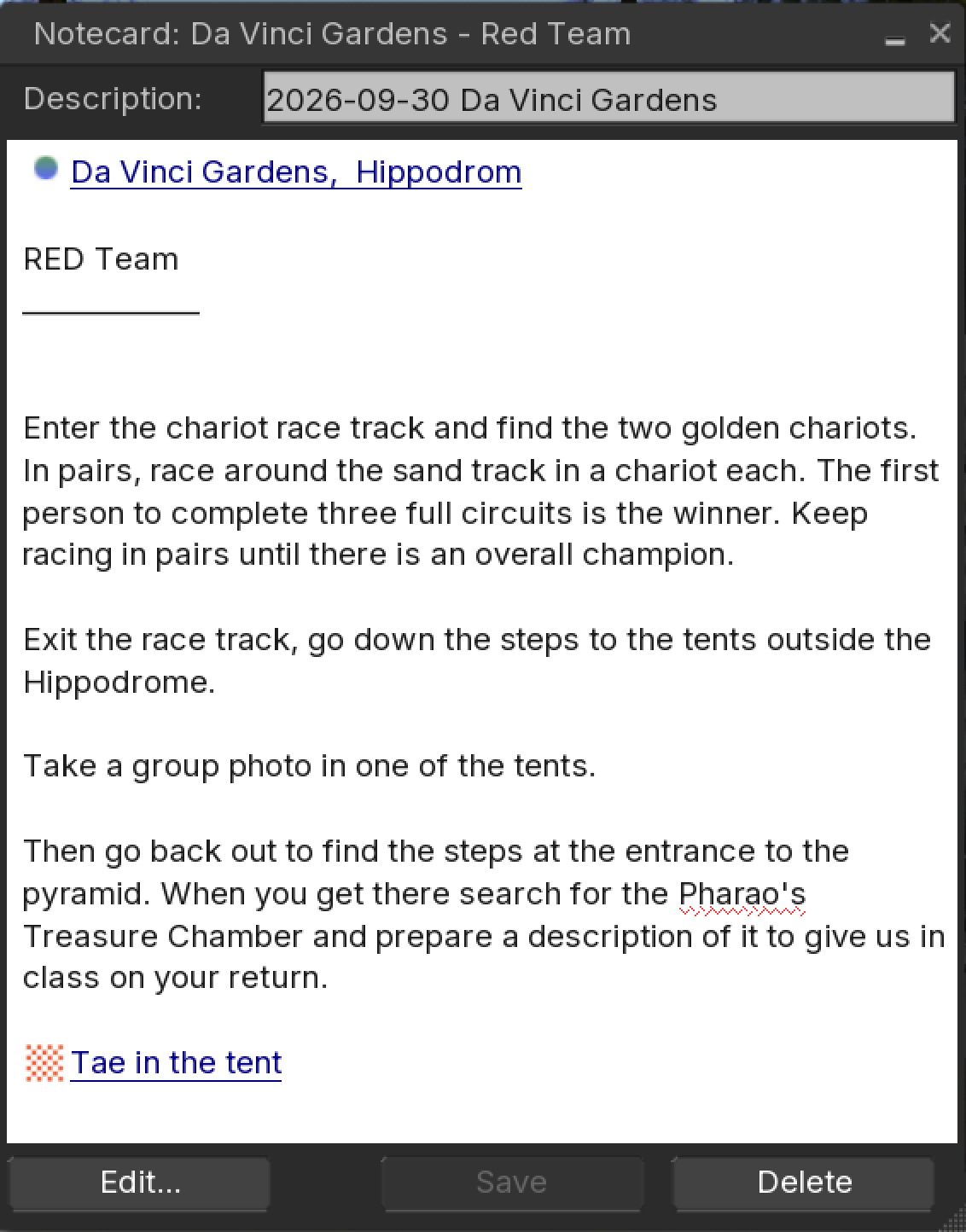
Then, John introduced an icebreaker exercise to give the teams a chance to get to know one another and explore different locations in Second Life. Each team was given a notecard with a landmark to a different location containing instructions on what to do on arrival. Each team also took a group photo which was displayed back on the campus when the teams returned. All teams managed to successfully explore their location, find their way back to the campus, and share their experience with the full class.
John shared the Team Project brief with the class and asked everyone to meet in the teams to read, review and discuss the project before next week’s class. He also asked each team to decide on a team leader and an assistant lead, who will be the communication coordinator.
Here are the tasks the be completed by each team before next week’s class :
decide on your team lead
decide on your team assistant lead (to be known as the communication coordinator
Read and discuss the project brief together to get an understanding of it
Next week we will meet at the Çağ campus in Second Life.
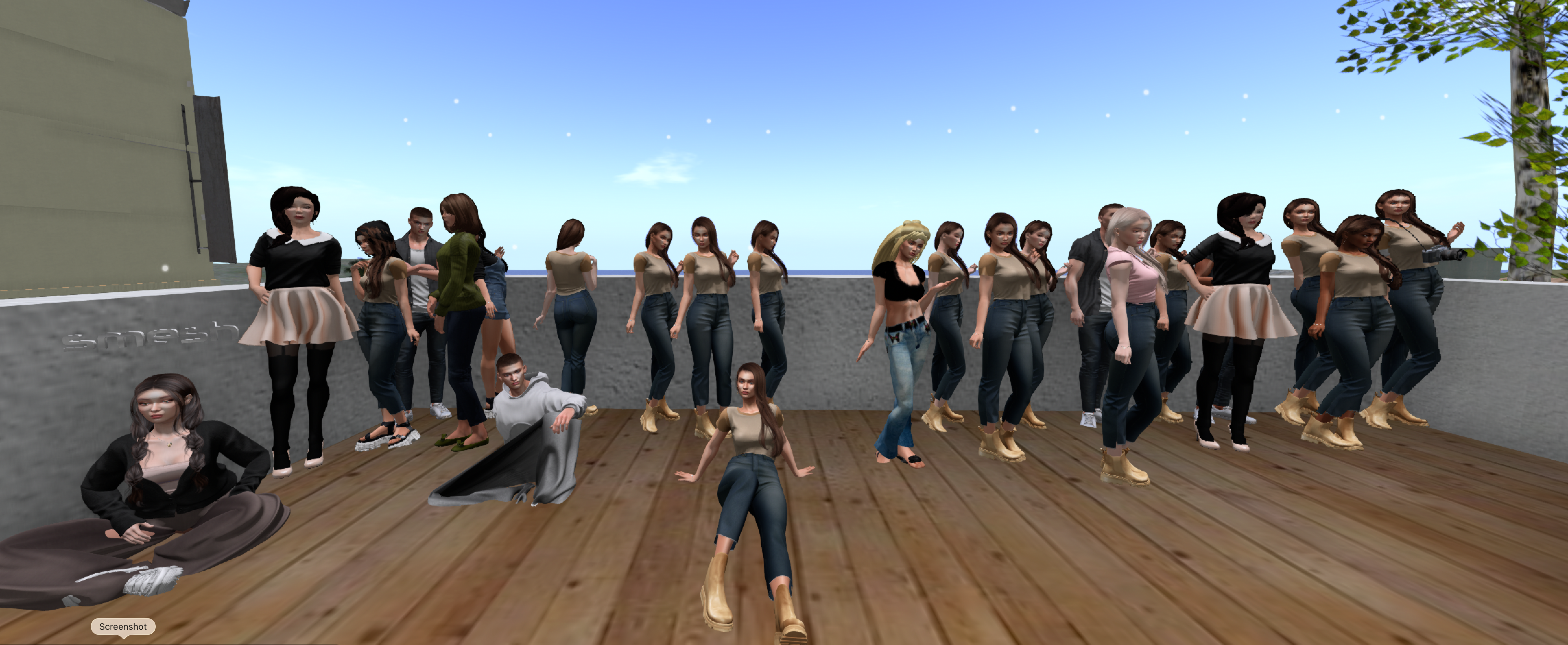
A big class this semester, with 25 students turning up for the first class. There is also a diverse range of programmes represented across most years of undergrad study. We started at TU Dublin in SL and had a quick visit to the Çağ campus online too. Everyone gathered on the roof terrace for the first class photo and it is clear that many are choosing the same avatar shapes from the menu!
Classes commence on Wednesday 23 September and we will meet every Wednesday thereafter. This semester we will work on teams made up of students from TU Dublin in Ireland, Çağ University in Tükiye, and Technical University of Cluj-Napoca in Romania. Professors will include John O’Connor in Dublin; Murat Gülmez and Çağla Solak in Türkiye; and Lia Pop in Romania. There will also be guest speakers making presentations and hosting site visits across Second Life throughout the semester as we explore technology and society. You will also need to meet in your teams outside scheduled classes to work on your Team Projects.
Wednesday class meeting times are:
0700 to 0900 Second Life time. 1500 to 1700 Ireland time. 1700 to 1900 Türkiye time. 1700 to 1900 Romania time. This will change in October when the clocks change to winter time See the schedule for more information.