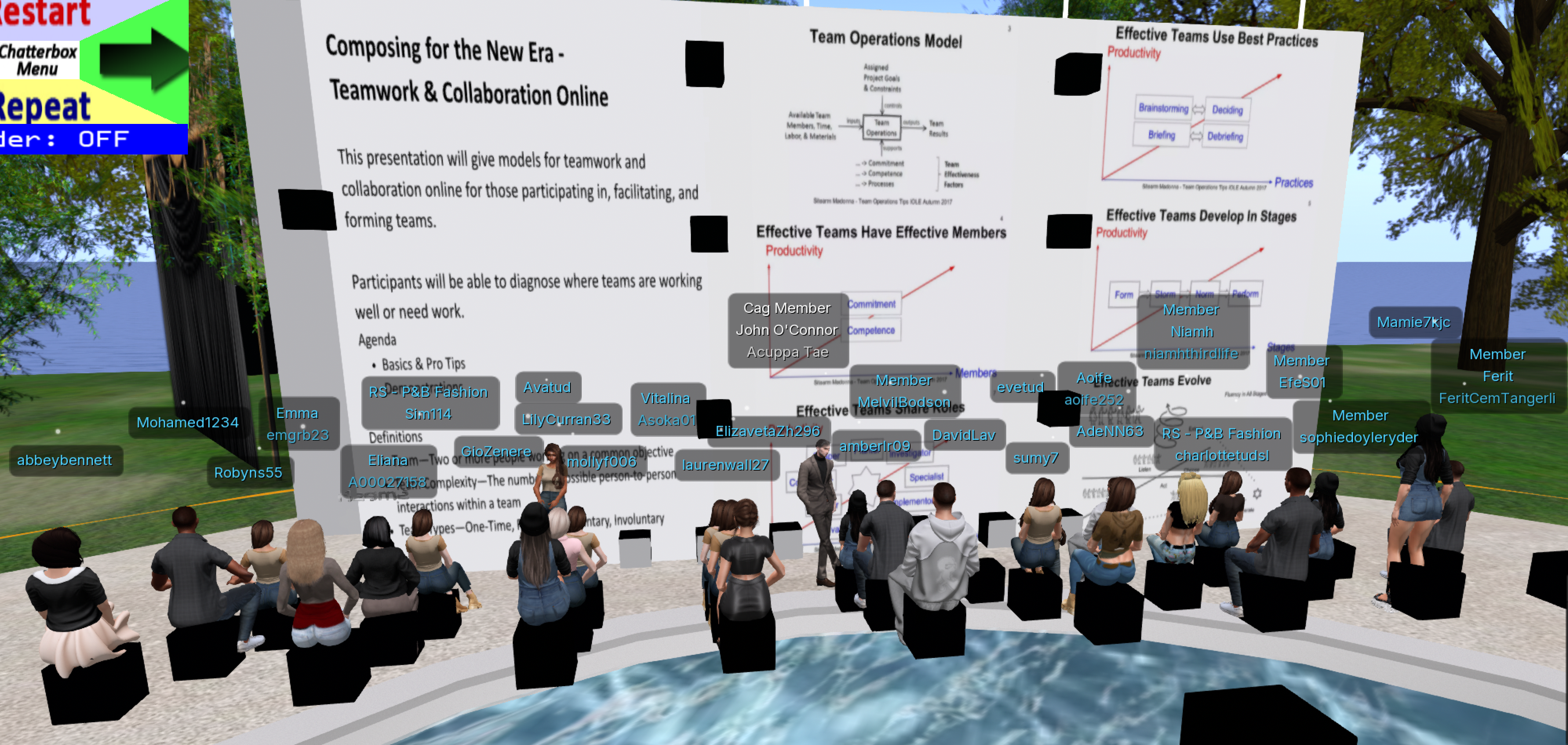
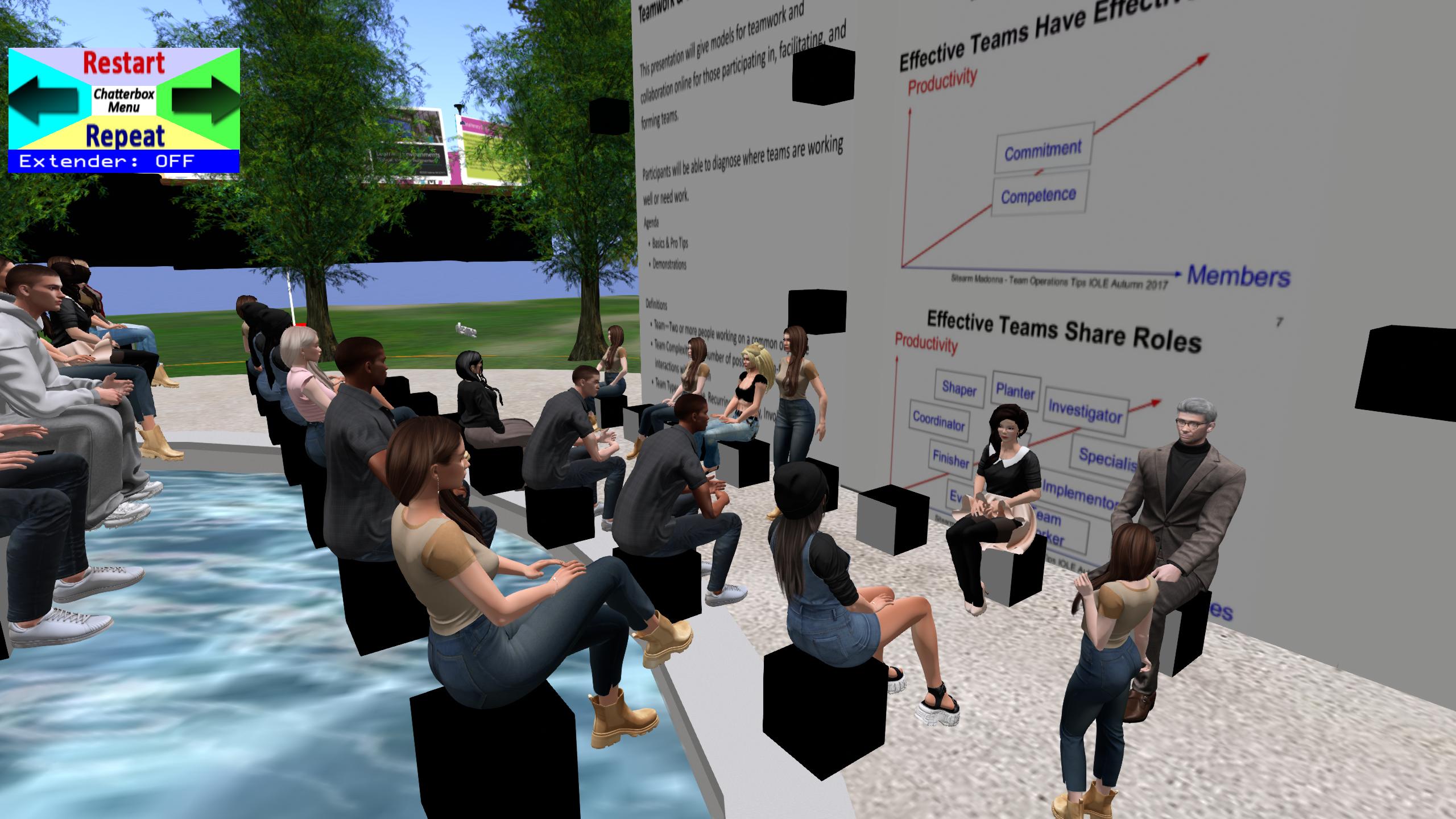
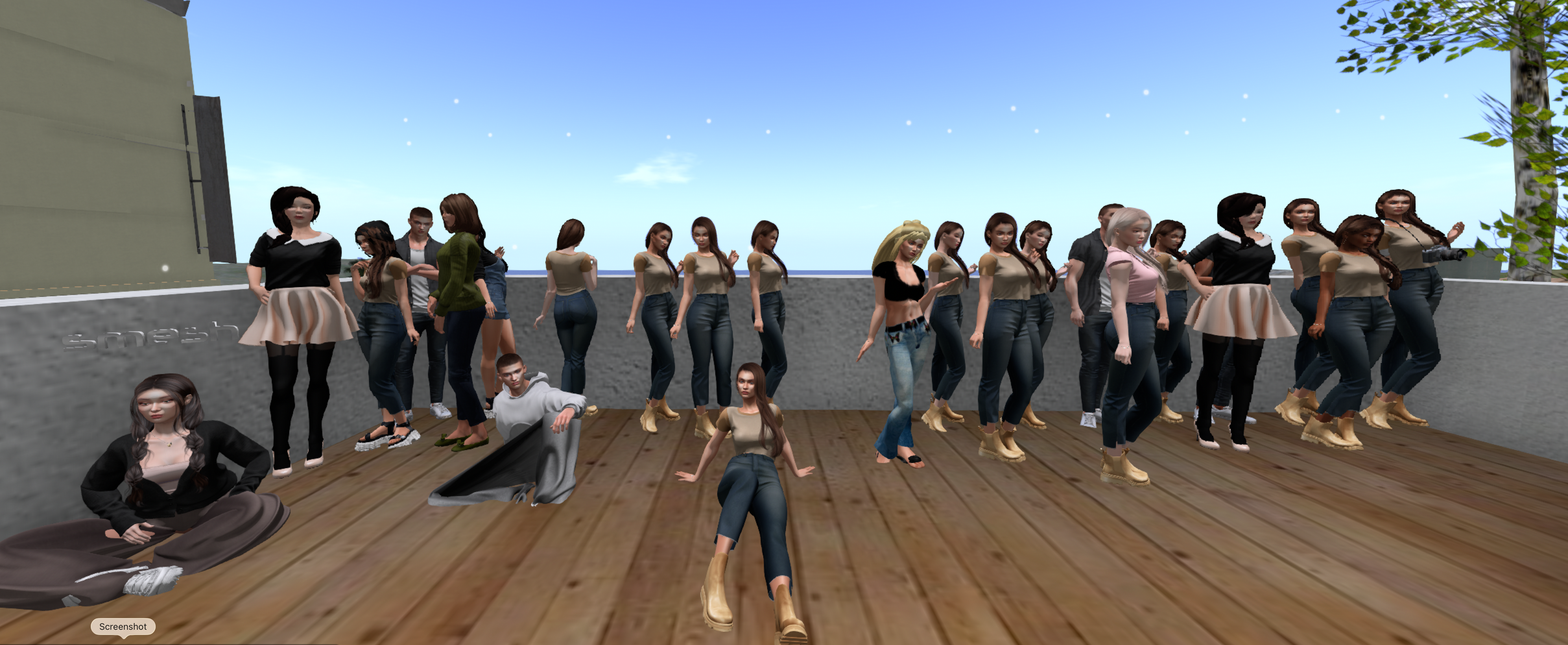
Following the excitement of the Student Challenge Awards the final class meeting gave all participants some space to reflect on the semester’s work. All gathered under the shade of the trees on Çağ campus where Merino spread out beautiful lotus flower seats. It was an informal session for students, in particular, to share what the found useful during the semester and what they considered might be improved upon.
Here is a summary of the discussion taken from the transcipt and made by the Opera Neon AI tool.
Summary of the discussion
The discussion was a reflective wrap-up of a module delivered in Second Life, focusing on what students enjoyed, what they learned, what challenges they encountered, and what could be improved for future iterations.
A major theme was accessibility and convenience. Students and staff noted that the course removed many real-world barriers such as travel, making participation easier. Several participants said the virtual format made it easier to attend, engage, and teach, especially compared with travelling to campus.
Another strong theme was engagement. Many students found the course more engaging than traditional classroom teaching, Zoom, or Teams. Reasons given included the visual richness of the environment, the less formal atmosphere, and the sense that communication between students and lecturers felt more equal. Avatars appeared to reduce some of the usual social barriers around age, status, and identity, which helped people participate more freely.
The discussion also highlighted confidence and participation. Some students said they were quieter in real life but found it easier to speak up, ask questions, and present in Second Life. Presentations were still stressful, but often felt less pressurised than face-to-face presentations. The environment was described as a useful space for developing communication and presentation skills that could transfer into real-world contexts.
A further important point was collaboration across cultures and languages. Students described teamwork as challenging but rewarding. Language barriers existed, but overcoming them was seen as a positive learning experience. Participants felt they learned from one another and developed patience, communication skills, and the ability to work across differences. Staff emphasised that although international virtual teamwork is difficult, the students had produced sophisticated outcomes in a short time.
The building and creative aspects of the module were clearly valued. Students enjoyed improving their builds over time as they gained more resources and skills. The course supported creativity, experimentation, and visual thinking. Some students said they could imagine returning to Second Life for future creative or project-based work.
The site visits and guest interactions were also seen as valuable, especially visits such as Virtual Ability Island and Happy Hippo. These experiences helped students understand how virtual worlds can support inclusion, accessibility, and community, particularly for people with disabilities. The discussion stressed that Second Life can be more than a teaching platform: it can be a meaningful social and rehabilitative environment.
There was also discussion of the Proteus effect and the broader educational value of virtual identity. Staff explained that avatar-based learning can influence behaviour, confidence, and skill development, and that actions practised virtually may transfer into real-world competence.
On the challenges side, students mentioned technical frustrations, including login problems, lag, crashes, and presentation anxiety caused by fear that technology might fail at the wrong moment. However, these difficulties were generally treated as part of the experience rather than a reason to reject the format. There was also appreciation for the fact that people in Second Life tend to be understanding when technical issues arise.
In terms of what could be improved, several practical suggestions emerged. Saturday sessions were repeatedly identified as difficult, especially for students who work and for participants in Europe and Türkiye because of timing. Students also suggested clearer information about who their mentors were, and better support around translation tools for multilingual collaboration. One student noted that while virtual collaboration was valuable, group work can sometimes be easier to organise in person, especially in non-international contexts.
The staff expressed strong satisfaction with the cohort, describing this term as especially successful because students worked with a high degree of autonomy and independence. They were proud of the quality of the work and the maturity shown by the teams.
The discussion ended with some administrative clarifications. Students were told how results would be communicated, and TU Dublin students were reminded that their final submission is a 2,000-word reflective report on learning about teamwork and virtual activity, including illustrations and references.
Main points made
Positive aspects
- The course was highly accessible because it removed travel and campus attendance barriers.
- Students found the module more engaging than traditional lectures and often more engaging than Zoom or Teams.
- The virtual environment felt less formal and more equal, making it easier to interact with lecturers and peers.
- Some students found it easier to speak up, ask questions, and present in Second Life than in real life.
- Students valued the creative building process and could see their skills improving over time.
- Teamwork across cultures and languages was challenging but rewarding and educational.
- The module helped develop patience, communication skills, and collaboration skills.
- Visits to communities such as Virtual Ability Island and Happy Hippo were especially meaningful and eye-opening.
- Students gained insight into accessibility, disability inclusion, and virtual community life.
- Staff and students agreed the overall experience was fun, and that enjoyment supported learning.
Challenges
- Language barriers required effort, though they were ultimately rewarding to overcome.
- Technical issues such as lag, crashes, and login problems caused frustration.
- Presentations could still feel stressful, especially when technology might fail.
- Virtual group work could be harder to organise than in-person collaboration in some cases.
- Saturday classes were inconvenient for several participants.
Suggestions for improvement
- Reconsider or improve the scheduling of Saturday sessions.
- Provide a clearer introduction to mentors and their roles.
- Offer better guidance on translation tools for multilingual teamwork.
- Continue supporting students with recorded materials, videos, and module website resources.
Actions to be taken
For staff / organisers
- Bring feedback about Saturday classes to the student challenge organisers, as this timing was difficult for many participants.
- Consider changing the timing of Saturday sessions if possible.
- Clarify mentor roles earlier in future iterations of the module.
- Consider adding mentors to team WhatsApp groups again, as this had worked better in previous semesters.
- Prepare and share recommended translation tools for students in future cohorts.
- Post the full student challenge results on the module website.
- Share details with any students who email expressing interest in speaking at the Friday expert talk.
- Attend the organising team meeting later that evening to discuss relevant matters.
For students
- Email staff if interested in speaking at the Friday expert talk about the student challenge.
- TU Dublin students to submit the reflective report by Monday 11 May at 5:00 p.m.
- The reflective report should:
- be about 2,000 words
- focus on insight into learning about teamwork and virtual activity
- include illustrations
- include references
- be emailed to the lecturer
- Students should use standard academic referencing for readings, workshops, presentation sources, and any other materials used.
Key deadlines and practical details
Expert talk
- An expert talk on the student challenge is scheduled for Friday at 9:00 p.m. Irish time
- Students interested in participating should email the staff over the next few days
TU Dublin final submission
- Reflective report due: Monday 11 May at 5:00 p.m.
- Submission method: by email to the lecturer
One-sentence overall takeaway
The discussion concluded that the Second Life module was a highly engaging, accessible, and creatively rich learning experience that successfully developed communication, collaboration, and confidence, while also revealing practical improvements needed around scheduling, mentoring clarity, translation support, and technical resilience.