Sitearm Madonna presents the theory of teamwork. Photo by Acuppa Tae
Meeting at Çağ campus this week we heard from Sitearm Madonna about how teams function and the roles of the team members. If you missed the class you can review the recording of the same class from last semester.
Then we had a look at the brief for the Student Challenge in a little detail to determine precisely what is expected. The detail is in the previous post Serious Simulations in the Metaverse. Some changes have been made to the teams for the Student Challenge which will be confirmed next week but, in the meantime the teams broke out with their instructors to confirm the team lead and assistant lead and share contact details. Both Red and Green teams met but nobody from the Blue team was in class so the members will need to catch up on that work in their own time.
After the breakout the full class met again and shared their progress. The Teams were asked to arrange to meet during the week to discuss the Student Challenge and select the SDG they will address. Following that we had a request from Nova, a PhD researcher at North Carolina University, to take part in a focus group about learning in virtual worlds. Anyone interested can let John / Tae know and he will share details.
Next week we meet at Çağ again when Valibrarian Gregg will talk to us about Metaliteracy and Digital Citizenship. Please arrive early.
This semester we are delighted to be joined by Prof Lia Pop from the Technical University of Cluj-Napoca in Romania – a member of the European University of Technology (EUt+) alliance with TU Dublin – and her students. We all met for an introduction to Second Life at the TU Dublin campus in Second Life (SL) where we friended each other, joined the TU Dublin group and spoke about the timetable for the semester. The importance of attending all the scheduled classes was emphasised. This is particularly necessary for the Student Challenge, which includes tuition on building in SL, an essential skill for completing the project. Also joining the class meeting was Dr Lucia Morales of TU Dublin and her PhD students TallNinja.
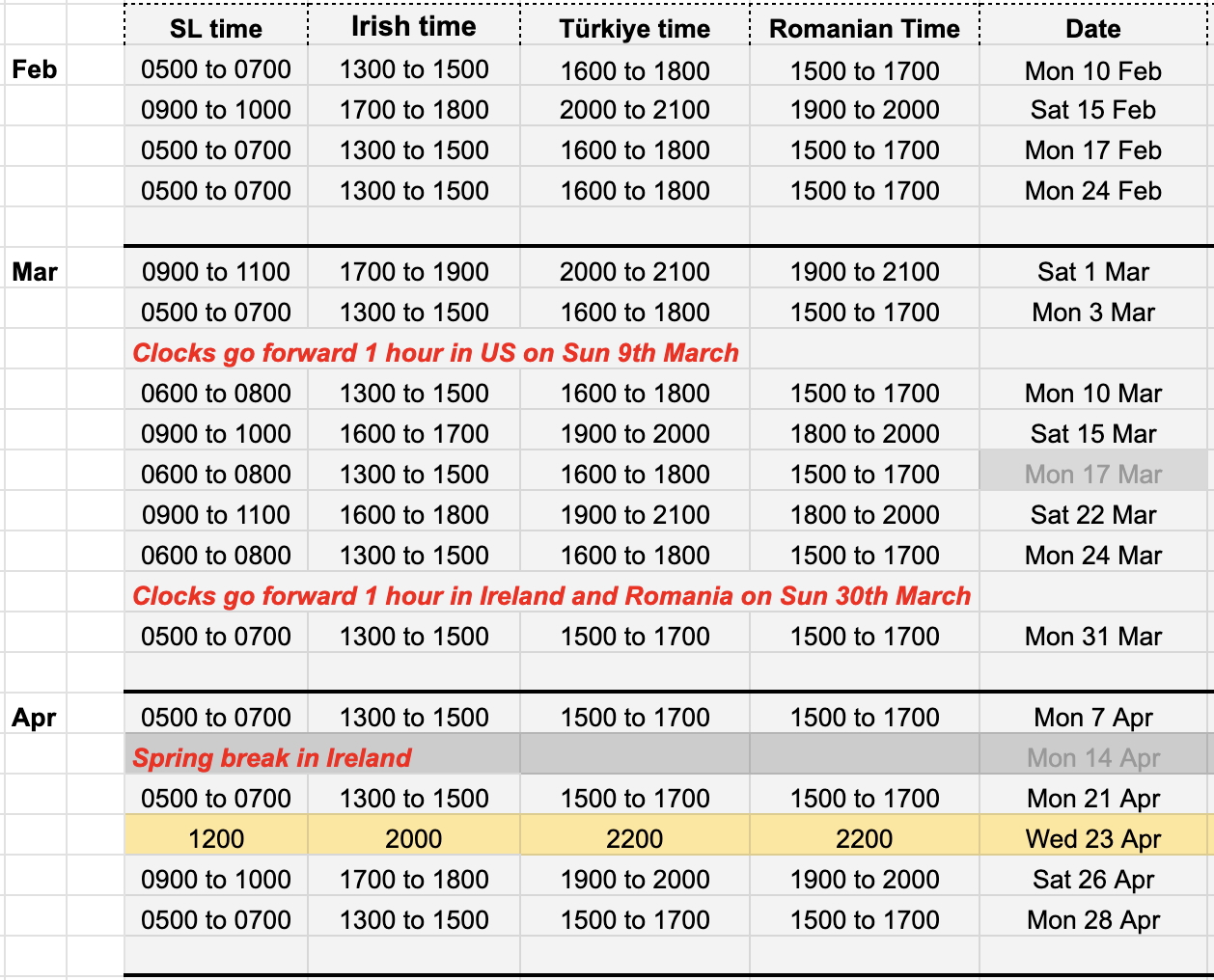
The schedule for the semester gives times for all class meetings that must be attended.
We explored the use of voice, Nearby Chat and Instant Messaging (IM) in SL, learning that IMs facilitate contact with anyone anywhere in SL. This can be very useful if you get lost or can’t find your way to where the class is meeting: just send an IM to a class mate or lecturer asking for a teleport (TP). This will enable you to go directly to the location. IMs are private and can be seen only by those who receive them. It is possible also to invite others to join an IM so that you can set up a private chat for your team or group. Saving a landmark (LM) so that you can TP there at a later time was then demonstrated and you were advised to save the TU Dublin campus as your ‘home’ landmark, making it easy to return there whenever you need to. The we practised teleporting away and back again.
Voice can be tempermental in SL, sometimes it can take a few moments before activating after logging on. There are a few things you can do to remedy this. First, try toggling the voice button on and off. If this doens’t fix it you might try logging out of SL and logging back in again. Always check your preferences to ensure you have voice enabled and the appropriate device is selected (eg, if you are using headphones they might have to be specifically selected from the dropdown menu in preferences). You must have voice activated even if you do not intend speaking in SL because if not, you will not be able to hear others speaking.
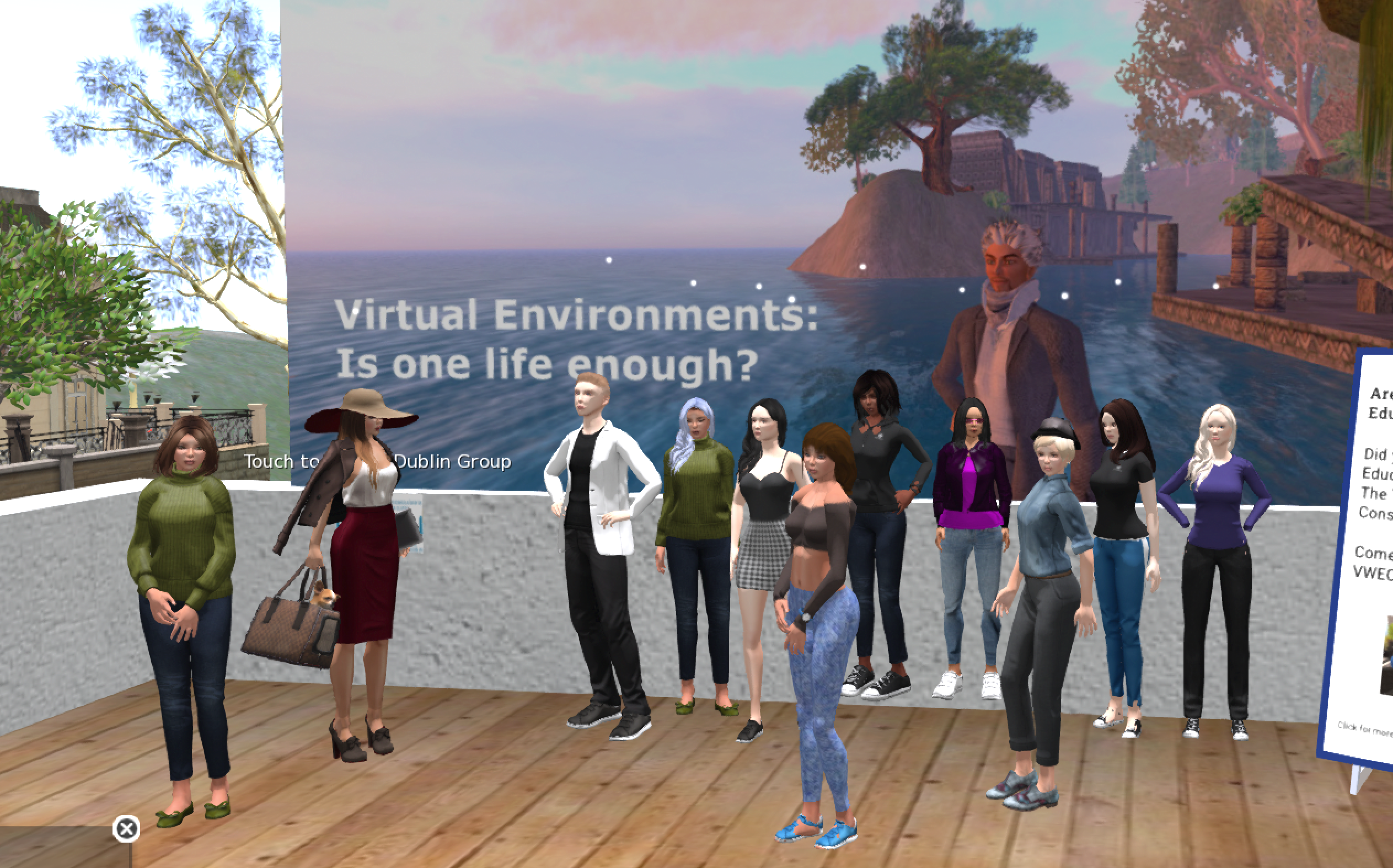
After going outside to the deck for a class photo we teleported to the Çağ (pronounced ‘chaw’) University campus to meet Magua (Prof Murat Gülmez) and Ginger (Ersin İnal) and their student. We set up three teams to work on the Student Challenge. Each team is to meet before the end of the week and select a Team Leader and an Assistant Leader. Their roles are to facilitate team meetings, ensure all team members are communicating with each other and generally try to support team development. Their role is NOT to do all the work or be responsible for team delivery. They will also be the spokespersons for the Team, with the Assistant taking over when the Leader cannot be present. To enable communication outside of SL each team was asked to agree on a communication tool. This will help with arranging meetings efficiently over the course of the semester. You could share email addresses or numbers for an app like WhatsApp.
Next week, each team will be asked to share the name of the Team Leader and Assistant Leader. We will have a talk from Sitearm Madonna on Team Building and have a briefing on the Student Challenge project. We will meet at the Çağ University campus at the usual time.
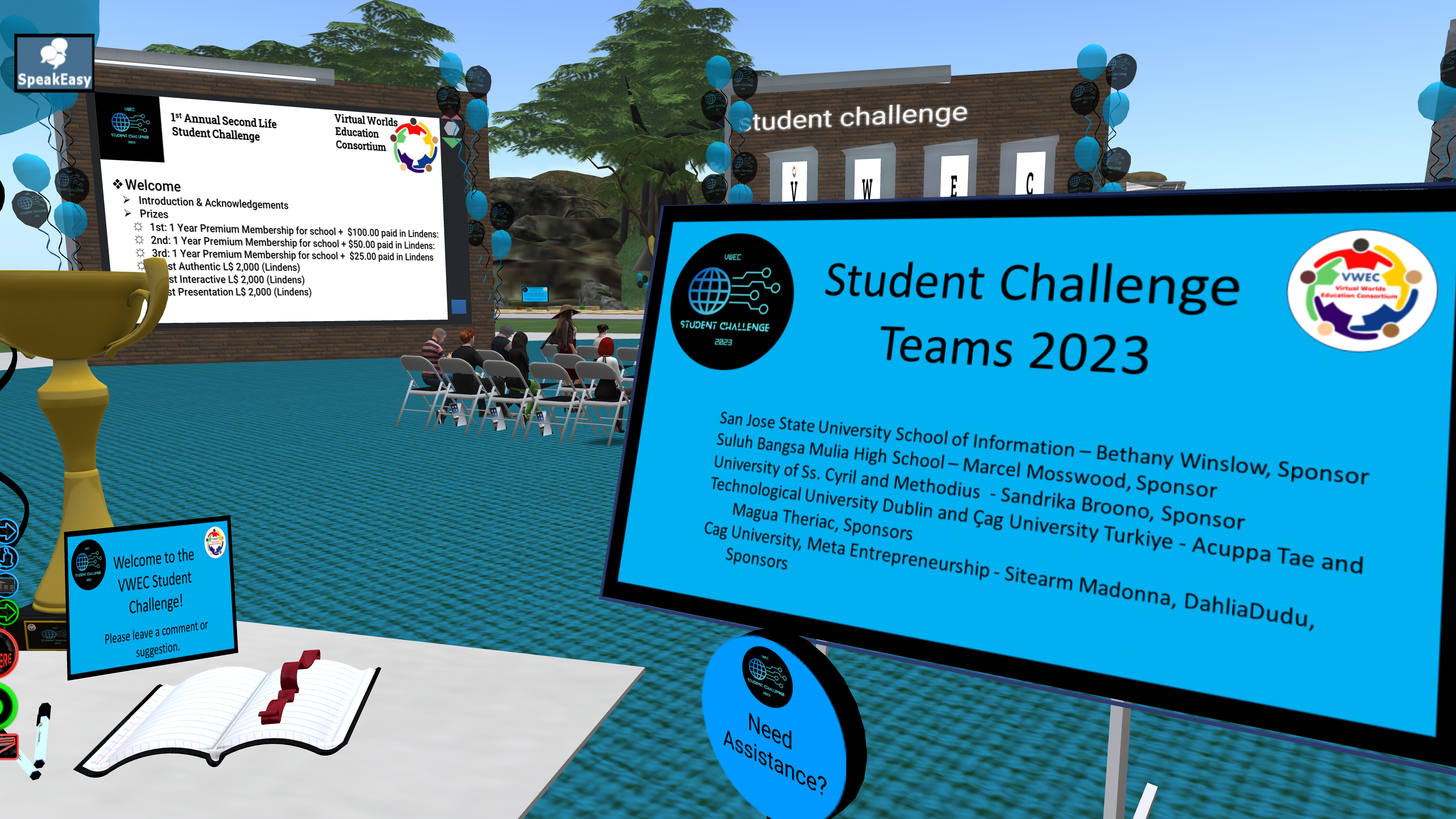
In the meantime, the Student Challenge will be launched on Saturday (see your local time on the schedule above) at the VWEC Student Challenge in Second Life. Please go there directly. If you need any help finding the location once you log into SL you can IM any of the class for a TP. This meeting will last no more than one hour.
The Team Project presentations were hosted by Çağ University in the auditorium. John received slide shows from each team and set them up on the platform in advance. There was full attendance from each team and they presented in the following order:
No technical problems arose and each presentation went off smoothly and efficiently. John complimented the participants on their submissions and thanked them for their attendance throughout the semester. He also thanked the Çağ students who had come along to class along with their supervisors and teahers and all the guest speakers.
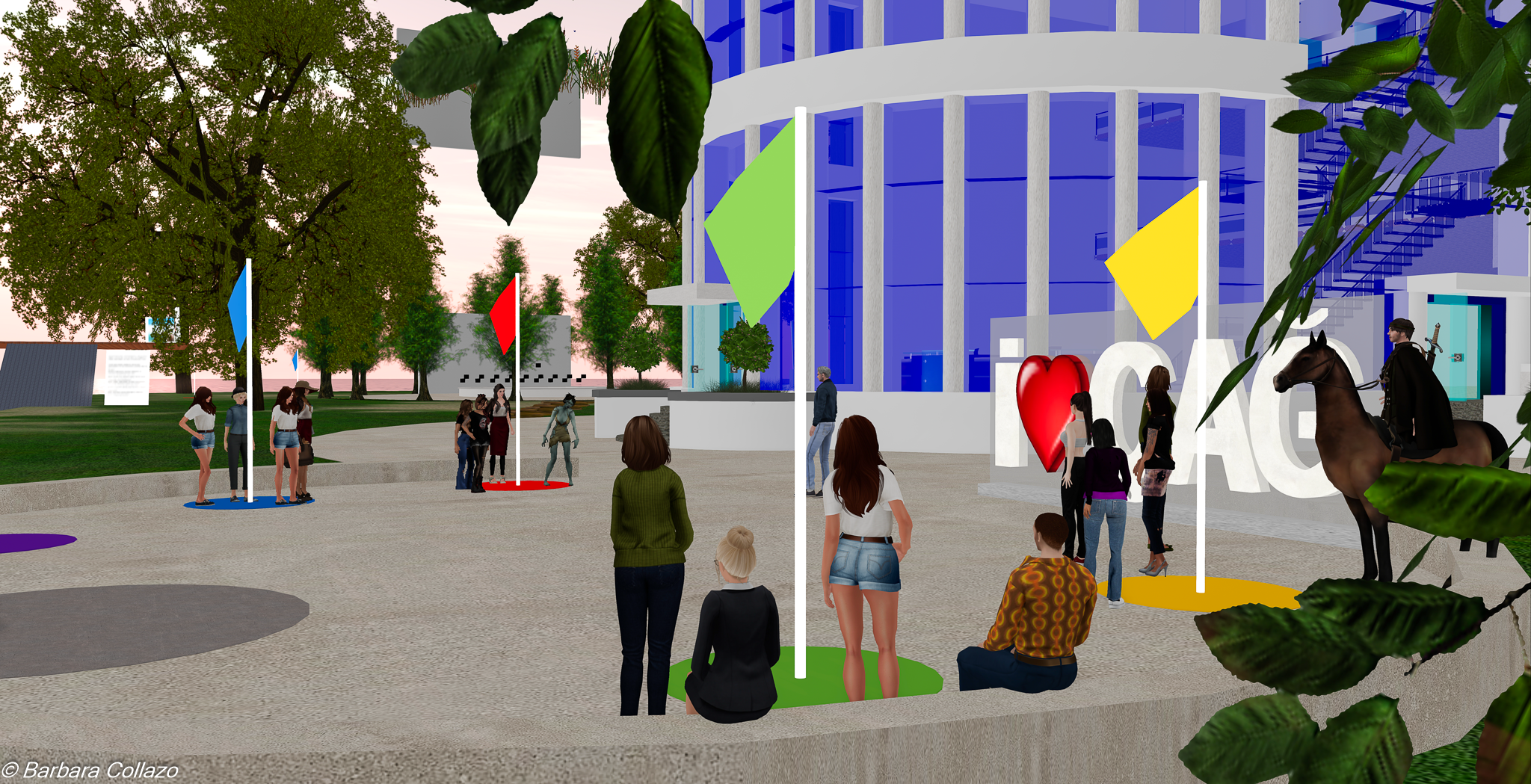
Project Teams gather at the Çağ University campus as class commences. Photo Barbara Collazo
Sitearm Madonna joined us at the Çağ University campus for today’s class on Teamwork and Collaboration. Here is a recording of Sitearm’s presentation:
Following the presentation we did a quick check-in with each team to answer the following questions: 1. Has your team held its first meeting? 2. Who is your Team lead and assistant lead? 3. How will your team communicate outside SL? 4. Did you discuss the brief for the Team Project?
All teams answered positively and have given some thought to the project and how they will address it.
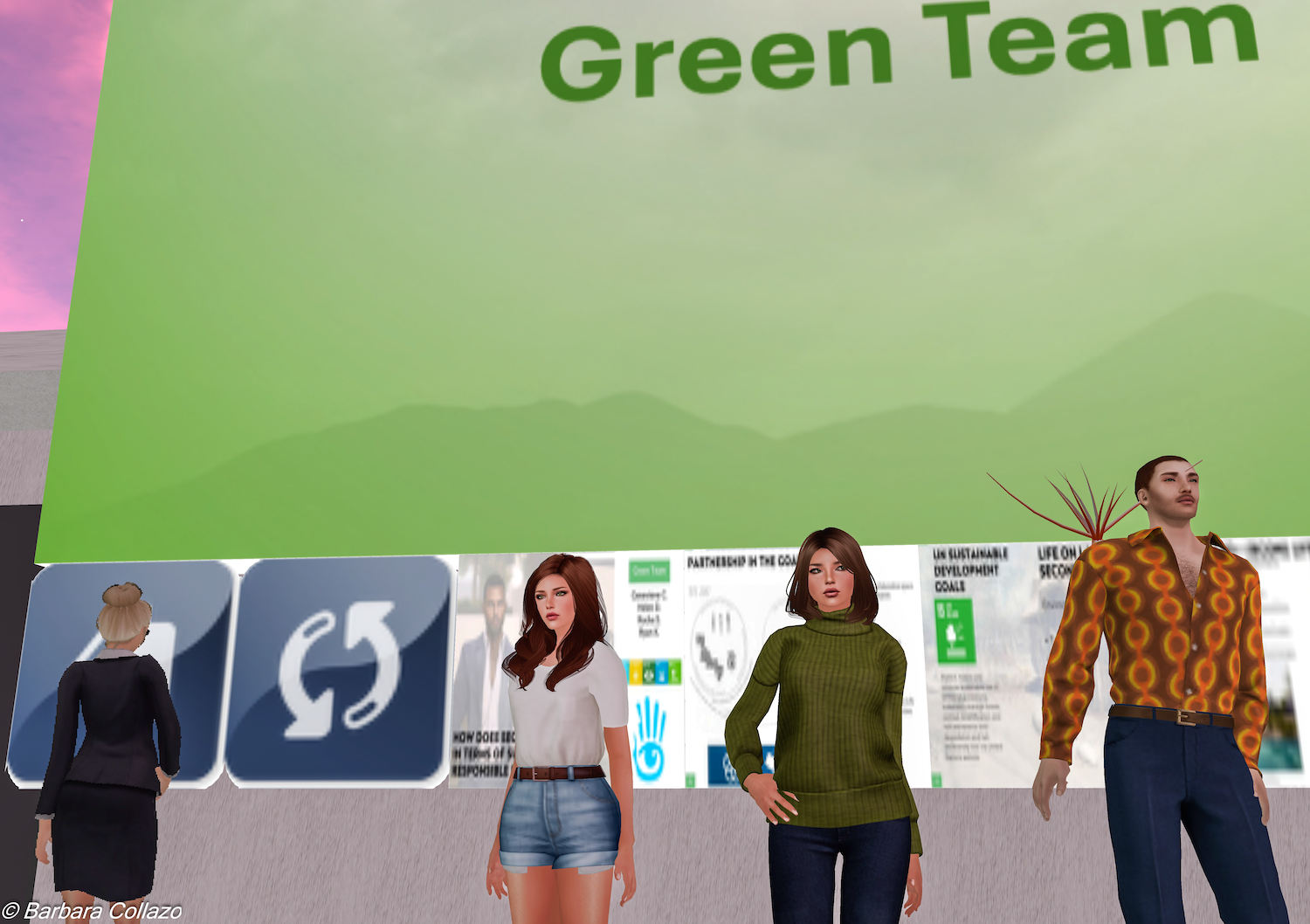
Sitearm Madonna presents on the theory of team development and operation. Photo Barbara Collazo
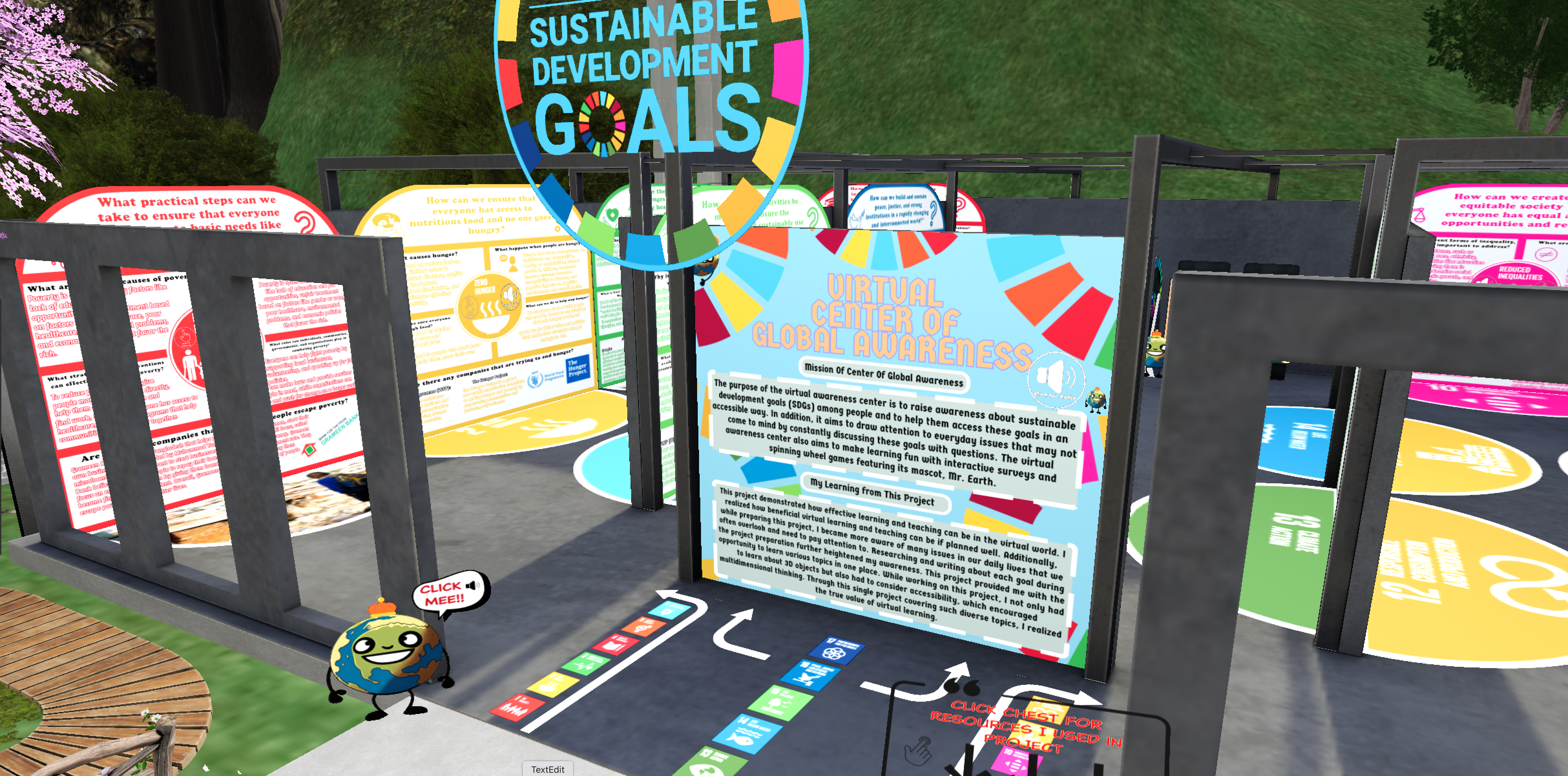
Finally, we paid a quick visit to a build by one of last year’s Turkish students, Ovcel, demonstrating the United Nations 17 Sustainable Development Goals.
The United Nations Sustainable Development Goals are a universal call to action in the face of global poverty and the impact of climate change on our planet. Seventeen goals were agreed by all member states in 2015 as part of the 2030 Agenda for sustainable Development. We have nine years left to achieve success and secure the future of humanity on Earth.
The United Nations call follows a Warning to Humanity issued by the Union of Concerned Scientists as long ago as 1992. They ‘feared that humanity was pushing Earth’s ecosystems beyond their capacities to support the web of life’. Five years ago the warning was updated as 15,000 scientists from around the world published World Scientists’ Warning to Humanity: A Second Notice.
Virtual reality (VR) has been in development since the last century but the coronavirus pandemic with its attendant public lockdowns and social distancing has resulted in a rapid growth in virtual engagement as reported in Forbes Magazine and in Newsweek recently. This, in turn, has led to significant development in the supporting technology.
Second Life was one of the first and remains one of the most successful platforms in the social and community development arena that also has significant educational and academic engagement. As an immersive environment with a functioning economy, creative building tools and a large active population it appears to be a self-sustaining world. According to the online magazine, Mic, residents have ‘full Second Life lives, filled with many of the same hobbies and activities one might enjoy in their first life’.
The platform is particularly relevant for online collaboration because it supports persistent chat, offline email, text chat, voice chat, group versus subgroup chat isolation, virtual to real world currency exchange (a precursor to bitcoin), inworld collaborative three dimensional build, three dimensional avatar self representation and interaction, and three dimensional environment immersion.
Second Life can be seen as a mirror to the real world, or an extension of the world. Does this virtual environment have a responsibility to also mirror the demand for sustainable development?
Assuming the answer is a resounding ‘Yes!’ the question becomes: how does Second Life measure up in terms of sustainability and responsible practices?
The Brief
Your task is to examine this question in the context of the UN Goals and report on the platform itself, the communities that it supports and the activities of the residents. Identify good practices and shortcomings; recommend possible improvements in operation; and present your conclusions. In researching this project draw on examples from your own culture, or the culture in which you are now residing. Compare this to what you observe in Second Life.
In short, your presentation should answer the question:
How does Second Life measure up in terms of sustainability and responsible practices ?
You will be assigned to a team to work on the project. Each team will be assigned one of the following three key topics: Economy, Society, or Environment and you will attempt to answer the question in the context of the sub topics listed for each theme below.
During the final class, at the end of the semester, each team will make a presentation in an entertaining, informative and lively manner, live in Second Life. The presentation should be no shorter than five minutes and no longer than ten minutes. You are encouraged to use visual, audio or any other aids to support the presentation during which each member of the team must take part.
Here are the three key topics, with the sub themes for each:
Economy
Society
Environment
All teams will also address the following sub topics:
Deliverables
Participation in the rehearsal of presentations.
Participation in the presentation of your Team Project.
Following the Team Project presentations write the sixth section of your essay reflecting on your contribution to the presentation, the reaction from the audience and the overall success (or otherwise) of your group work.
Assessment Criteria
It is important that you read and understand the Assessment Rubric (you will receive a copy from your lecturer in class) given for this assignment so that you understand the basis on which the assessment will be made. There are 6 assessment criteria in total. Each member of your group will receive the same mark for the first 2 criteria, For the other 4 criteria you will receive an individual mark.
Group Mark:
Communication with the audience: establishing a connection with the audience to deliver a coherent presentation.
Content: addressing the theme of the brief coherently.
Individual Mark:
Tools for Collaboration: selection of appropriate tools for group planning and effective use of the tools.
Teamwork: contribution to the team and demonstration of understanding of team dynamics.
6th section of your essay: ability to describe activity coherently, reflect on experience and present a critical evaluation of the process of developing the project, citing appropriate references.
Quality of Presentation: individual contribution to the presentation of the project.
The Project Team presentations for the VWEC Student Challenge were recorded on the final day of class this semester and this formed part of their submissions. The presentations were well delivered with participants making a strong showing. The collaboration between Turkish and Irish students was excellent. All video recordings are courtesy of Sitearm Madonna.
The Purple Team:
The Yellow Team:
The Red Team:
At the presentation of awards for the VWEC Student Challenge. Photo Acuppa Tae
Each of the four student groups presented their final Team Projects in the final class of the semester. The work was excellent and very well presented. Each of the students spoke during their team’s presentation and everything went off without a hitch. Many of the guest speakers during the semester were in the audience, along with many others who have an interest in online and virtual education.
Video courtesy of Sitearm Madonna.
Francisco Koohaven from Whole Brain Health made a video of the Student builds supporting their presentations. This video fly-through of each project shows the amount of thought and effort the students put into the supporting work for their presentations.
Sitearm Madonna presented on the theory of teamwork at today’s class. This was followed by a briefing on the Team Project No One is too Small to Make a Difference by John / Tae.
Our friends from Çağ University joined us for the first time today and Sitearm Madonna gave us a gentle introduction on how to work together in teams in a virtual environment. The Turkish students and their facilitators joined in seamlessly as if they had been working in Second Life since the beginning of the semester.
Video courtesy of Sitearm Madonna.
After the talk Sitearm gave the class an immersive collaborative experience through music. It was tremendous fun and we were sorry not to have more time to engage with his brilliant instruments.











 Virtual Environments: Is one life enough?