Posts Tagged ‘online presence’

h1

New course begins October 1st

September 17, 2015

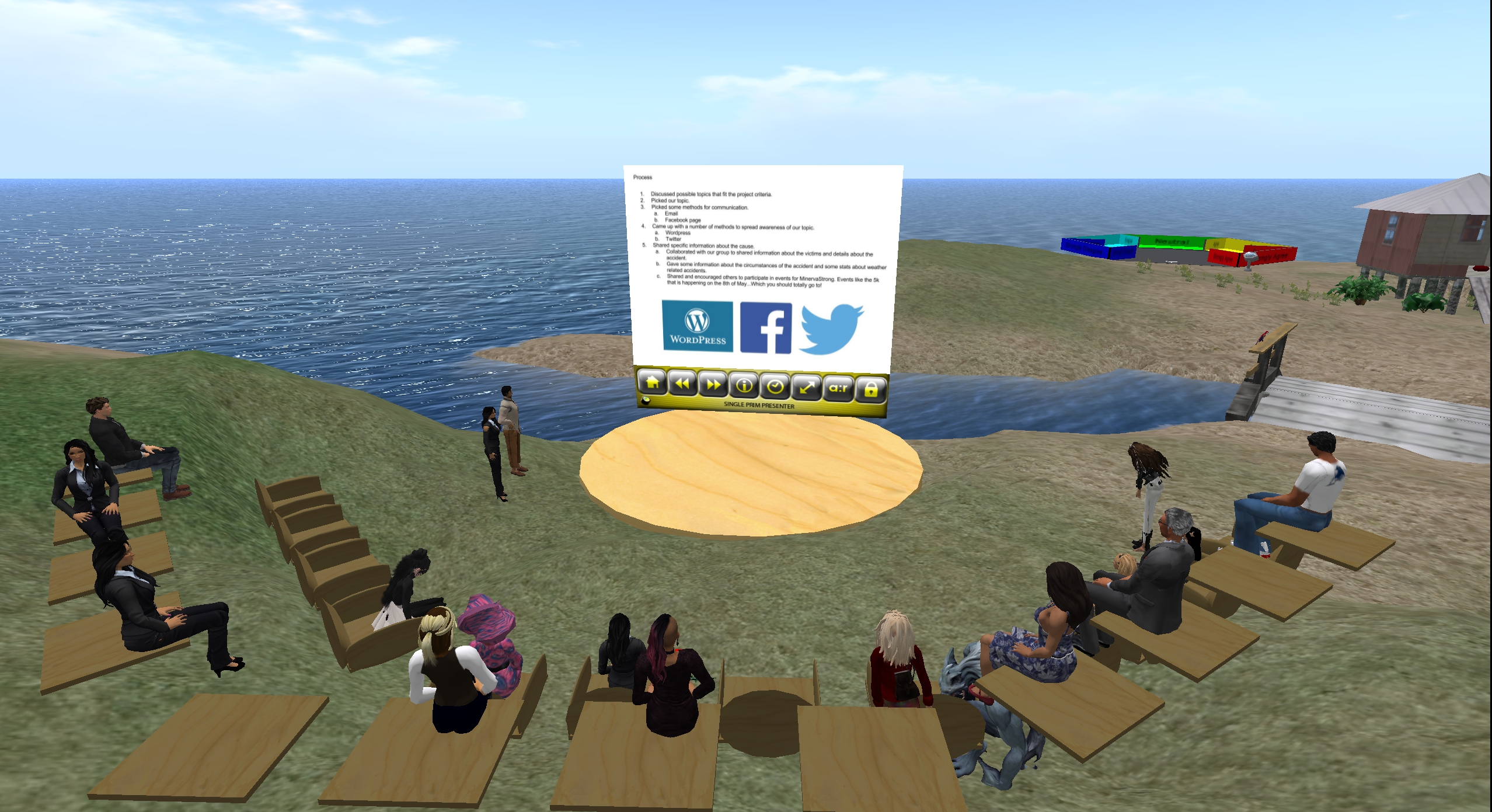
Snapshot6_004We are pleased to announce that registration for the Autumn/Fall 2015 course is now open. The module will begin Thursday, October 1st, 8:00 p.m. Irish Time, and will be taught online in Second Life.

The ‘Is One Life Enough’ professional social media course is a university-level online course taught weekly for 10 sessions held at Dublin Institute of Technology Campus in Second Life and accredited by Dublin Institute of Technology in Ireland. The audience for this course is undergraduates, professionals, and educators seeking university-level training and credit in the use of online tools, such as Second Life, WordPress, Twitter and LinkedIn. Attending class as avatars participants will maintain online journals between sessions. Students will learn to establish and strengthen their online professional presence. You will learn also to work collaboratively, online, to complete team projects selected by the students and presented at module’s end to a collective university and Second Life audience.

Dublin Institute of Technology Students will receive 5 ECTS Credits as part of their current tuition – contact the office of Dean John O’Connor or your School for details.
Second Life Students receive DIT Accredited Professional Continuing Education Credit for a part-time tuition fee (99 Euro or equivalent in L$/US$) – contact Dublin In SL Registrar Sitearm Madonna
University of Akron Students may receive UOA College Credit as part of their current tuition – contact the office of Dr. Dudley B. Turner.

Inquiries: James Neville (‘Sitearm Madonna’ in SL) sitearm@gmail.com

Module History

In 2009, the ‘Is One Life Enough’ module was founded for Dublin Institute of Technology DIT students by (then) Head of School, John O’Connor (‘Acuppa Tae’ in SL), and eLearning Development Officer, Claudia Igbrude (‘Locks Aichi’ in SL).

In 2010, IOLE received the ‘Jennifer Burke Innovation in Teaching and Learning Award’ from the Irish Learning Technology Association and Dublin City University. Also in 2010, module eligibility was expanded to the greater Second Life Community via collaboration with Dublin Virtually Live Owner, John Mahon (‘Ham Rambler’ in SL).

In 2012, IOLE received the ‘Further and Higher Education Innovation Award’ from Learning Without Frontiers (London, UK). Also in 2012, Dr. Dudley Turner (Dudley Dreamscape in SL) graduated from the Autumn 2012 module as a Second Life Student.

In 2014, module eligibility was further expanded to University of Akron students via collaboration with Dr. Turner.

Organization History

Dublin Institute of Technology is the largest provider of third level education in Ireland with degree awarding authority and is on track to be Ireland’s first nationally accredited technological university.

Dublin in Second Life is a recreation of Dublin City online, celebrating the music, art, education, culture, and enterprise of Ireland and is a premier member of the broad Second Life Community, recognized by both Residents and Linden Lab Top Management.

University of Akron is one of America’s strongest public universities, focused on innovation, entrepreneurship and economic growth.

Vitae

John O’Connor is a Director of Dublin Institute of Technology (DIT) in Dublin, Ireland, and Dean of the College of Arts and Tourism. His work includes sitting on the Senior Leadership Team of DIT, teaching the award winning module, ‘Virtual Environments: Is one life enough?’ and promoting Dublin as a creative city and thriving economic hub. His academic interests include: access to education for isolated communities; the use of technology to support learning; typography; and development of the professional design sector in Ireland.

Dr. Dudley B. Turner is Former Interim Dean, College of Creative & Professional Arts, University of Akron (UOA) in Akron, Ohio, USA. He teaches communication, persuasion, and professional speaking. Dr. Turner is a champion of the use of virtual world communication technologies such as Second Life. He is the 2014 winner of the prestigious Ohio’s Innovative Teacher Award from the Ohio Communication Association.

h1

Class 9: Consumers to Produsers

March 28, 2015

This week is Spring Break for Akron students so the class was in the DIT seminar room in Dublin for a change of scene. For the first half we discussed progress on the group project and re-emphasised the importance of reflecting on what is not working in the collaboration in addition to what is working. It is important that participants are writing about this in their blogs from now to the end of the semester.

The second part of the class consisted of a discussion based around Prof Axel Bruns’ lecture that students had read over the week. At the beginning many professed confusion about what Bruns was proposing but as the discussion progressed it became clear that most understood it better than they realised. It may be that as emerging ‘produsers’ themselves the concept is so familiar that it is almost invisible to them.

The concept of wikipedia not being about the creation of finished products but the ongoing revision of information – constantly amended and updated by people who may have originally come to it as consumers but have become content creators – was clearly understood. The development of the distribution system for news from the formality of traditional newspapers that are controlled by editors and publishers to the openness of blogs, Facebook and such systems that have eliminated the gatekeeper was considered – with particular consideration of the pros and cons. The issue of reliability was surfaced, leading to a reminder of the importance of reputation – and brand. As users become the producers of content: people who care enough to participate – as opposed to those who merely want to consume – personal brand becomes increasingly important.

DIT students are reminded that their blogs were due for the second assessment (after week 8) but this has been postponed to this week giving you a chance to catch up if necessary. The importance of proofreading posts before publishing was emphasised.

ACTIVITIES FOR NEXT WEEK:

  1. Read: about the girl who resigned her position as uk police youth commissioner due to previous tweets (accessed 02/13/15).
  2. Read: about another example of a person losing her job over a tweet (accessed 02/13/15).
  3. Read: why Dr Phil removed a tweet from his TV show (accessed 02/13/15).
  4. Write the ninth post: to your blog reflecting on the benefits and difficulties of collaborating online across time zones.
h1

Class 4: Content creation, part one

February 20, 2015

Class this week opened with some more participants delivering their elevator pitches. Following that we had a discussion, informed by the reading material set last week, about the creation of ‘content’. Students participated confidently and coherently via text and voice.

.
Content is anything online, a person’s print on the virtual web. Content does not have to be interactive, but Daniel argued that by being online in video or text form implies it is already interactive by default.
There are different types of content, but does it have any value? Some content only has meaning to the person who posted it, eg, random posts on twitter. But then meaningless to who? Or is it more a case of having value to a few people only Sometimes, commentary may only have relevance to certain people. Sometimes people use social media to hide behind and post spiteful and malicious material. They behave differently from how they may behave in the real world because there is no accountability. Internet trolls being an example.

.
The point was made that interaction on the internet is different from face to face. This is not necessarily negative.
Going back to look at your own blog, do you have a different take on what content is now? The answer was yes, creating blog posts is creating content as it is contributing something new to the internet. The Humans of New York blog is a good example of how a creator uses multiple media-images plus text to tell stories of humans. As we create content for people, we hope to make connection, often emotional connections, and it is through these connections that we project our personae into the online world.

.
According to Olwyn ‘many businesses or corporations using social media have had a negative review/blog/comment written about them therefore creating negative content around their brand. It is possible to hire people to write so many positive comments it rids the page in question of negative content. It shows how important your virtual footprint is.’
Have a think about how you are going to create content for your project and while doing so, create a credible personae for yourself to complete your assignment.

.

Snapshot_007

Elfay Pinkdot

Guest speaker Elfay Pinkdot was introduced to the class to talk about communities and making connections. She brought us on a field trip to Bugs and Us, a butterfly sanctuary. Once settled in the peaceful environment Elfay talked to class about online communities she has been involved in. Her SL radio programme Coffee and Pajamas is an SL group around jazz. She wanted to share her love of jazz with other SL residents. She had previously used Jazz and her love of music to teach geography, as a social lubricant, as a way in, and that was not different when trying to form the community in SL. The show was widely listened to and quickly formed into a tight community, impacting people in more ways than Elfay realises. When you start to create content or connect online, especially around something that means a lot to you, you cannot always envisage how rich a resource it can be. In Elfay’s case, her SL life has led her to meet with people from around the world – including the lecturers in this module.

.
The internet can seem like a really dauntless place but what #IOLE enables you do, is take control of how you choose to use and engage with the medium of the internet, and control the message(s) you choose to put out. Elfay does not consider SL or online life different from real life… she sets boundaries just like real life. She encourages that you take responsibility as you make your mark.

Snapshot_003
As was pointed out in the class, there is a lot more potential for people to think they can get away with things that are not permissible in real life. There is a huge challenge in how the law keeps up with change in the online space and the various envionmnents and changing methods of interaction. All of this is the reason why you need to give a full and measured consideration to how much of yourself you want to share online.
Kaiya, one of the owners of Bugs and Us, added by saying ‘I have been in SL a long time, and I bring my RL morals into SL, I prefer honesty and loyalty. There are many here in SL that bring drama, and lose their sense of self. Don’t make yourself vulnerable as there are many wolves in SL that prey on others.’
Also, taking a lead from Sitearm Madonna, don’t be shy about playing with your identity in SL. And you are welcome to reach out to Elfay as you prepare for your final presentation and work on your project.
Don’t be vulnerable, let people earn your trust, don’t underestimate the online medium.

.

At the end of the class the lecturers told the participants about the research work they were doing around the class. We asked that you complete an anonymous survey by clicking here.

Finally, DIT students are reminded that your blogs are undergoing the first of three assessments this week so make sure you are up to date!

ACTIVITIES FOR NEXT CLASS:

  1. Read: this thoughtful blog post Content Licensing in Virtual Worlds about the legal issues around protecting ‘things’ you create in SL and online in general. Read the comments also.
  2. Read: The Laws of Virtual Worlds. From the California Law Review 2003 this is an excellent, if highly specialised, review of the legal position of avatars in virtual worlds.
  3. Write the fifth post: to your blog about the value of copyright in a world where everything can be easily copied
h1

Class 3: Personal branding

February 12, 2015

The class met in the amphitheatre in Dublin to be briefed on the group project. Details of the project are given in the next post.

As the briefing came to an end an unwelcome visitor arrived and caused some disruption by walking aimlessly around so we went back to Akron Island for a discussion on personal branding based on the reading material from the previous week. Most participants said they had based their appearance in SL on their Real Life (RL) selves. The opportunity to reflect a different aspect of their personalities was considered in the context of the guest speaker from last week. Claudia argued that managing one’s identity online is now becoming a necessity as to have no presence is a statement in itself.

The bio (or ‘about me’) piece you write is a very important element in establishing your ‘promise’, your possible value to a potential follower. It is a signal to those who may decide whether or not to follow you. But, your identity will really be formed by the content you add and that should reinforce your promise. Just as the corporate brand builds recognition by repetition and consistent delivery on its promise your personal brand will be shaped by your reliability also.

B9q_O_8CQAIDHCm.jpg-large

ACTIVITIES FOR NEXT CLASS:

  1. Go: outside your established community/group (eg, this class group) in SL and make contact with at least two people relevant to your interests (artist, gallery owner, musician, shop manager, business owner, educator, builder, etc).
  2. Write the third post: on your blog describing your encounters.
  3. Decide: among your group what tools you will use for planning your project (how you will stay in touch and share information, etc.).
  4. Write the fourth post: on your blog explaining your choice of communication tools and reflect on how the group arrived at the decision.
  5. Read: Your Employee is an Online Celebrity. Now What Do You Do? from the Wall Street Journal. The article discusses employees developing their personal brand and implications for their employer (accessed on 12/02/15).
  6. Explore: the website Humans of New York (accessed on 12/02/15) and see how the author has used social media to make an impact – an example being his use of instagram, facebook, twitter alongside the blog. Take note of how he has identified and positioned himself.
  7. Read: about the Heron Sanctuary which we will be visiting next week (accessed on 12/02/15).
h1

Class 3: Personal branding

February 28, 2014

CLASS SUMMARY:

The reading for this class included an article in Forbes and Chris Brogan’s blog post on personal branding. We discussed the difference between corporate and personal branding and looked more closely at the latter. The importance of distinguishing between the professional and personal when it comes to our online presence was identified and this led to some consideration of the different expectations supported by different platforms. So, for example, LinkedIn is a specifically for professional promotion whereas Facebook is primarily personal, and twitter can be seen in either category.

The bio (or ‘about me’) piece you write is a very important element in establishing your ‘promise’, your possible value to a potential follower. It is a signal to those who may decide whether or not to follow you. But, your identity will really be formed by the content you add and that should reinforce your promise. Just as the corporate brand builds recognition by repetition and consistent delivery on its promise your personal brand will be shaped by your reliability also.

ACTIVITIES FOR NEXT CLASS:

  1. Go: outside your established community/group (eg, this class group) in SL and make contact with at least two people relevant to your interests (artist, gallery owner, musician, shop manager, business owner, educator, builder, etc). Write about the experience in a post to your blog.
  2. Decide: among your group what tools you will use for planning your project (how you will stay in touch and share information, etc.).
  3. Write: the third post on your blog explaining your choice of communication tools and reflect on how the group arrived at the decision.
  4. Read: this article from the Wall Street Journal that looks at what might happen when employees mix their ‘personal’ and ‘professional’ online identities. Your Employee is an Online Celebrity. Now What Do You Do? (accessed on 02/28/14)