h1

Class 2: Getting to know SL

February 11, 2016

There seems to be an issue with attendance in the class. Only three out of the nine participants enrolled have attended so far – and not the same three each time. That means that four participants have not yet appeared in class. Last week one person sent apologies in advance but none of the other absent class members has done so since. Therefore it is unclear whether some people have opted out of the module with letting John know or were absent for another reason.This is unsatisfactory for all concerned because we are now two weeks into the syllabus but not everyone has gone through the introduction to the module.

Small classes, by their nature, are more intense and demanding on students than larger ones because there is nowhere to hide: everyone must contribute if meaningful discussion is to occur. This means that students can gain more due to greater individual participation. Unfortunately, it also means that even one absence from class meetings is very obvious and impacts on the possibility of sharing a range of different views. It also means it is not viable to host guest speakers or visit other locations as a class.

empty class_001

Finally, lack of attendance makes student group project work difficult. (This will not impact on assessment because participants are assessed individually.) It has a real impact on the depth of learning – experiential learning about the dynamics of group work is not possible of one is not actually a member of a group! The learning can only only be academic if you are in a group of one.

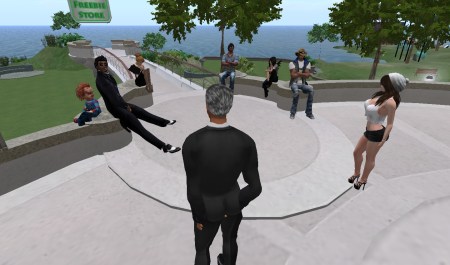
Those who attended class this week met Prof Dudley Dreamscape from University of Akron who joined the class and offered his support to participants. Each participant introduced themselves in the form of an ‘elevator pitch’, a less than thirty second statement of their interests. Other than that the class was a repetition of last week’s introduction. Interestingly, some of the participants already have blogging experience. The advice for this class is not to use an existing blog but to start a new one to record your experiences and reflect on what you learn throughout the module.

John also identified the student groups for this semester which will be notified to participants by email.

All participants are asked to read the post for Class 1 and complete the tasks listed under ‘Activity for next week’s class’ before we meet next week. In addition, you need to complete the tasks listed below before next week. That will involve visiting Second Life during the week, with your team mate.

THINGS TO DO BEFORE THE NEXT CLASS:

  1. Explore: Get to know your team partner and explore SL together. You are to visit at least 3 locations that are new to you. Find them in search, or ask other residents for recommendations or select them at random.
  2. Write the second post: on your blog reviewing the locations you visited. Describe the places and include photos, if you can. Explain what you liked and disliked about the location and talk about any interactions you had.
  3. Read: 5 steps to build a productive and tight knit remote team

h1

Class 1: First meeting

February 4, 2016

Well done to those who made it to Second Life for the first class! You all managed very well indeed. For those who are still having difficulty logging into SL please talk to your colleagues and see if they can offer advice and help.

The landmark to Dublin is no longer working so after contacting John we all teleported directly to the media centre for an introduction to the course. The regular class meeting time will be Thursday at 8.00 pm and finishing between 9.00 and 9.30 pm. We will meet at the Media Lab and all participants saved the location so you will be able to return there whenever you log into SL. For anyone who missed it here is the link again DIT in SL

We also added each other to our ‘friends’ list. This enables you to see when participants login to SL and you can send an instant message (IM) to each other when you are in different locations – very handy if someone gets lost in SL. John also added you to the DIT Module group.

John explained that class will be interactive and discursive. Each week we will look at a different topic, introduced by a set text that you are asked to read before the class so as to inform the debate. It is important that all participate fully and engage to get the full benefit from attending. You will also need to visit SL between class times to complete activities that will be set to encourage exploration. Specific activities will be set for the first few classes to get you started.

You were all asked to create a new blog for the duration of the course. You will be expected to write a weekly post describing your experience of the class and the discussions and activities in which you engage. If you keep this habit and post weekly you will avoid the burden of having to write a complete paper at the end of the module. John also explained that you will be paired off next week to work on a project which will be presented at the final class of the semester. You are encouraged to read through the pages listed in the right hand column of this website to get full details of the project, see examples of previous student blogs and get an idea of what to expect in the rest of the course.

ACTIVITIES FOR NEXT CLASS:

  1. Set up your blog: using bloggerwordpresstumblr or any other blog site. Complete the ‘About Me’ page (read some of those pages on other blogs first) and remember it is different from the first post on your blog. Write from the perspective of your avatar: the persona you will be using to explore in this module. 
  2. Write the first post: to your blog about your expectations for this module – what you hope to get out of it, what you think you might contribute, etc. Address the relevance of  module objectives from your perspective, ie, justify why you think they are important to you.
  3. Look at: John O’Connor’s blog and Dreamscape Diary bearing in mind what you learned today compare your own blog writing to this.
  4. Visit the following: Dolce Merda, Brain PickingsIllustration Friday, Chris BroganStyle Pantry Think about how you would identify these blog authors…what impression do you get of the person behind the blog?
h1

Spring semester 2016

February 4, 2016
Rory_003

Students presenting their group projects in December 2015

The first class meeting of the Spring 2016 semester is on Thursday 4 February, 8:00 p.m. Irish Time, and will be taught online in Second Life.

The ‘Is One Life Enough’ professional social media course is a university-level online course taught weekly for 10 sessions held at Dublin Institute of Technology Campus in Second Life and accredited by Dublin Institute of Technology in Ireland and the University of Akron in Ohio. The audience for this course is undergraduates, professionals, and educators seeking university-level training and credit in the use of online tools, such as Second Life, WordPress, Twitter and LinkedIn. Attending class as avatars participants will maintain online journals between sessions. Students will learn to establish and strengthen their online professional presence. You will learn also to work collaboratively, online, to complete team projects selected by the students and presented at module’s end to a collective university and Second Life audience.

Dublin Institute of Technology Students will receive 5 ECTS Credits as part of their current tuition – contact the office of Dean John O’Connor or your School for details.
Second Life Students receive DIT Accredited Professional Continuing Education Credit for a part-time tuition fee (99 Euro or equivalent in L$/US$) – contact Dublin In SL Registrar Sitearm Madonna
University of Akron Students may receive UOA College Credit as part of their current tuition – contact the office of Dr. Dudley B. Turner.

Inquiries: James Neville (‘Sitearm Madonna’ in SL) sitearm@gmail.com

Module History

In 2009, the ‘Is One Life Enough’ module was founded for Dublin Institute of Technology DIT students by (then) Head of School of Creative Arts, John O’Connor (‘Acuppa Tae’ in SL), and eLearning Development Officer, Claudia Igbrude (‘Locks Aichi’ in SL).

In 2010, IOLE received the ‘Jennifer Burke Innovation in Teaching and Learning Award’ from the Irish Learning Technology Association and Dublin City University. Also in 2010, module eligibility was expanded to the greater Second Life Community via collaboration with Dublin Virtually Live Owner, John Mahon (‘Ham Rambler’ in SL).

In 2012, IOLE received the ‘Further and Higher Education Innovation Award’ from Learning Without Frontiers (London, UK). Also in 2012, Dr. Dudley Turner (Dudley Dreamscape in SL) graduated from the Autumn 2012 module as a Second Life Student.

In 2014, module eligibility was further expanded to University of Akron students via collaboration with Dr. Turner.

Organization History

Dublin Institute of Technology is the largest provider of third level education in Ireland with degree awarding authority and is on track to be Ireland’s first nationally accredited technological university.

Dublin in Second Life is a recreation of Dublin City online, celebrating the music, art, education, culture, and enterprise of Ireland and is a premier member of the broad Second Life Community, recognized by both Residents and Linden Lab Top Management.

University of Akron is one of America’s strongest public universities, focused on innovation, entrepreneurship and economic growth.

Vitae

John O’Connor is a Director of Dublin Institute of Technology (DIT) in Dublin, Ireland, and Dean of the College of Arts and Tourism. His work includes sitting on the Senior Leadership Team of DIT, teaching the award winning module, ‘Virtual Environments: Is one life enough?’ and promoting Dublin as a creative city and thriving economic hub. His academic interests include: access to education for isolated communities; the use of technology to support learning; typography; and development of the professional design sector in Ireland.

Dr. Dudley B. Turner is Former Interim Dean, College of Creative & Professional Arts, University of Akron (UOA) in Akron, Ohio, USA. He teaches communication, persuasion, and professional speaking. Dr. Turner is a champion of the use of virtual world communication technologies such as Second Life. He is the 2014 winner of the prestigious Ohio’s Innovative Teacher Award from the Ohio Communication Association.

h1

2015 in review

January 4, 2016

The WordPress.com stats helper monkeys prepared a 2015 annual report for this blog.

Here’s an excerpt:

A New York City subway train holds 1,200 people. This blog was viewed about 3,900 times in 2015. If it were a NYC subway train, it would take about 3 trips to carry that many people.

Click here to see the complete report.

h1

Class 9: Site visits

November 26, 2015

We spent this class on site visits to the buildings chosen by each group. This gave us an opportunity to observe if voice is available and discuss how the presentations might best be made. Where voice is unavailable text would need to be prepared in advance: for example, prepared text could be pasted into local chat or notecards could be prepared for circulation.

We also noted the footfall at each site. It might be disturbing if there are too many people in the vicinity so we suggested you give this some consideration – visit the site at the same time as class is usually held to ensure you know if it will be busy and to find a suitable location for the presentation.

ACTIVITIES FOR NEXT CLASS:

  1. Write the ninth post: to your blog describing progress on your project.
h1

Class 8: Projects

November 19, 2015

Students presented progress on their projects in this week’s class. Each group is well engaged in their work, having visited potential buildings around SL and selected one to work with. Students have made an effort to contact the owners of buildings with varying success. We discussed ways of finding out who to contact and how to go about establishing communication. Sometimes this is not as easy as it sounds – even if the avatar is standing in front of you as we discovered last week.

John introduced the class to ‘notecards’ and demonstrated how to make a new notecard and share it with somebody, even when they are offline. This can be a useful way of explaining your interests and reason for making contact.

A few comments on your blogs: most of you are not keeping up with the prescribed posts. You should all have written at least seven posts by now (as listed in the Activities for Next Class section of each class summary). Your posts should be more than a simple description of your activity in SL. You need to reflect on what you are seeing around you; what you feel about the experience; and what you are learning. Look at Rory and Paige’s blogs for good examples. After class 8 your blogs will be assessed again so make sure to get them up to date.

ACTIVITIES FOR NEXT CLASS:

  1. Write the eighth post: to your blog describing progress on your project.
h1

Class 7: Online conventions

November 12, 2015
Prof Dudley Turner, University of Akron Ohio, visits the class

Prof Dudley Turner, University of Akron Ohio, visits the class

Prof Dudley Turner, University of Akron in Ohio, visited class this week. He invited us to drop by Akron Island (see links at right) anytime and also offered his help to students on their projects. If you haven’t already made friends with Dudley look out for him when you next log into SL.

Class opened with a discussion around the reading material from last week, Reinventing Ourselves. Despite the fact that it is quite a dense and academic text it revealed the importance of understanding how identity is formed both in Real Life and online. Many of you needed to read through it a few times to get an understanding of the philosophical and psychological issues underlying this complex process. It also demonstrated to you the seriousness with which these matters are taken and how much is at stake.

The discussion informed your feedback on progress in your projects. Everyone has been exploring SL for interesting buildings and trying to meet the owners and builders. The latter is proving less simple than it sounds and you report having come up against time zone differences, e.g., arriving in deserted cities because (despite the 4 time zones) everyone in North America is sleeping or working! Or being unable to establish contact with people, sometimes even when their avatar is standing in front of you. We talked about strategies for engaging with individuals you meet in SL: understanding what avatars in SL might be doing; the difference between Instant Messaging (IM) and local chat; contextualising your request. So, when you meet someone online the normal human cues that allow you to decide when and how to introduce yourself are not available. You need to keep in mind that people may well be engaged in different conversations that you cannot see. Trying to engage them in conversation may not succeed therefore you need to leave a message that they can see at a more convenient time. When doing so it is important that the message gives the full context of your request: who you are, what you are asking for; why you are asking this particular person; how can they contact you. This approach should be used in any form of online communication.

John also reminded you to read the project brief and the assessment requirements thoroughly so you understand precisely what to do. He said that although you are working on a group project you will be assessed individually based on your discussion of the project during class, your blog posts about your contribution to the project and your role in the final presentation at the end of the semester.

Finally, John spoke about writing posts to your blog. A summary of his advice can be read in a post to this blog from last year and would be useful for you to read now.

ACTIVITIES FOR NEXT CLASS:

  1. Read: about the Impact of Technology on Disaster Relief and the History and Power of Hashtags and Five Brilliant Ways to Use Hashtags.
  2. Write the seventh post: to your blog describing progress on your project.
h1

Class 6: Content creation

November 5, 2015

empty class_001

For some reason attendance at class this week was very poor. This made it difficult to have a really meaningful discussion. However, Rory made up for it by sharing his experience of co-creating a successful automotive blog over the last five years. He shared the story behind the development as a few friends went from posting photos about their common interest to becoming a recognised source of expertise with several hundred followers. We discussed how this led to more focussed sense of responsibility towards the community of followers and greater sensitivity around the audience. Issues of copyright and plagiarism emerged also. The value of having a recognisable approach to the subject is one way of counteracting this – Rory suggested that the source of distinctive images remains recognisable even if cropped or altered.

John reminded the class that everyone should have at least the following five posts made to their blogs by now:

  1. Expectations for the module.
  2. Review of three locations visited in SL.
  3. Description of encounters with two residents of SL.
  4. Three adjectives describing yourself and a 30 second elevator pitch.
  5. How to convert your personal presence online to an identity for professional networking.

From this week on you should write at least one post a week describing progress on your project: how you are communicating with your partner, the tools you find useful, how easy/difficult you are finding online collaboration, what works for you and what doesn’t, etc.

ACTIVITIES FOR NEXT CLASS:

  1. Read: some of Reinventing Ourselves: Contemporary Concepts of Identity in Virtual Worlds, Eds Anna Peachy and Mark Childs, published by Springer 2011.
  2. Prepare: a report on your progress with the project for next week’s class.
  3. Write the sixth post: to your blog describing progress on your project.
  4. If you have some time visit The Garden Maze at Falconmoon and see if you can find your way to the middle!
h1

Group project: Building in SL

October 30, 2015

The project is to explore SL to find an interesting building. By ‘interesting’ we mean:

  1. the design (interior or exterior);
  2. the purpose (what use the building has been designed for);
  3. the actual use of the building (it may be that it ends up having a different use than the original purpose);
  4. the type of people who visit, own or use the building; etc etc.

For the project each pair of students will visit at least five possible buildings before selecting one to work with. The building must be open to the public (or, in the case of a private dwelling, permission should be sought from the owner) and freely accessible. The rationale for selection is to be developed and a presentation made to support your choice. The presentation should describe the building drawing attention to the key aspects that make it interesting. It should also describe the building in context:

  1. how it fits into the immediate environment;
  2. its fitness for purpose;
  3. the use to which it is being put;
  4. the origin of the building;
  5. how and why it was built;
  6. whether or not it is considered a success by its owner, builder, users, neighbours etc.

The presentation should also give the audience a flavour of the building.

The presentation can be made in or near the building or in any other appropriate venue selected by the group/pair. It should last between 5 and 10 minutes. Presentation date is normal class time on Thursday 10th December.

Each participant should also describe the progress of the project in a weekly blog post. Discuss the details of the project and also the issues that arise in working collaboratively online. How easy is it meet up virtually and plan the project? What difficulties arise in development? How easy or difficult is communication? What particular problems arise and how do you deal with them?

See page 6 Module assessment for assessment criteria applying to this project.

Important note: If you use images or sound be mindful of copyright, particularly as presentations will be posted to the module blog.

Central station, Amsterdam

Central station, Amsterdam

Mocha cathedral

Mocha cathedral

Falling Water

Falling Water

h1

Class 5: More on personal branding

October 29, 2015
Participants present their 'elevator pitches' in class today.

Participants present their ‘elevator pitches’ in class today.

Most participants have now set up their blogs and sent links to us. John reminded you of the importance of posting something every week and ensuring, in particular, that you are keeping up with the posts specified for each week. That way you won’t have a panic at the end of the semester when all module submissions are required. To encourage this there is a assessment point this week and in week eight of the module. Final assessment will be made at the end. So, ensure you have sent us a link to your blog and that you keep it up to date. There was some discussion around privacy and it was agreed that you may keep the blog private if you wish – just don’t forget to invite John and Locks to have access.

The class then continued the discussion about personal branding from last week. The reading informed your responses and it is clear that you all have an instinctive understanding of the nature of your online presence. It was generally agreed that we try to present the best sides of ourselves on Facebook. Many of you noticed, however, that when friends get jobs they become more aware of their social activity and often separate their Facebook identity by changing their names. This led to some consideration of the different platforms available online: LinkedIN for professional networking; Facebook and Instagram for social activities; Twitter for impromptu comment. We didn’t get around to looking at Google Plus or some of the more recent apps that allow people to remain anonymous, or delete posts after they have been read. The rise of public interaction promoted by Twitter and Facebook is now beginning to result in privacy having a premium. Have a look at the app Path which is very much like Facebook except that it guarantees only your own circle of contacts can see you.

We took a break from the Media Centre and went downstairs to hear everyone’s elevator pitch. Although it can be difficult to sum up your personal life or personality in 30 seconds – particularly in a format more suited to pitching a simple idea – each of you put some considered thought into the process and presented very well. This led to a discussion of the appearance of your avatars in SL. Concern about the choice of female avatar costumes resulted in triplets in the class! John suggested using the meagre few L$ given to you at the start of the module to explore the shopping experience in SL to find alternative clothing – or indeed alternative avatars. Visit Redgrave for an extensive range of clothing for men and women. There are also plenty of places to find free clothing. Some of you have also raised this topic in your blogs and it is one to which we will return. In the meantime you might like to read about the Heron Sanctuary, an SL community for people with disabilities.

ACTIVITIES FOR NEXT CLASS:

  1. Read: this thoughtful blog post Content Licensing in Virtual Worlds about the legal issues around protecting ‘things’ you create in SL and online in general. Read the comments also.
  2. Read: The Laws of Virtual Worlds. From the California Law Review 2003 this is an excellent, if highly specialised, review of the legal position of avatars in virtual worlds.
  3. Write the fifth post: to your blog about how you might convert your personal presence online into an identity for  professional networking.