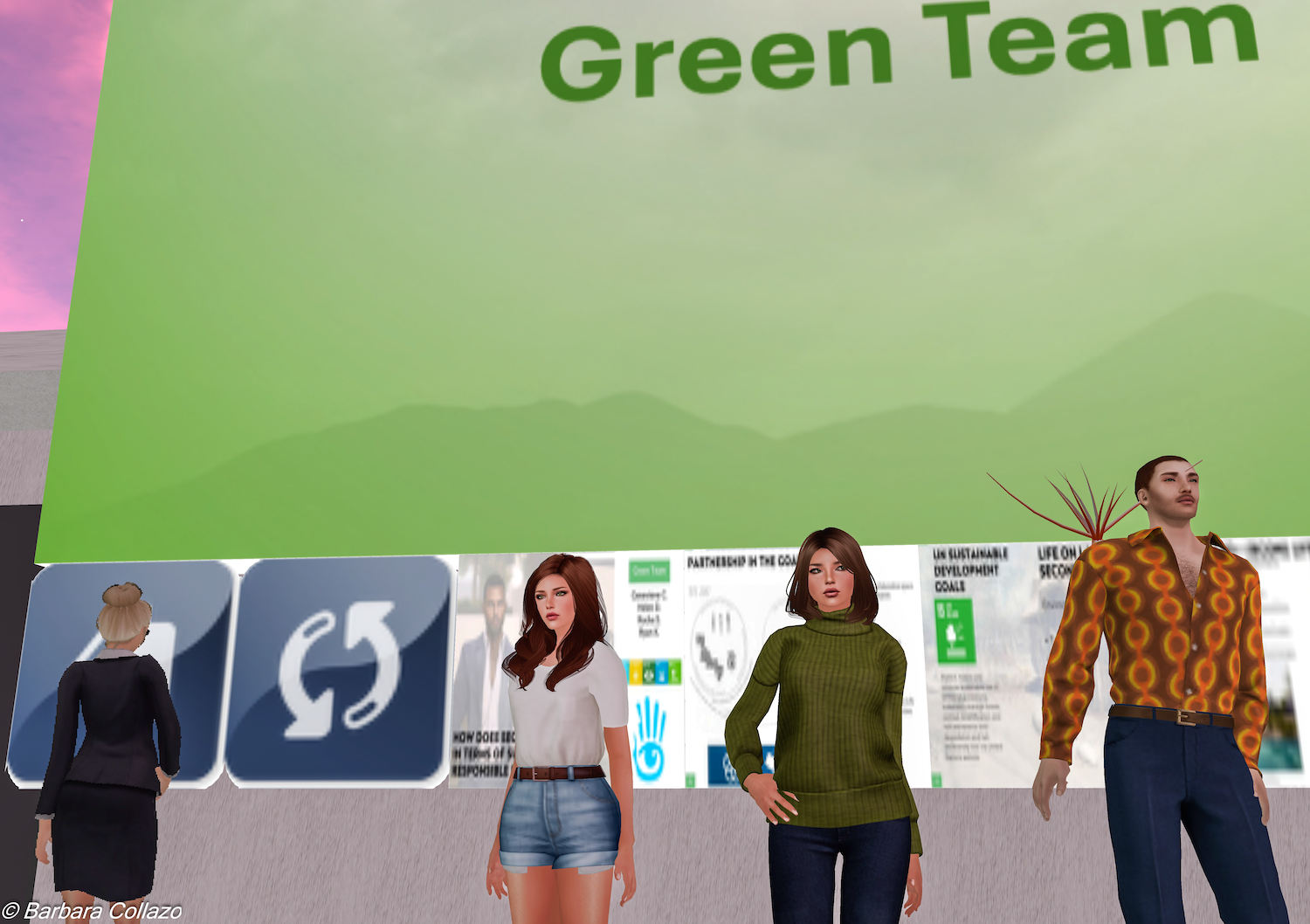
The Team Project presentations were hosted by Çağ University in the auditorium. John received slide shows from each team and set them up on the platform in advance. There was full attendance from each team and they presented in the following order:
No technical problems arose and each presentation went off smoothly and efficiently. John complimented the participants on their submissions and thanked them for their attendance throughout the semester. He also thanked the Çağ students who had come along to class along with their supervisors and teahers and all the guest speakers.
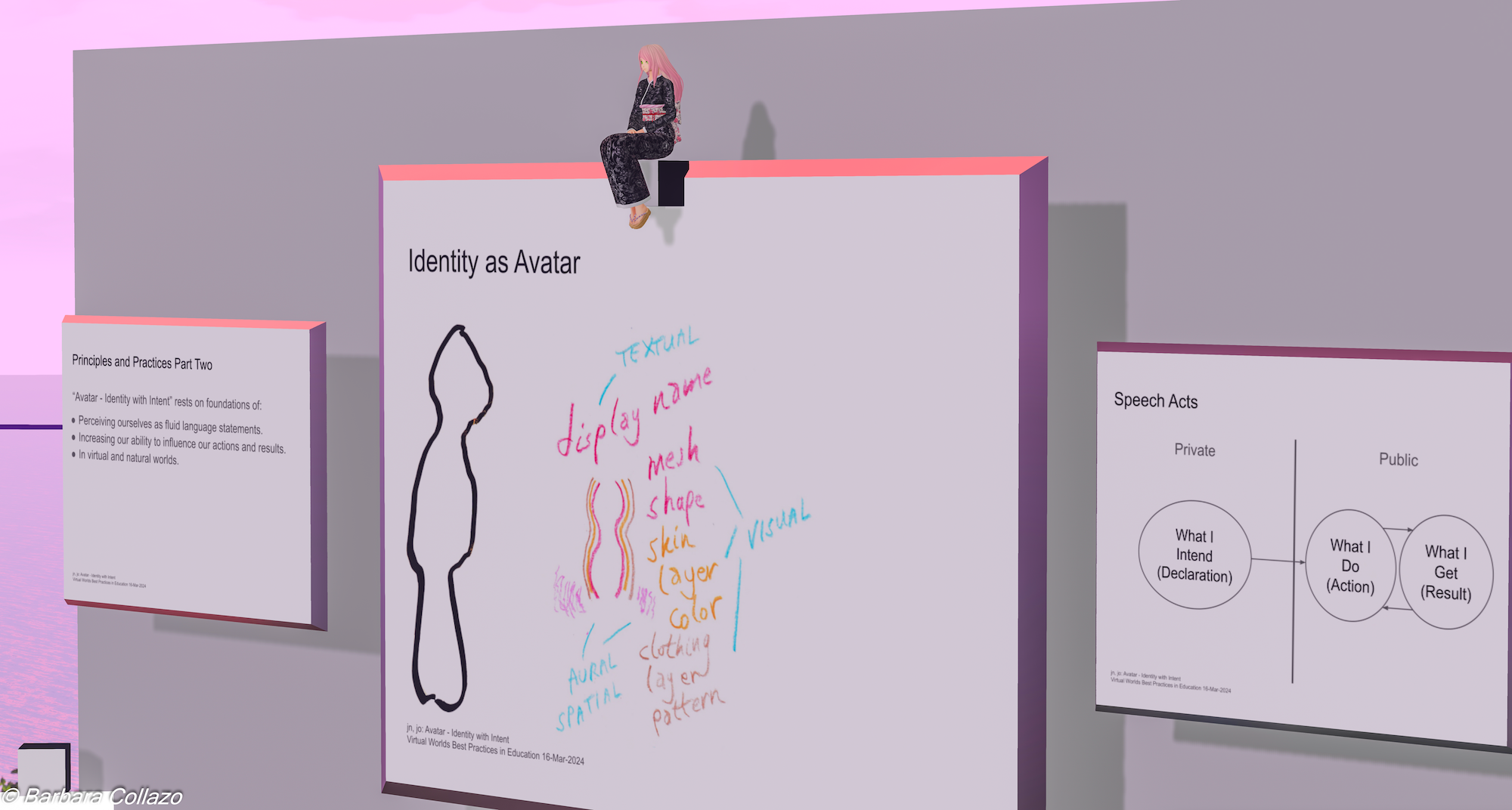
Sitearm Madonna and Acuppa Tae introduced the concept of thinking about identity with intention, a way of thinking that allows us to deliberately develop our approach to presenting ourselves purposefully. The content of the class emerged from a talk we gave jointly at the Virtual Worlds Best Practices in Education (VWBPE) conference earlier this year.
Sitearm Madonna talks about identity as avatar. Photo Barbara Collazo
Second Life, through the use of avatars, allows for the opprtunity to choose an identity and so opens the door to considering identity not just in a virtual world but also in the natural world.
Avatar – Identity with Intent, presentation by Sitearm Madonna and Acuppa Tae. Recording courtesy of Sitearm Madonna.
Following the formal talk we demonstrated how easy it is to change the physical appearance of our avatars. Sitearm and Tae explained how to save your current avatar using the ‘My Outfits’ before changing your avatar either by editing your existing one or selecting a completely different avatar from the menu bar. You can also change your appearance by dressing your avatar in the wide range of clothing available freely, or to be paid for in stores, across Second Life or through the web at the Second Life Marketplace. We discussed how the simple act of changing your avatar affects how you feel about yourself immediately. Those of us who have been resident in Second Life for many years shared how attached we have become to our avatars and how strong the identification can be after such a long association. This is particulary noticable in those who attempt to fashion avatars that mirror their natural world appearance.
Demonstrating how easy it is to change the avatar’s appearance. Recording courtesy of Sitearm Madonna.
To close, Sitearm spoke about the many personality tests and team role identifiers that are used both by employers, teams and individuals to identify traits, stengths and weaknesses. Two of the most commonly used systems are the Belbin Team Inventory and the Myers-Briggs Type Indicator. He introduced a more recent addition, Principles You, that uses a cartographic in an attempt to explore the complex nature of personality archetypes and how they connect. This all comes with the warning that such tools are relatively crude and should not be taken as giving definitive descriptions however, they can be helpful in exploring our personalities and building effective teams.
Sitearm Madonna introduces the Principles You Archetype Archipelago. Recording courtesy of Sitearm Madonna
For example, Sitearm and Tae completed the free test offered by Principles You which yielded the following results:
Sitearm: Artisan; strategist, planner in CREATORS and ARCHITECTS
Tae: Inspirer; impresario, entertainer in ADVOCATES and ENTHUSIASTS
On the map Sitearm and Tae connect through the CREATIVE and LEADERSHIP islands.
You can visit the Principles You website to see the ‘archetypes archipelago’ and see how this approach offers a flexible approach to teambuilding.
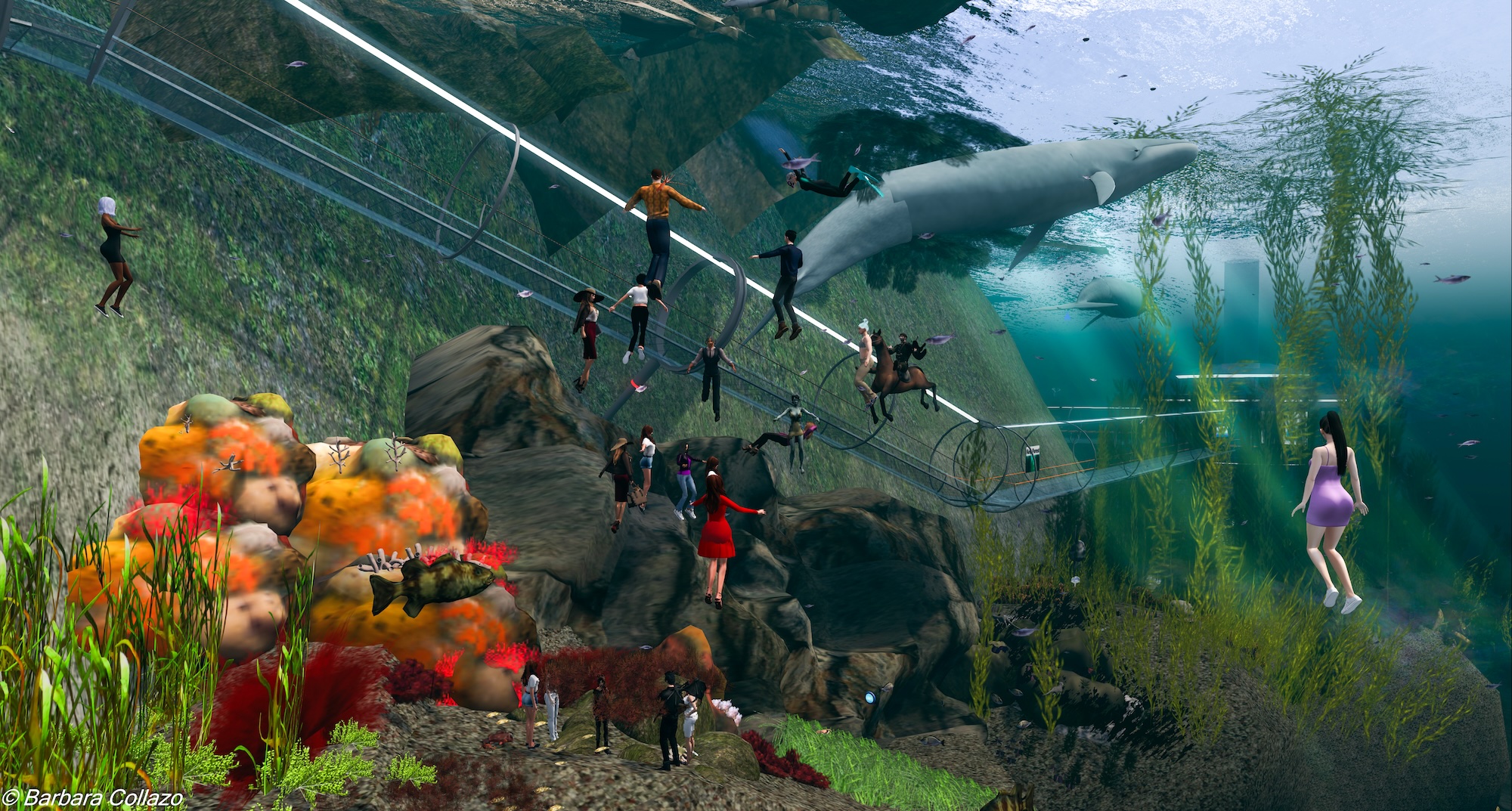
Another field trip this week: we visited the Abyss Observatory where Delia Lake brought us on a tour of this science museum / aquarium of the Earth, marine life, undersea technology that inspires a sense of wonder for the deepsea world. This included seeing various ecosystems recreated accurately with appropriate flora and fauna. Delia explained the impact of human intervention on these environments and how they are changing due to the heating of the oceans. There is so much to see in this very detailed and extensive sim that Delia invited us back to explore further in our own time. Everyone is welcome anytime.
There were a few issues with the sound and some participants experienced occasional drop out. So, here is a recording of this field trip from last year’s class which covers much of the same ground.
We had the field trip to Virtual Ability Island (VAI) this week where we were welcomed by Gentle Heron who outlined the history and raison d’être for the community. Following this we broke out into five groups, each one led by a member of the VAI team, for an opportunity to have a discussion about the functioning of the community. The small groups made it easier for the students to ask questions and learn a little more about the members of VAI, why they joined, and what they get from being members.
John O’Connor / Acuppa Tae introduces the work of Marshall McLuhan. Photo Barbara Collazo
This week the class met at the VWEC Eduverse Fireside Deck for a talk on the 20th Century media theorist from Canada, Marshall McLuhan. If you missed it you can view a video of the talk from February 2023. We were joined again by our friends from Çağ University, Prof Murat Gülmez (aka Magua) and Ersin İnal (aka Ginger) along with their students.
The Virtual Worlds Education Consortium (VWEC) hosts the VWEC Eduverse, a space for educators and educational institutions across Second Life. The Fireside Deck is a communal space used for informal meetings, a series of Fireside Chats where issues of interest to teachers and educators can be discussed (with groups meeting to chat in English, Spanish and Polish), and the VWEC Metaverse Expert Series featuring talks by educators and academics with expertise and experience of teaching in virtual worlds. The series is available to review on YouTube with the full schedule of presentations freely available.
Valibrarian talks about literacy in the digital age and digital citizenship. Photo Barbara Collazo
We were joined by the Turkish students from Çağ University for this week’s class. Valibrarian presented on metaliteracy and digital citizenship introducing us to the topics addressed in her 2020 book book Metamodernism and Changing Literacy: Emerging Research and Opportunities. Following the main presentation we teleported to a ‘dark room’ to learn about the dark side of digital existence. Then, to finish on a bright note Val invited us to the Community Virtual Library for a lively discussion on the issues raised in her talk.
The dark side of the metaverse… Photo Barbara CollazoThe class concluded in the Community Virtual Library with a lively Q&A session. Photo Barbara Collazo
We were joined by PhD reseacher from the University of North Carolina at Charlotte who is looking at education in the metaverse. She invited the students to take part in a focus group to provide data for her research.
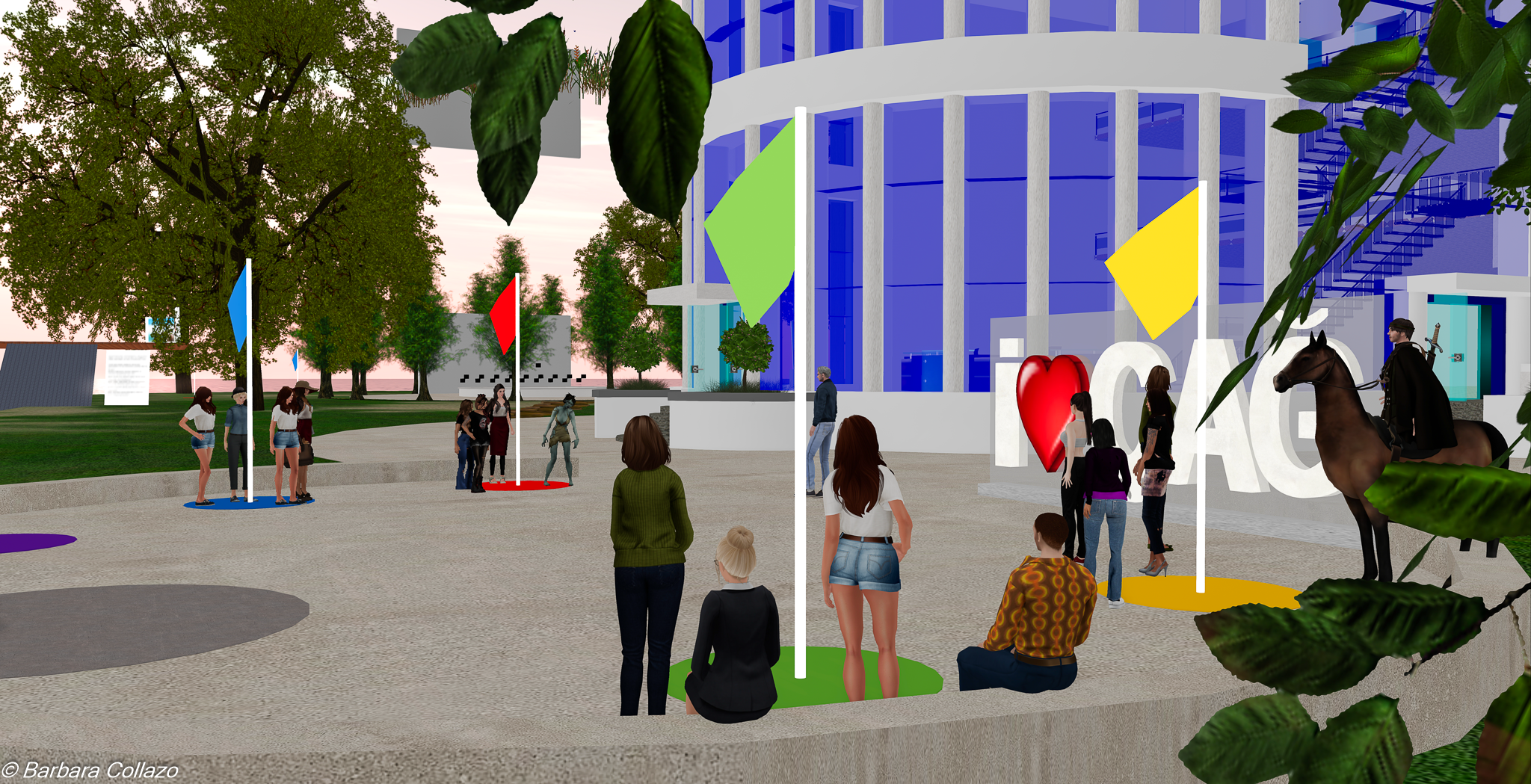
Project Teams gather at the Çağ University campus as class commences. Photo Barbara Collazo
Sitearm Madonna joined us at the Çağ University campus for today’s class on Teamwork and Collaboration. Here is a recording of Sitearm’s presentation:
Following the presentation we did a quick check-in with each team to answer the following questions: 1. Has your team held its first meeting? 2. Who is your Team lead and assistant lead? 3. How will your team communicate outside SL? 4. Did you discuss the brief for the Team Project?
All teams answered positively and have given some thought to the project and how they will address it.
Sitearm Madonna presents on the theory of team development and operation. Photo Barbara Collazo
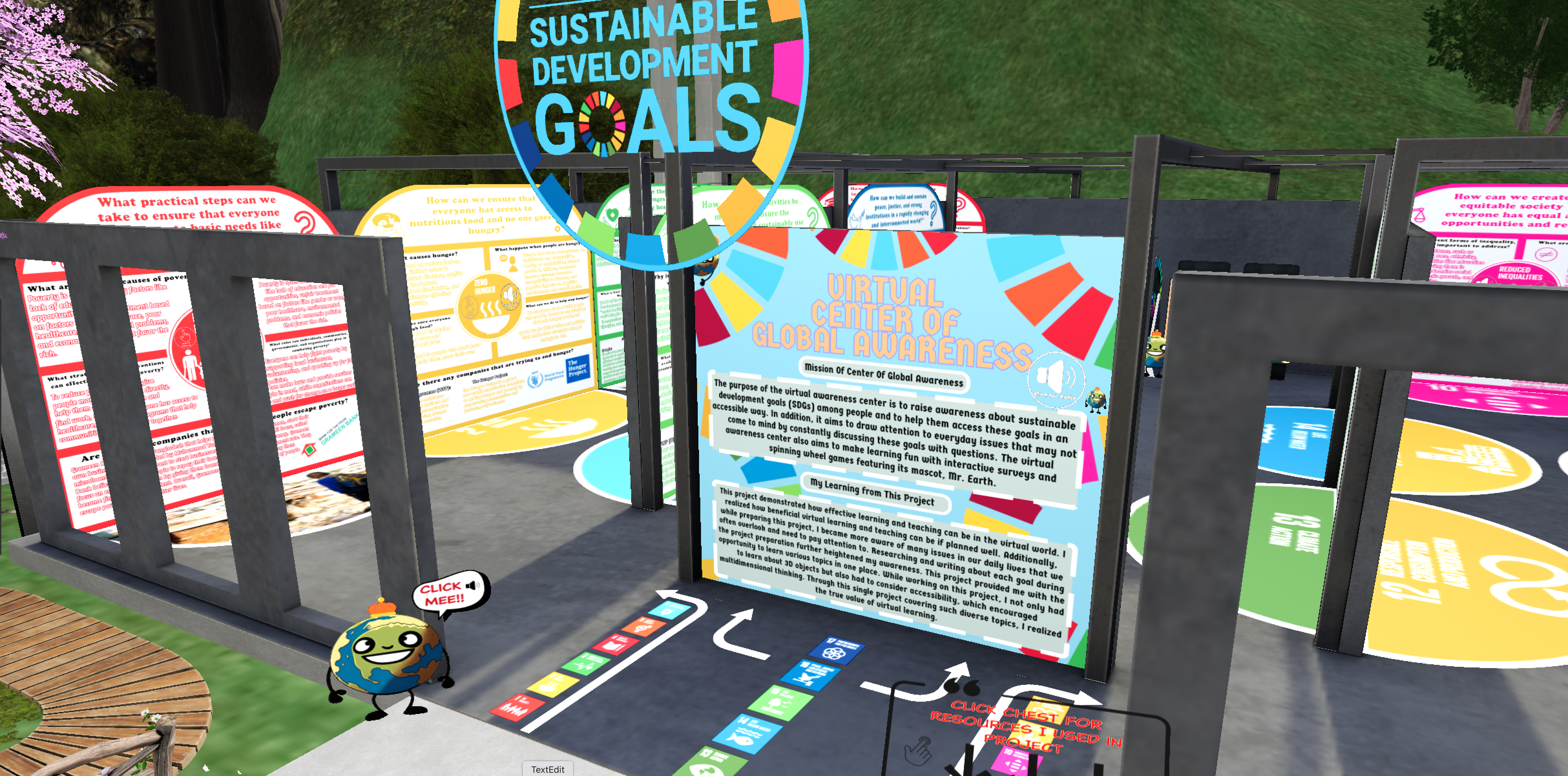
Finally, we paid a quick visit to a build by one of last year’s Turkish students, Ovcel, demonstrating the United Nations 17 Sustainable Development Goals.
The United Nations Sustainable Development Goals are a universal call to action in the face of global poverty and the impact of climate change on our planet. Seventeen goals were agreed by all member states in 2015 as part of the 2030 Agenda for sustainable Development. We have nine years left to achieve success and secure the future of humanity on Earth.
The United Nations call follows a Warning to Humanity issued by the Union of Concerned Scientists as long ago as 1992. They ‘feared that humanity was pushing Earth’s ecosystems beyond their capacities to support the web of life’. Five years ago the warning was updated as 15,000 scientists from around the world published World Scientists’ Warning to Humanity: A Second Notice.
Virtual reality (VR) has been in development since the last century but the coronavirus pandemic with its attendant public lockdowns and social distancing has resulted in a rapid growth in virtual engagement as reported in Forbes Magazine and in Newsweek recently. This, in turn, has led to significant development in the supporting technology.
Second Life was one of the first and remains one of the most successful platforms in the social and community development arena that also has significant educational and academic engagement. As an immersive environment with a functioning economy, creative building tools and a large active population it appears to be a self-sustaining world. According to the online magazine, Mic, residents have ‘full Second Life lives, filled with many of the same hobbies and activities one might enjoy in their first life’.
The platform is particularly relevant for online collaboration because it supports persistent chat, offline email, text chat, voice chat, group versus subgroup chat isolation, virtual to real world currency exchange (a precursor to bitcoin), inworld collaborative three dimensional build, three dimensional avatar self representation and interaction, and three dimensional environment immersion.
Second Life can be seen as a mirror to the real world, or an extension of the world. Does this virtual environment have a responsibility to also mirror the demand for sustainable development?
Assuming the answer is a resounding ‘Yes!’ the question becomes: how does Second Life measure up in terms of sustainability and responsible practices?
The Brief
Your task is to examine this question in the context of the UN Goals and report on the platform itself, the communities that it supports and the activities of the residents. Identify good practices and shortcomings; recommend possible improvements in operation; and present your conclusions. In researching this project draw on examples from your own culture, or the culture in which you are now residing. Compare this to what you observe in Second Life.
In short, your presentation should answer the question:
How does Second Life measure up in terms of sustainability and responsible practices ?
You will be assigned to a team to work on the project. Each team will be assigned one of the following three key topics: Economy, Society, or Environment and you will attempt to answer the question in the context of the sub topics listed for each theme below.
During the final class, at the end of the semester, each team will make a presentation in an entertaining, informative and lively manner, live in Second Life. The presentation should be no shorter than five minutes and no longer than ten minutes. You are encouraged to use visual, audio or any other aids to support the presentation during which each member of the team must take part.
Here are the three key topics, with the sub themes for each:
Economy
Society
Environment
All teams will also address the following sub topics:
Deliverables
Participation in the rehearsal of presentations.
Participation in the presentation of your Team Project.
Following the Team Project presentations write the sixth section of your essay reflecting on your contribution to the presentation, the reaction from the audience and the overall success (or otherwise) of your group work.
Assessment Criteria
It is important that you read and understand the Assessment Rubric (you will receive a copy from your lecturer in class) given for this assignment so that you understand the basis on which the assessment will be made. There are 6 assessment criteria in total. Each member of your group will receive the same mark for the first 2 criteria, For the other 4 criteria you will receive an individual mark.
Group Mark:
Communication with the audience: establishing a connection with the audience to deliver a coherent presentation.
Content: addressing the theme of the brief coherently.
Individual Mark:
Tools for Collaboration: selection of appropriate tools for group planning and effective use of the tools.
Teamwork: contribution to the team and demonstration of understanding of team dynamics.
6th section of your essay: ability to describe activity coherently, reflect on experience and present a critical evaluation of the process of developing the project, citing appropriate references.
Quality of Presentation: individual contribution to the presentation of the project.
Students settle in to their first class of the semester in Second Life. Photo by Barbara Collazo.
We got off to a good start this semester with a good show of students who all arrived well prepared. All had voice activated and were able to get their avatars sitting down ready to pay attention to the class content. This is not always an easy task and it demonstrated that participants had signed up for SL at least a few days before the class and had spent some time getting to know the basics – always a good sign of genuine interest and engagement. I also noted that participants were happy to use voice and IM to communicate and ask useful questions.
We quickly ensured that everyone had been added to each others friends lists, and that all joined the TU Dublin group so that we could keep in contact. There is some interest in upgrading from the basic avatars and students would like to customise them. We will return to that in the next class.
We were joined for some of the class by Barbara Collazo, a photographer, who was commissioned by The Avatar Scholar to record some images for the forthcoming issue which features an article I have written. We all went out to the deck to provide some variety for the photographs and to give us all a chance to stretch our legs (not that avatars get tired or stiff from sitting for long periods but, the people behind the avatars need to be stimulated by something different or there is a tendency to drift off and lose focus).
I explained the structure of our VLA, Brightspace, to the class and asked paticipants to spend some time reviewing the content – particularly the section for today’s and also the section on Assessment. It is important to be familiar with the assessment requirements because the work is spread evenly throughout the semester to ensure there is not too much pressure on students at the end of the semester, when all their other modules will require submission of work. I also reminded them that the schedule/timetable is available in the Introduction section and it is important to note that for reference. We will also welcome guest speakers joining to share their expertise on a range of topics and will go on site visits with some of them to see other places in Second Life.
John O’Connor / Acuppa Tae welcomes participants to the class in Second Life. Photo Barbara Collazo.
Then we made a brief visit to the campus of Çağ (pronounced ’Chá‘ in English) University where we will meet students from this Turkish university during the semester. We will also meet here for some of the talks by guest speakers. Following that we went to the VWEC Eduverse plaza where many of the academic institutions that have a presence in Second Life meet to share experiences and knowledge. There are many interesting events held in the plaza with a schedule giving the full listing. I particularly recommended the Expert Talks series on Friday evenings at 9:00 pm Irish Time.
Concluding, I gave the class their assignment to be completed before the next class: Explore Second Life with some colleagues from the class. Visit at least 3 different locations. Find them in ‘Search’, or ask other residents for recommendations, or simply select places at random. Participants were also asked to review the section in the Brightspace VLE on Class 2: Team Project – Virtually Sustainable?
Classes will start on Wednesday 2nd October at 3:00 pm for two hours. We meet online every week at TU Dublin in Second Life. Please note: you will need a Mac or PC desktop or laptop to access Second Life – you cannot do so with a mobile device.
Full details about the module are available to eligible registered students on the university VLE, Brightspace, where you may self-enrol. Read the Introduction unit carefully where you will find instructions on how to access Second Life and set up your personal avatar. Learning how to get around the virtual world and familiarising yourself with the environment and how to control your avatar will take a few hours so give yourself plenty of time before class starts.
Please read pages 1 to 9 in the column on the right also. If you would like to find out more about what to expect during the semester read the posts in this blog: all class since 2009 have been summarised.
If you have any problems email John O’Connor at TU Dublin.
Once again, this semester we will be working with Prof Murat Gülmez (aka Magua) and his students at Çağ University in Turkey.












 Virtual Environments: Is one life enough?