Posts Tagged ‘class meeting’

h1

Class 7: Making the project work

March 21, 2013

CLASS SUMMARY:

Two graduates of this module from the previous semester returned to share their wisdom and experiences with the class. Dudley Dreamscape and Inish Karu spoke about the group project: how to manage group dynamics, determine each member’s skill set, share the workload, monitor progress and deliver the killer presentation. They also discussed ways of promoting the event and ensuring there is an audience on the night.

h1

Class 6: Content creation, part two

March 13, 2013

CLASS SUMMARY:

Guest Lecturers Sitearm Madonna and Elfay Pinkdot delivered this week’s class at the Dublin Conference Area.

The aim of this class was to get participants thinking about and using the tools needed for creating the final presentation and what the implications of making your own or using existing ones might be.

Madonna and Pinkdot covered a list of collaborative tools used for making and uploading: videos, audio tracks, images etc, with emphasis on how these funnel into a typical IOLE Formal Presentation including whether to do it inworld or via YouTube.

This list of tutorials to watch BEFORE class was circulated in advance; to save time and give you a chance to absorb the technical aspects of these tools.  *NOTE: some of these tutorials refer to SL viewers that you may not be using, you may need to look on your own viewer to find where the buttons are located – but they will be there!

http://www.youtube.com/watch?v=JcuscQPZ2wg

http://www.youtube.com/watch?v=QBVmFafFatE

http://www.youtube.com/watch?v=2jS9J2ecP0w 

http://www.youtube.com/watch?v=l0O0gr0jIrs

http://www.youtube.com/watch?v=fcy1yje6o6k

There will be time for Q & A during class.

h1

Class 5: Content creation, part one

March 8, 2013

CLASS SUMMARY:

The class discussion started by talking about Axel Bruns’ concept of the Consumer – Prosumer – Produser as outlined in his online lecture given as reading material last week. We considered what constitutes online content – from text to image – and how it is generated. Sharing content, making it widely available and generating an income from it raised the question of professional versus amateur content creators and this led to considering the nature of ‘value’. What value might our content have? and how can we determine that value?

The fair use of our content by others prompted an example from Locks about the student who discovered a photo of herself she had posted on Facebook was used by Tesco on a line of child’s shirts without her knowledge. Copyright and Intellectual Property (IP) issues were touched on as means of protecting content but the difficulty and cost of enforcement were recognised as issues.

We discussed the project work and asked that a brief progress report be given next week.

ACTIVITIES FOR NEXT WEEK:

  1. Read: the journal article User-Generated Content & Virtual Worlds by Greg Lastowka. Written in 2008 it nevertheless identifies some key legal issues for those creating content in online virtual worlds.
  2. Read: this thoughtful blog post about the legal issues around protecting ‘things’ you create in SL. Read the comments also. Content and Licensing in Virtual Worlds.
  3. Write: the fifth post to your blog on content creation.
h1

Class 10: Presenting projects

December 14, 2012

CLASS SUMMARY:

"

Sitearm Madonna outside the Dublin Amphitheatre.

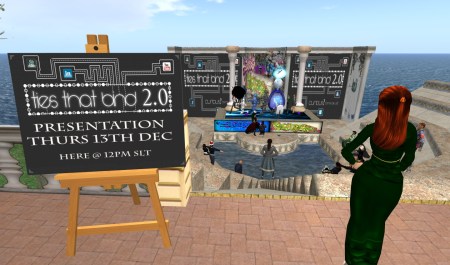
The students’ presentation of their projects at the Amphitheatre in Dublin Virtually Live was a real success. A good crowd (including a liberal scattering of pirates) came along and guest judges Elfay Pinkdot and Sitearm Madonna were in attendance.

Acuppa Tae, aka John O'Connor, introduces the students.

Acuppa Tae, aka John O’Connor, introduces the students.

Acuppa Tae Introduced the groups, who presented their projects magnificently, commencing with Inish Karu, B.ro, Seranox and Ace Regan; continuing with Dudley Dreamscape, Box of Chocolates, Thomas Tully and Sofia; and concluding with Fenix Muhindra and KautoStar.

The Amphitheatre in Dublin Virtually Live.

The Amphitheatre in Dublin Virtually Live.

Following the presentations students responded to questions from the judges and Locks Aichi and this was followed by a general discussion with member of the audience.

The event was a tremendous success from every point of view and particular credit is due to the participants for the significant efforts put into the event. Well done to you all and congratulations!

More photographs here.

ACTIVITIES FOR NEXT CLASS:

  • [and you thought the module was complete…!]
  • Tae and Locks will be available next week 20 December during normal class time 8.00 to 9.00 pm Irish Time (12 noon to 1 pm SL Time) for feedback on your presentations and/or blogs, or to answer any other questions you may have.
Box of Chocolates at the Dublin Amphitheatre…

Box of Chocolates at the Dublin Amphitheatre…

…and in the Fr Ted Corner at DIT Mountjoy Square.

…and in the Fr Ted Corner at DIT Mountjoy Square.

h1

Class 9: Wrapping up

December 7, 2012

CLASS SUMMARY:

We have almost reached the conclusion of the module. Next week sees the presentation of students’ projects so Locks and Tae met with each group of students individually. We discussed the dynamics of the group, the tools used to facilitate cooperation and planning and the intended approach to the presentation.

Feedback on each student’s blog was also given.

The rest of the class was given over to project work and final planning for the presentation.

ACTIVITIES FOR NEXT WEEK:

  • Complete the group project for presentation.
  • Check that all required blog entries have been posted.
h1

Class 8: Dublin Virtually LIve

November 30, 2012

CLASS SUMMARY:

The class started with a review of progress on the group projects. It was decided that the presentations would take place at the Dublin Amphitheatre (although group 2 suggested they may need to present at a different location – this will be confirmed next week). Each presentation should last between five and ten minutes. Participants were reminded that part of the brief is to promote your presentation and ensure a relevant audience attends.

Sitearm Madonna returned this week and was joined by Ham Rambler, the creator of Dublin Virtually Live. The slide show can be see here. Ham spoke about the origins of Dublin in Second Life. As an airline pilot he has travelled widely across the real world and noticed that wherever he went he usually found an Irish bar. The notion to develop an equivalent in SL led to him opening the Blarney Stone in the early days of the virtual world. The immediate success of the venture was due to the unique qualities of the Irish bar: a safe, friendly, welcoming environment where people could meet and socialise. This led Ham to develop a virtual replica of the city. He flew an experienced designer/builder to Dublin for a weekend to document Dublin photographically and commence the project, of which the first phase took about three months to complete. The new Blarney Stone was based on the real life Oliver Synge Gogarty pub in the Temple Bar cultural quarter of Dublin. In 2010 Ham brought delegates of the Meta Meets conference in Dublin to the bar and met the owner who told him people from all over the world were visiting the place having first come across it in SL.

Snapshot_001

The launch of Dublin Virtually Live was a major event in SL and was also covered by the media in the real world. It attracted the attention of multinational brands such as IBM keen to explore the possibilities of virtual worlds for marketing and promotion. Dublin Tourism also saw the opportunity to promote the city.

The project demonstrated Sitearm’s proposition that ‘We Are All Content Creators All the Time (WAACCAT). Site also summarised the issues around intellectual property and copyright; how to protect what you create and the recent development of the Creative Commons licence. The class discussion ranged across approaches to developing and protecting our content, cost of creation versus the market value of our efforts, alternatives to monetary commerce such as barter and distribution.

Sitearm concluded by reminding us to keep account of the content we create. This becomes more important as we progress in our careers and reputations develop into capital worth.

However, content may not always be what it seems, warns Ham, as he described the hoax of Dublin Coastal Development that was merely a mechanism to promote a new property development company. It succeeded massively, even making the primetime news bulletin on national television.

ACTIVITIES FOR NEXT CLASS:

  • This week is the second assessment point for your blogs so ensure they are up to date.
  • Write a post to your blog reflecting on your own particular contribution to the development of the group project. It is important to consider the shortcomings and failures in addition to the successes. Indeed, there is a greater opportunity for learning when you reflect on what went wrong and how you might improve your contribution in future team projects.
  • Prepare a short presentation to be given in the next class describing your project and the progress made so far.
  • Remember, your project presentation is only two weeks away.
h1

Class 7: Team working

November 23, 2012

CLASS SUMMARY:

We started with some discussion on the students’ blogs and suggested that you review the ACTIVITIES FOR NEXT WEEK sections for each class to ensure you have written the required posts. We also had a a quick review from each team on progress in the group project. As is normal at this stage in the module some teams appear to be making more progress than others. Locks and Tae reminded students that the purpose of the project was to give participants the opportunity to discover the joys AND difficulties in working with others online and to learn something about the differences between online collaboration and real life team working. Participants were also reminded that even though this is a group project you will be assessed individually: based on your feedback in class; participation; and critical reflection on the process in your blogs.

Sitearm Madonna, guest lecturer, then delivered his talk on team working in an online environment. Accompanying slides can be seen here. Commencing with an explanation of ‘le nom en ligne’ concept (similar to nom de plume and nom de guerre) he went on to talk about the challenges of collaborating with others online. As a graduate of the module he is in a good position to give participants some guidelines on how to work on the group project. Site gave an overview of how teams work, the roles of individual team members and referred to the Belbin approach. He emphasised the importance of all nine roles being activated: meaning that you will need to take on more than one role at different times during the project.

Then he spoke about the importance of clarity around the group’s presentation of their project and how easy it is to leave your audience confused. The most common mistake when presenting is for the participants to be unclear about their key message. Site suggests it is ‘impossible to underestimate the ability of an audience to understand you’! He described a range of tools teams can use to support the planing and development of their project.

Finally, Site spoke about identities and affiliations. He described how multiple affiliations lead to multiple identities and the importance of being aware of your online presence. He concluded with a warning to guard your privacy, keep space between your identities and post appropriately.

Sitearm will return next week to talk about content creation online.

Following some discussion we visited the Dublin Virtually Live Conference venue. Site offered support to the teams in developing their projects and said participants could use either the amphitheatre or the Conference venue for their presentations. We agreed to make a decision on the venue at next week’s class.

ACTIVITIES FOR NEXT CLASS:

  • Write a post to your blog comparing your experience of team work with the description outlined by Sitearm, particularly with reference to Belbin’s Nine Team Roles.
  • Decide on your preferred venue for the presentation. We will make a decision at next week’s class. (It was agreed that all presentations should take place in the same venue because the logistics of moving everyone around SL would be insurmountable.)
h1

Class 6: Content creation, part 2

November 17, 2012

CLASS SUMMARY:

The class discussion looked in more detail at what is meant by ‘content’ and talked about the various types of content that can be created online, from building objects in SL to writing posts for blogs etc. This led on naturally to considering the merit and value of content. Determining the value of other people’s content requires an understanding of their reputation. In traditional publishing the high cost of production has resulted in an industry that is controlled by the commercial publishing houses or the press. Academics are published following peer review. These mechanisms regulate the output and give consumers a signal regarding the quality and value of the output.

The online environment has all but eliminated the cost of production allowing anyone to publish to  a blog, or create any other content they can imagine, without any of the ‘gatekeepers’ of the analogue world filtering the wheat from the chaff. Therefore we have to find other methods for rating the calibre of what it available.

When offering our own content we should be aware of these issues so that we can present ourselves in the most appropriate manner to our relevant audiences. Developing our personal brand requires establishing a reputation for reliability and consistency to start with. Many of the online tools available to support content distribution also include statistical analysis of how our content is accessed which is useful for seeing how others might value our content.

We moved the class to the Dublin Amphitheatre for the second half of the class simply to vary the environment. This is one of the possible venues for the final presentation of the group project. However, it is entirely up to the class to decide on the most appropriate venue, which may be anywhere in SL that suits you and can be agreed by all. There was some discussion about how the groups are functioning and we decided to review that in the next class.

ASSESSMENT:

Tae reminded the class that he and Locks were conducting the first assessment of the module. Some students have not yet submitted links to their blogs or their twitter contact details. You need to do both immediately or you risk failing the assessment. Participants were advised to re-read the posts for each class and ensure they have completed all items listed under ‘activities for next week’, particularly ensuring you have written all the posts required.

ACTIVITIES FOR NEXT CLASS:

  1. In your groups prepare a brief summary of progress on your project work.
  2. Write a post to your blog describing your experience of working in your group so far. Be honest about what is not working in addition to what is working and consider how you would like to be better.
h1

Class 5: Content creation, part 1

November 9, 2012

CLASS SUMMARY:

The class was based on a discussion about content creation online. We started by considering what constituted content and came up with writing on blogs, Facebook, Amazon, Kindle; music on iTunes; videos on Youtube; photos; and objects made for SL among others. This led on to thinking about how content is generated, and why, what is the purpose of writing a blog, or posting photos? Sharing content and thinking about its value led Inish to share a link to a website that values twitter accounts which proved interesting as we discovered how much ours are worth.

A recurring theme throughout the discussion was the ownership and protection of content. The terms and conditions to which we agree when signing up with social networks such as facebook and twitter frequently include relinquishing our copyright. In addition, even though we might wish to remove images or text at a later date this may not be possible. It was also clear that copying digital data is much easier than copying analogue information which may lead to greater infringement of copyright. Generating an income from online content was thought to be as time-consuming as it is in real life and the conflict that can ensue was noted.

Inish Karu shared her experience of creating content for her store in SL.

After class Symeon Siamendes took us on a tour of the fabulous Lauk’s Nest, one of the earliest remaining natural parks in SL.

ACTIVITIES FOR NEXT WEEK:

  1. Reading: Thoughtful blog post about the legal issues around protecting ‘things’ you create in SL. Read the comments also.
  2. Write a post about content creation in your blog.
h1

Class 10: Presentation

December 15, 2011

The class team was unable to present the final project work as scheduled for the class meeting. On the surface this was because it was unable to stream the sound into the Dublin Amphitheatre but, the real problem was lack of preparation, organization, project management, planning or rehearsal. Clearly, some team members had worked to produce a soundtrack, others wore costumes and some invited guests arrived but, there was little evidence of a coherent team effort. Despite a requirement for Plan B in the event of a sound breakdown no such plan was available. The performance was rescheduled for Wednesday 21st December.