h1

Class 5: Content creation, part 1

November 9, 2012

CLASS SUMMARY:

The class was based on a discussion about content creation online. We started by considering what constituted content and came up with writing on blogs, Facebook, Amazon, Kindle; music on iTunes; videos on Youtube; photos; and objects made for SL among others. This led on to thinking about how content is generated, and why, what is the purpose of writing a blog, or posting photos? Sharing content and thinking about its value led Inish to share a link to a website that values twitter accounts which proved interesting as we discovered how much ours are worth.

A recurring theme throughout the discussion was the ownership and protection of content. The terms and conditions to which we agree when signing up with social networks such as facebook and twitter frequently include relinquishing our copyright. In addition, even though we might wish to remove images or text at a later date this may not be possible. It was also clear that copying digital data is much easier than copying analogue information which may lead to greater infringement of copyright. Generating an income from online content was thought to be as time-consuming as it is in real life and the conflict that can ensue was noted.

Inish Karu shared her experience of creating content for her store in SL.

After class Symeon Siamendes took us on a tour of the fabulous Lauk’s Nest, one of the earliest remaining natural parks in SL.

ACTIVITIES FOR NEXT WEEK:

  1. Reading: Thoughtful blog post about the legal issues around protecting ‘things’ you create in SL. Read the comments also.
  2. Write a post about content creation in your blog.
h1

Class 4: Online communication and relationships

November 2, 2012

CLASS SUMMARY:

After a brief summary of last weeks session on the self and personal branding, guest lecturer Elfay Pinkdot (biography) presented this week’s class. She spoke about the development of her online life – from an early interest in how things around her worked, to a specific interest in technology.

As an early adopter of email, internet access, online communication and residency in virtual worlds, she has a unique perspective on their development. Describing the process of developing her online presence Elfay remarked on how it simply became an extension of her own personality. She also noted that it can often be easier to establish online relationships but that they require the same attention as any other relationship might.

She was able to indulge her passion for jazz by hosting a weekly show in SL for over five years and this formed the basis of an online network that evolved into a community and led to her connecting with other communities. There was some discussion on the organisation and regulation of communities, the rules governing access to SL and their enforcement and the development of behavioural conventions and etiquette.

Elfay gave some useful links in her pre-class post on this blog.

For the second half of the class Elfay introduced the Dutch artist, Rob Steenhorst, who took us to his gallery in SL and spoke about how he developed his practice in SL. The fascinating insight into his development as an online artist working in 3D was both witty and informative. He also spoke of how inter-twined his SL presence has become with his RL life. Other artists he has met in SL have become friends and collaborators in RL. The evening ended with the delivery of a poem by Karima Hoisan. Many of Rob and Elfay’s SL friends were at the gallery also. Tae recommended that you make friends with these people who will be able to help you with your project and introduce you to more communities.

Finally, Tae reminded everyone that he and Locks will be reviewing blogs – the first point in the assessment of the module. So, make sure your blog is up to date.

ACTIVITIES FOR NEXT CLASS:

  1. Visit the artists’ community website Deviant Art.
  2. Read ‘The Laws of Virtual Worlds’ from the California Law Review. This academic paper gives a useful insight into the legal issues around online presence.
  3. View the lecture ‘From Prosumer to Produser: Understanding User-Led Content Creation’ by Prof Axel Bruns (Creative Industries Faculty at Queensland Institute of Technology). He explains his theory of user-led collaborative content creation.
  4. Post an essay (written according to academic conventions) to your blog on the importance of regulation, convention and etiquette in online communities. Minimum 500 words.
h1

October 31, 2012

REMINDER: Clocks have changed in Europe but not in the U.S. this week. So best to keep the Second Life clock in mind!

h1

Class 4: Elfay’s Notes: Preparation for class

October 30, 2012

13:00 SLT/20:00 GMT: Class will begin at the regular DIT classroom in Virtual Dublin with Elfay for about 45 mns

Coffee & Pajamas Jazz Show Sites/Info
You can find a  recent Bio here: http://www.mutantspace.com/skills/internet-radio-sec12ond-life/:
Facebook   http://www.facebook.com/elfay
Show Intro/Demohttp://xxelfayxx.wix.com/jammies
Deviant Art: http://elfay.deviantart.com/gallery/
Show Poster Designerhttp://www.vandalhandle.com/
Sorry my own portal site is being updated and not useful to you right now.

Second hour will move to Rob Barber’s SIM in Second Life (make sure you have found him already have the SLURL for that SIM ahead of class time)

He (and I) will have invited our regular friends/guests from both our shows to participate in this portion of the class. Rob will be talking about himself, his art and his work hopefully both in and out of SL). You can find his work here: http://www.robsteenhorst.nl/

Interact with us and our guests throughout the hour. – That means; I expect you can already teleport, use basic animations, talk in chat, and most importantly-have your audio working to enable you to hear live streaming (and in-house voice) before this class starts

There will be time for Q & A in chat before class ends. It’s social. loose. interactive and (supposed) to be fun! Prepare ahead of time so you can enjoy it and participate fully!

“The Frequent Asides”;
There are also my own ”private” networking pages on Flickr, Tumblr, Linkedin, Artbistro, Google and Mandys as well as my own portal site. But they can all be found by starting at one or more of the above. So nothing is private. So in other words…nothing is private.”

h1

Class 3: Personal branding

October 26, 2012

CLASS SUMMARY:

The class started with each participant giving his/her elevator pitch. Most were able to deliver using voice, others texted their pitches which were then read out by Locks. Generally all did a good job and for us, there is a better sense of knowing who is behind the avatar which is the point of the exercise.

The discussion then focused for a while on the creation of a personal brand or online identity and why this is important. The class identified reasons such as being in control of your own reputation, establishing yourself as a trustworthy brand or person for professional purposes, amongst others, as reasons why they would be looking at creation of an identity. We briefly looked at the people behind the blogs visited during the last weekly activity and tried to determine what impression we got from their blogs … if we got a good sense of who they were and what they were about … why we should be interested in what they had to say and if we could trust them.

The issue of how to present yourself was also raised and this led into a discussion of whether, and indeed how, to keep professional and personal separate in your online identities and also, why you might want to do that.

Coming back to identity within  SL, this starts with the naming of our avatars, designing the physical shape, selecting clothing and accessories and so on. Tae explained the context from which the Acuppa Tae name and avatar emerged and some of the issues about maintaining an alternative personal identity, explaining that the real life John O’Connor was beginning to replace the SL identity of Tae – particularly in twitter. The concept of managing this persona, or personal brand, in a professional manner was considered leading to discussion around the development of online networks using tools like twitter and Facebook.

We ended the week’s discussion by briefly going beyond the self (personal identity) and  looking at how online relationships (professional and personal) are established and maintained, the importance of trust and the need for appropriate conventions and rules of behaviour to support online communities. This will be continued next week.

Finally, Tae drew everyone’s attention to page 6 in the right hand column describing how the module will be assessed, the schedule and criteria. It is very important to understand this fully. If you have any questions post them here, in twitter or Facebook or ask at the next class.

All participants were given their L$300 stipend last week.

ACTIVITIES FOR NEXT CLASS:

  1. Go outside your established community/group (eg, this class group) in SL and make contact with at least two people relevant to your interests (artist, teacher, selling online, etc). Write a post on your blog explaining the relevance of these new contacts you have made, what you discussed and how to met and/or approached them.
  2. Discuss with your group and choose a social network to create  profiles for your avatar  and link your blog to this profile. Use this profile to connect with others in your community as appropriate to your group project.
  3. Blog post: Reflect on why you and your group chose the social network platform you have chosen to use.

h1

Group Project Work: ‘Ties that bind 2.0’

October 18, 2012

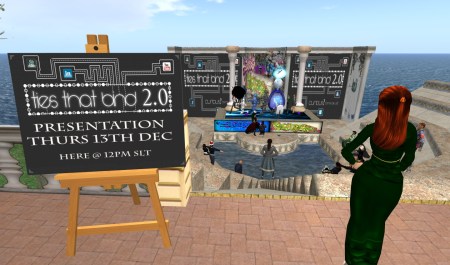
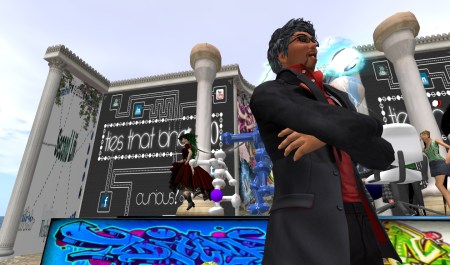
In keeping with  our time honored tradition, this year the students have been set a collaborative project to work on a joint presentation to be delivered in Second Life at the end of module. The presentation should use various media forms and the use of props and all is encouraged… (creativity welcomed).

The brief is to interpret the theme ‘Ties that bind 2.0’ in terms of the module objectives, bearing in mind that the module is based on the identification of the self online, forming relationships and becoming part of communities.

Discussions will be ongoing, culminating in the final presentation. Each presentation should last between five and ten minutes.

Groups

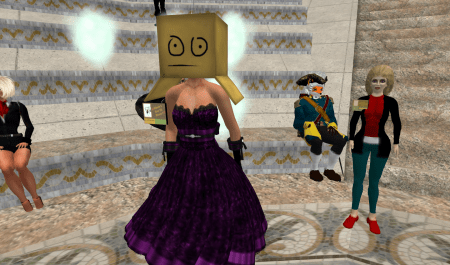
  1. Dudley, Thomas, Sofia and Box
  2. Fenix, Kautostar and autocat
  3. Inish, Seranox, B.ro, and Ace.

Students will also be using various means to publicize their event and engage with the communities they identify with and engage with. They will be expected to reflect on the experience of collaborating online, working online and highligh their main contributions in their blogs.

For more details about the assessment of this module see page 6 (Module Assessment) in the right hand column of this blog.

h1

Class 2: Communicating…Writing 101

October 18, 2012

CLASS SUMMARY:

We discussed writing – the types used and the conventions around them.
Main points:

  • Forms of writing we use include Narrative, Descriptive, Reflective, Critical,
  • Sourcing information – where to look- make sure sources are reliable and credible (judging sources)
  • Referencing – why and How (Chicago style): Give credit when due!
  • Writing to topic: don’t go off point. Use your heading as an anchor

Mostly, the aim this module is to enable you to become accountable and confident in your writing.
The following three links give some more detailed information about academic writing.

DIT’s Study & IT Skills Survival Guide for Academic Writing
Purdue Online Writing Lab page on Academic Writing

Here is a guide to the Chicago referencing style

We also talked about how your work for this module will be assessed. You need to write at least one post to your blog each week. Your blogs will be assessed at certain milestones so ensure they are up to date always. We assess for quality in writing, your writing should go beyond narration and description to be also reflective and critical.
The introduction to the group project deserves a blog post of it’s own!

ACTIVITIES FOR NEXT CLASS:

  1. Bearing in mind what you learned today, have a look at http://www.johnoconnor.org/, compare the writing style with your own blog.
    Write a new blog entry, this time address the module objectives from your perspective. Justify why they are important to you, while applying the conventions of academic writing given in the class. This will be a mix of descriptive/information, critical/reflective writing.
  2. Visit the following blogs to see a selection of different ‘voices’:
    http://dolcemerda.com,
    http://vandalhandle.com/
    http://confusedlaowai.com/
    http://yumiko-froehlich.hazeliris.com/page/2/ ,
    http://illustrationfriday.com/blog/
    http://joasiakafka.blogspot.ie/
    http://www.stylepantry.com/
    Think about how you would identify these blog authors…what impression of the person behind the blog do you get?
  3. Read: http://www.forbes.com/sites/dailymuse/2012/02/14/the-first-step-to-building-your-personal-brand/ and relate it to what the blogs you have just looked at are doing.
    Now think about yourself (ie, your avatar). Who are you? What is your online identity?
  4. Prepare a 30 second ‘elevator pitch’ about yourself and the identity you want to portray online. (ie, who you are and what you are about).
h1

Class 1: Rules of engagement

October 14, 2012

CLASS SUMMARY:

Participants were introduced to Acuppa Tae and Locks Aichi, the module leaders, and Sitearm Madonna and Elfay Pinkdot, guest lecturers on the module. Tae explained that for the first half of the module classes would be based on reading material to be given in advance. Participants will need to study this to inform their contribution to discussion in the class. Tae also asked participants to familiarise themselves with the learning outcomes of the module described on page 3 in the right hand column of this blog.

ACTIVITIES FOR NEXT CLASS:

  1. Complete your SL profile.
  2. Set up your blog using blogspot.com, wordpress.com or any other blogging tool.
  3. Complete the About Me section on your blog by writing about your expectations for this module – what you hope to get out of it, what you think you might contribute, etc, referring to the learning outcomes for the module.
  4. Find and explore three locations in SL.
  5. Post an entry to your blog describing the locations you visited.
  6. Set up a twitter account in your SL avatar’s name (or your real life name), if you don’t already have one and post a link to your blog. Use #iole12 to identify your twitter posts. Follow @johnoconnorDIT, @acuppatae, @iclaudiad, and each other.
h1

New module starts on 11th October 2012

September 21, 2012

A new intake of students will start on the module on Thursday 11th October. They will come from the School of Art, Design & Printing at DIT through the Optional Module Programme for Fine Art, Design, Visual and Critical Studies and also from other parts of the Real World and Second Life through Dublin Virtually Live. If you are not a registered DIT student and would like to take the module please email sitearm (at) gmail (dot) com for application details.

New participants should read through this blog to get a sense of what the module offers and, in particular, read page 8 (see column to the right) titled ‘Getting into Second Life’ to make sure your pc is up to spec. You will also find details on joining Second Life, which you must do before the first class.

All participants must also friend Acuppa Tae and Locks Aichi in Second Life saying that you intend taking the module.

If you are new to Second Life it is a good idea to explore the environment before the module starts. You should be familiar with moving your avatar around, interacting with others and be able to use voice inworld. You will not receive technical tuition on Second Life during class time – it is up to each participant to learn how to live, act and behave in the environment in advance.

Acuppa Tae and Locks Aichi look forward to meeting you next week!

h1

Teaching in Virtual worlds…

May 25, 2012

Our regular module “Is one life enough” has just ended andrather thanstaying quiet all summer, we are now running a module on Teaching in Virtual worlds.
We will be using this space to document the path of this module as well.

Last night, Thursday the 24th o fMay , we had the second session of our new module: Teaching in Virtual worlds.
The module is being offered to teaching and training staff and run at 8pm GMT on thursdays and will hold for 7weeks….5wereks more.
Last night’s class was on virtual environments in general, how they function, conventions governing behaviours, communities, etc.
Here a snapshot of the discussion group sitting around the table. we were missing two participants.