
Class 10: Online Communities and Relationships
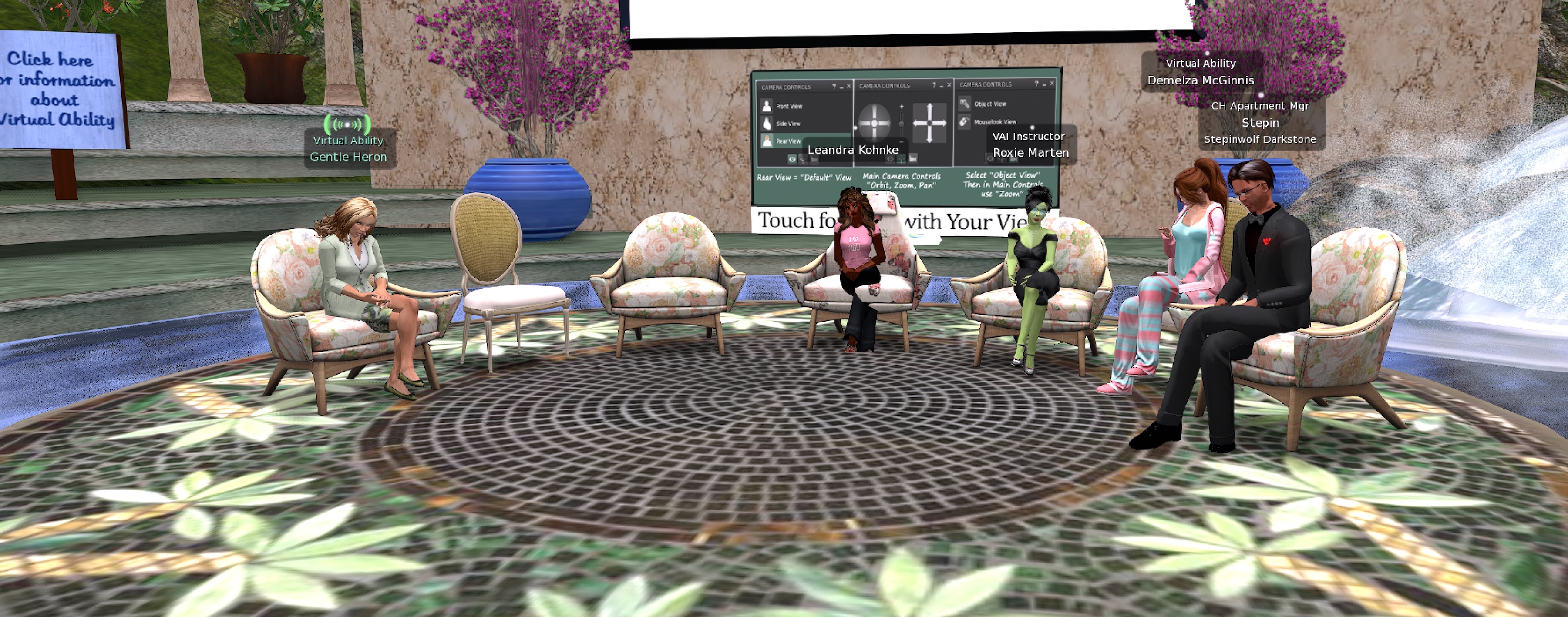
March 24, 2025We visited Virtual Ability Island where we were welcomed by Gentle Heron, the founder of this remarkable community in Second Life. Gentle welcomed the class and told us a little about the community and how it came about. Here is the text of her presentation.
(1) Who is the Virtual Ability community?
Virtual Ability (VAI) is an international cross-disability peer support community of over 1,300 members. We’re international because the people in the community come from 6 continents. “Cross-disability” means our members who have disabilities may have a physical disability, a mental or emotional or developmental disability, or a sensory disability (deafness or blindness). Many of us have multiple disabilities. We offer peer support as well as education, acceptance and understanding. Our community assists people with all kinds of disabilities to enter and thrive in virtual worlds like Second Life and other virtual worlds.
Although Virtual Ability offers various educational and entertainment activities daily, we strongly encourage members to explore throughout Second Life. You only find our members on our islands for our events. Most of the time they are elsewhere in SL. Many of us act as peer mentors or role models. We are NOT acting as professionals, even those of us who are professionals in RL. Sometimes it’s important to communicate with people who are most like yourself, who will “get” your concerns, your language, your point of view. That’s why most people with disabilities seek to relate at times with others like ourselves. But we don’t want to live in isolation from others who do not share our disabilities. We are not a virtual “leper colony.”
About ¼ of our members do not (yet!) have disabilities. We call them TABs, temporarily able bodied. They may be a parent, spouse, child, or friend of a person with a disability; a professional or non-professional caregiver; an academic researcher; medical professional; or an educator. Our community has been in Second Life for almost 18 years, so we have a good record of continuity. We are widely recognized for the quality of our service to our community. We won the first Linden Prize back in 2009 for a project that has “a tangible impact on the real world.” We are supported in virtual worlds by a US nonprofit corporation, Virtual Ability, Inc. We are probably the first SL entity to be given legal RL nonprofit status.
(2) What is the relationship between physical and virtual (online) communities?
I reject the term RL for “real life” when it is used to distinguish the physical world from the virtual world. Some avatars may not be realistic if by realistic you mean a replica of the individual sitting at the computer operating it. But they are realistic in terms of the person who created them. Our avatars express our personal sense of self. Virtual communities are real! I have found that communities are quite similar in both venues.
(3) Why do I consider Virtual Ability to be a community?
Some definitions of ‘community’ are based on geographic proximity. That’s not us. Nor are we culturally similar. In fact, we embrace diversity! The population of persons with disabilities is the largest minority group in the world, and is the most varied. In our VAI group chats, we often hear “Oh, I didn’t know [people with that disability] had that [symptom] too, like I do [with this different disability].” or “Wow, we have the same diagnosis, but your life is really different from mine.” Our diversity is a constant for all our interactions, requiring a group value of respect and accommodation. Both respect and accommodation are necessary for effective collaboration. So we aren’t “together” physically, and we aren’t really very similar.
However, we definitely exhibit other aspects of community:
- Our members form both close and informal relationships.
- We promote mutual support among members.
- We ask potential new members what the community can do for them, and what they can do for the community.
- We share common values and beliefs. One important community value is our emphasis on Ability, not DISability.
- We offer organized interactions and activities.
- Some of the most popular are campfire chats and dances.
- Most members exhibit a strong sense of belonging to the community.
(4) How are virtual communities developed and maintained?
I believe community development is by organic, biological-like processes of accretion and evolution. We have a niche within the larger Second Life ecosystem, and we specialize to fill that niche. We are maintained through the continued interest and volunteer time of so many wonderful community members. You will get a chance to meet a few of them during the Q&A session. As a community, we interact with other communities and individuals as well. On our public Healthinfo Island directly to our west, we focus not on disabilities and impairments, but rather on health and wellness. You will find educational exhibits and displays, a pavilion listing research opportunities you might participate in, and the Path of Support. The Path of Support lists information about the more than 120 disability peer support communities we have identified so far in SL. There is a list of the current month’s exhibits and displays on Healthinfo Island on a notecard in the blue poster to the left of the stage. I’ll point at it so you can see where it is. Just click on the poster to get a folder with some notecards in it,
Another notecard in the poster tells more about the SL islands our community maintains. Our community has 3 residential islands, with private properties around the edges and public land in the central area. On Cape Able, there is an art gallery on the public land showing art created by persons with disabilities. Cape Serenity hosts a library with books, articles, stories and poetry by VAI authors and others much more famous whom you may not know have or had a disability. Offering only works created by persons with disabilities goes along with our emphasis on the abilities of people with disabilities. You are welcome to visit our public areas any time. You can learn more about the VAI community at our website: https://www.virtualability.org
Gentle then introduced her friends, members of the community who shared their stories and explained why they joined Virtaul Ability. This was followed by an opportunity for the students to ask questions and engage in a discussion with presenters.
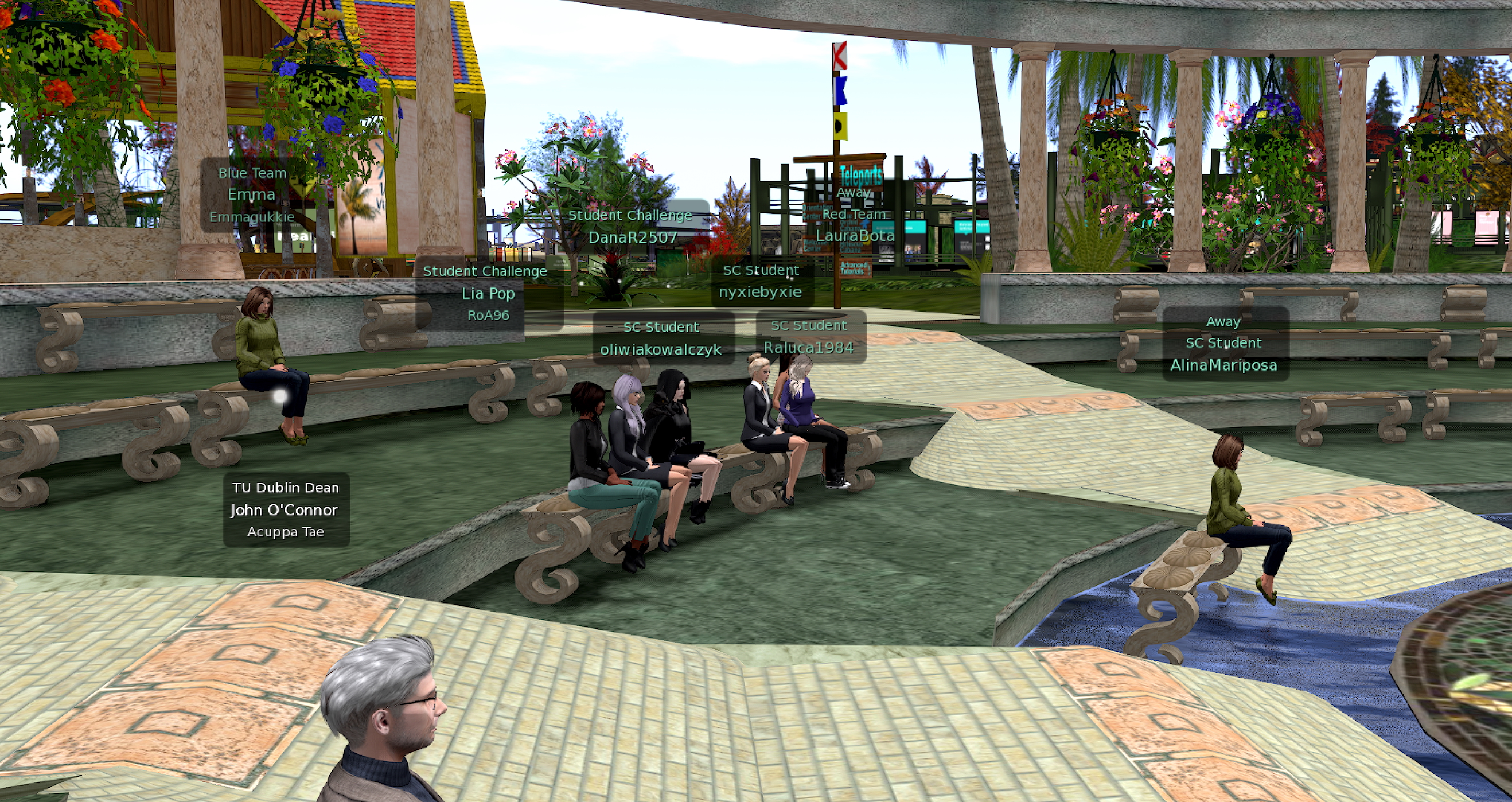
John concluded by thanking Gentle and the members of VAI for their generosity in sharing their experiences and emotions.
 Virtual Environments: Is one life enough?
Leave a comment